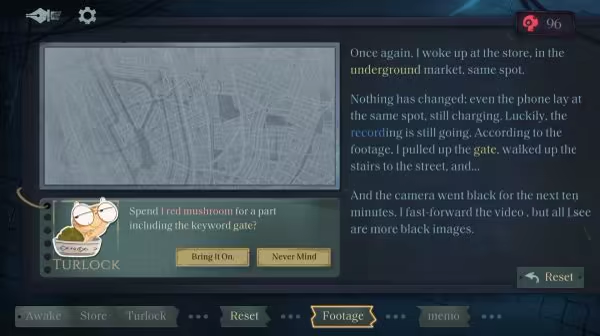
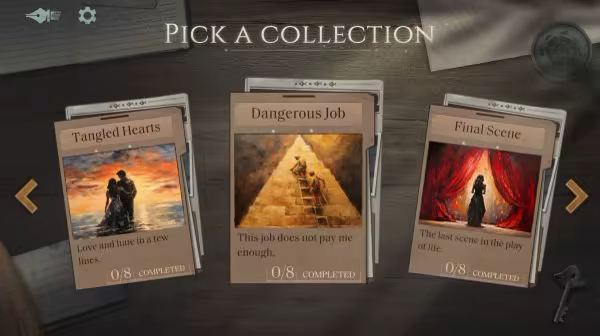
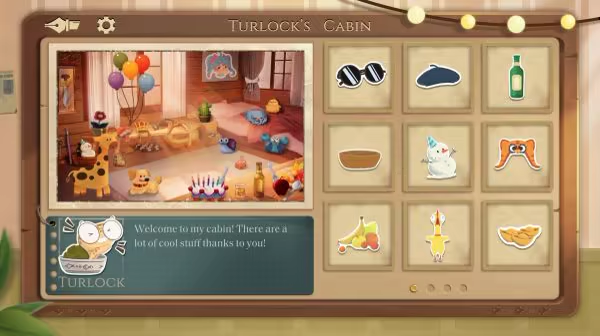
A detective narrative puzzler without pre-set options! Raise your questions at will, and an AI-host will answer only with 'yes' or 'no.' Drive the investigation with your curiosity; the path to solving the mystery lies in questions you ask. Can you dig out the truth through your questions?
Modeled estimate, not a reported figure. How we estimate →
Discounts
Every price cut of more than 20% we have observed, in each market that quoted one, with this game's chart position on either side of it. These are episodes, not a model: a sale is one event, and one event cannot tell you what the next one will do.
Reviews, worldwide (the counter carries no country): 0.29/day in the week to Sep 5 → 0.71/day in the week after.

Reviews, worldwide (the counter carries no country): 0.71/day in the week to Jul 23 → 0.14/day in the week after.
For scale, across Steam · Top Sellers · Brazil over the last 30 days: the 26 chart moves that followed a price cut of more than 20% went a median of 7 places towards #1, and the 2,400 moves with no price cut behind them went 2 away. One store, one chart, one country — it is the only place we have enough observations to say even that.
Prices outside the United States have been collected since 6 August 2026 and chart positions since 19 July 2026, so a cut older than that has no market to compare and a market that joined later has no history yet. Nothing here is converted between currencies.
About


Engagement
Reviews
Themes across 70 recent reviews and how positive each mention is. A keyword signal, not full sentiment analysis.
Reviews
Turlock Holmes, developed by Find the Lamp Games and published by Neverland Entertainment, is a detective puzzle game that builds its entire identity around a single, unconventional concept: solving mysteries by thinking like an investigator rather than following scripted interactions. Instead of guiding players through predefined dialogue trees or clue-collecting sequences, it challenges them to actively deduce the truth by asking their own questions. This shift in approach makes the experience feel more like a collaborative exercise in reasoning than a traditional narrative-driven game. Each case begins with a puzzling scenario that appears incomplete or illogical. Rather than presenting obvious clues or interactive objects, the game asks the player to probe the situation through input-driven questions or keywords. The system responds in a limited but structured way, confirming or denying whether certain ideas are relevant. Through this back-and-forth, players gradually piece together the hidden logic behind each case. It is a design that relies heavily on lateral thinking, rewarding players who can reframe problems, consider unusual possibilities, and refine their assumptions. When the solution finally comes together, the sense of satisfaction is strong, as it feels genuinely earned rather than guided. This approach gives Turlock Holmes a unique sense of player agency. Progress is entirely dependent on how effectively you can interpret the situation and formulate meaningful questions. There is no handholding, no obvious path forward, and no guarantee that your first line of reasoning will lead anywhere productive. This freedom can be both empowering and challenging. For players who enjoy problem-solving and abstract thinking, it creates a deeply engaging experience. For others, it can feel confusing or even frustrating, particularly when progress stalls due to unclear phrasing or missed connections. The cases themselves vary in tone and structure, ranging from straightforward mysteries to more surreal or darkly humorous scenarios. This variety helps maintain interest, as each puzzle introduces a different kind of logical challenge. Some require careful attention to detail, while others demand a more creative or unconventional perspective. Despite this variation, the underlying system remains consistent throughout, which can make the experience feel repetitive over time. Once the novelty of the questioning mechanic begins to fade, the similarities between cases become more apparent. Visually, the game adopts a simple and slightly stylized presentation that complements its focus on logic rather than spectacle. The interface is functional, designed to support the input-driven gameplay without unnecessary distractions. Character design, including the titular detective, adds a touch of personality, giving the experience a light layer of charm. The audio design reinforces the atmosphere with subtle music and sound effects, though it does not significantly evolve as the game progresses. Overall, the presentation serves its purpose without becoming a defining feature. Narrative elements exist primarily to frame the individual cases rather than to drive a continuous story. While there are hints of a broader context, the game remains largely episodic, with each mystery standing on its own. This structure makes it easy to play in short sessions, as there is no need to commit to a long, ongoing narrative. However, it also means that the game lacks a strong emotional or thematic throughline, which may limit its impact for players who prefer more story-driven experiences. Replay value is limited by the nature of the puzzles. Once a case has been solved, the core challenge disappears, as the satisfaction comes from discovering the solution rather than revisiting it. While players can experiment with different lines of questioning, the outcomes remain the same, reducing the incentive to return. The game’s longevity therefore depends largely on the number of cases and the player’s interest in solving them one by one. What ultimately defines Turlock Holmes is its commitment to a single idea and how thoroughly it explores it. It offers a genuinely different take on detective gameplay, one that prioritizes thought and interpretation over interaction and spectacle. This focus is both its greatest strength and its main limitation. It delivers a distinctive and intellectually engaging experience, but it does not expand far beyond its core mechanic. In the end, Turlock Holmes stands as an inventive and memorable puzzle game that will resonate most with players who enjoy logical challenges and unconventional design. It may not provide the variety or depth of larger titles, but it succeeds in offering something that feels fresh and mentally stimulating within its niche. Rating: 7/10
Media

Related
Related
Price dynamics, follower growth, revenue and sales trajectories with interactive tooltips
This and every other Pro feature is free until October 20, 2026. A free account is all it takes.
Genres
Stats
All-time low is the lowest price we've recorded for this game since we started tracking it.
Languages: Simplified Chinese
Hours played at review time, across 70 reviews with recorded playtime.
positive critical· bar length = how often the theme comes up
好玩,希望可以开发创意工坊,让更多的汤加入。
其实一般
适合一个人玩的海龟汤
好玩
有点意思,适合用来逗朋友玩
烧脑
AI需优化
不错,提问回答机制很智能,很多剧情很反直觉、意想不到,推荐购买
游戏中的每一个故事我都觉得不错,包括废稿。但是,地下通道犯人结局恶心到我了,确切的说,那个白糖的结局恶心到我了。为什么要让她活着,她应该下十九层地狱。没错就是十九层,地狱应该给她单独建一层!!!人为什么会犯罪,只是因为代价太低!即便是故事,她也不配得到这个结局!!!
Selling now
See how fast this game is selling right now — estimated copies and revenue per day from recent review growth.
Active players
Estimated daily and monthly active players (DAU/MAU) modeled from peak concurrency.
Players by region
Where this game's players are, estimated from review languages.
Players also reviewed
The games this title's players most often review too — audience affinity.
Related
| Game | Estimated lifetime revenue | Reviews | Review score | Price |
|---|---|---|---|---|
| $5.6M | 45.1K | 98% | $9.89 | |
| $3.7K | 15 | 67% | $14.99 | |
| $0 | 0 | — | $4.99 | |
| — | 0 | — | — | |
| $3.7M | 10.4K | 89% | $9.99 | |
| $1.8M | 6.8K | 95% | $19.99 |
Related
| Game | Estimated lifetime revenue | Reviews | Review score | Price |
|---|---|---|---|---|
| $152.4K | 380 | 82% | $14.99 | |
| $152.4K | 642 | 81% | $9.99 | |
| $152.5K | 399 | 62% | $19.99 | |
| $152.5K | 445 | 95% | $19.99 | |
| $152.5K | 964 | 97% | $9.99 | |
| $152.3K | 450 | 66% | $14.99 |