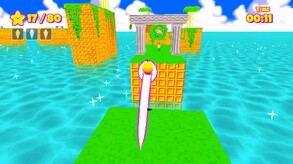
Toree's Panic Pack is a collection of three tiny 3D Platformer games in a classic low poly aesthetic.
Modeled estimate, not a reported figure. How we estimate →
Prices
The United States storefront in every case, so this compares stores and not countries.
About
Genres
Stats
All-time low is the lowest price we've recorded for this game since we started tracking it.
Languages: English
Sums Steam only; Nintendo publishes no volume signal, so the true total is higher by an unknown amount.
| Store | Price | Audience | Score | Chart | Est. revenue |
|---|---|---|---|---|---|
SteamYou are here | $0.99 | 136reviews | 57% | — | $3.4K |
| $0.99 | — | — | — | not modelled |
Matched by title — a reused name can pair the wrong games. * is a critic aggregate. Prices and positions are each store's United States storefront; Epic charts worldwide. Audience and Score too, except Steam's, which is worldwide.
Engagement
Reviews
Themes across 45 recent reviews and how positive each mention is. A keyword signal, not full sentiment analysis.
Reviews
No tiene la misma calidad que los demas toree pero sigue siendo muy entretenido, y el más retante para mi
Toree’s Panic Pack, developed by Kalliros, Diplodocus Games, and Siactro and published by Siactro, is a compact anthology of short-form 3D platforming challenges that leans heavily into speed, precision, and replayability. Rather than presenting a long, continuous adventure, it offers a collection of tightly designed stages that can be completed quickly but are clearly intended to be revisited multiple times. The overall design philosophy favors immediacy and responsiveness, creating an experience that feels closer to an arcade-style challenge than a traditional platformer. Each segment within the pack is structured around short levels that emphasize movement and efficiency. Players guide Toree through a variety of environments, aiming to reach the end as quickly and cleanly as possible while collecting items and achieving higher ranks. The brevity of each level is intentional, encouraging experimentation and repetition rather than extended playthroughs. Completing a stage is only the first step; the real engagement comes from returning to it, refining routes, and shaving seconds off completion times. This loop gives the game a satisfying sense of progression that is driven entirely by player improvement. Movement is the centerpiece of the experience, and it is handled with a level of responsiveness that makes even simple actions feel rewarding. Controls are tight and fluid, allowing players to build momentum and chain movements together in a way that feels natural. As players become more familiar with the mechanics, they begin to move through levels with greater confidence and efficiency, turning what initially feels like a straightforward run into a carefully executed sequence of actions. This emphasis on mastery gives the game a strong identity, as success is tied directly to skill rather than upgrades or external progression systems. Variety is introduced through different level designs and optional objectives that alter how stages are approached. Some levels focus on straightforward navigation, while others introduce hazards, tighter spaces, or additional challenges that require more precise timing. Secondary goals, such as collecting all items or defeating enemies, add another layer of replayability, encouraging players to explore each stage more thoroughly. While the core mechanics remain consistent, these variations help maintain interest and provide reasons to revisit levels beyond simply improving completion times. The difficulty curve is notable for how it escalates over time. Early stages are accessible and serve as an introduction to the mechanics, but later levels demand a higher degree of precision and awareness. Mistakes can be punishing, and success often requires repeated attempts and careful execution. This design reinforces the game’s focus on mastery, but it can also be a source of frustration for players who prefer a more forgiving experience. The game offers little in the way of assistance, expecting players to improve through persistence and practice. Visually, Toree’s Panic Pack embraces a retro-inspired aesthetic that draws from early 3D platformers. The low-poly environments and simple textures create a nostalgic atmosphere, while the bright colors and clean design ensure that levels remain easy to read during fast-paced movement. This visual style complements the gameplay well, as it prioritizes clarity and responsiveness over detail. The soundtrack adds to the energetic tone, providing a lively backdrop that enhances the sense of momentum without becoming overwhelming. Despite its strengths, the game’s limited scope is its most noticeable drawback. Each individual experience within the pack is relatively short, and while replayability extends the overall playtime, the amount of content is modest. Players who are not interested in chasing high scores or perfecting their runs may find that the experience ends quickly. Additionally, while most levels are well designed, there are occasional moments where difficulty feels uneven, with certain challenges relying more on trial and error than on clear skill-based progression. Ultimately, Toree’s Panic Pack succeeds by focusing on what it does best: delivering fast, responsive platforming that rewards improvement and encourages repetition. It does not attempt to offer a large-scale or narrative-driven experience, instead embracing its role as a collection of focused challenges. This clarity of purpose allows it to feel polished within its scope, even if it does not provide the depth or variety of larger platforming titles. In the end, it stands as a lively and skill-driven experience that captures the spirit of classic arcade platformers. Its emphasis on movement and mastery makes it particularly appealing to players who enjoy refining their performance, even if its limited content may not satisfy those looking for a longer or more varied adventure. Rating: 7/10
Media

Related
Related
Price dynamics, follower growth, revenue and sales trajectories with interactive tooltips
This and every other Pro feature is free until October 20, 2026. A free account is all it takes.
Hours played at review time, across 45 reviews with recorded playtime.
positive critical· bar length = how often the theme comes up
fun for fans of Toree
could be worse but honestly could be so so much better in terms of level design CD placement this time around isnt as bad as in 2 so thats good the pet peeve ettings Menu is still barebones which is annoying, and the game has to be manually set to 60FPS otherwise some stuff just breaks apart. idk if i want to say that i reccomend this game, when i really find the first 4 levels half decent. Toree missions becomes a kaizo-level challenge halfway through. Which at the end becomes an absolute slog to S rank. anyway, if you want more Toree 2, play it.
BIENS UR
The other games in this series are decent and fun enough, but this one for some reason has absolutely dreadful level design. Just buy the other games in this series. Skip this one.
Yeah, this one is more flawed than the others but i still had fun with it. Had to give up on mission pack 4-4, as boosts simply don't work well, feel the physics aren't as they intended them to be so it's just bad. But the rest were decent enough, the lava stage was just plain mean though, 2 stars right behind spawn >:( But fun per cost still great value (even got it on sale) so thumbs up from me.
Me encanta Toree, pero este es injugable. Muchos bugs. Niveles imposibles de completar porque los paneles de turbo no aplican la velocidad adecuada debido al frame rate de mi monitor... y el diseño de niveles no ayuda.
Para el que diseñó 4-4: ¿A ti no te querian en tu casa o que?
injustamente dificil
Selling now
See how fast this game is selling right now — estimated copies and revenue per day from recent review growth.
Players by region
Where this game's players are, estimated from review languages.
Related
| Game | Estimated lifetime revenue | Reviews | Review score | Price |
|---|---|---|---|---|
| $312.3K | 1.8K | 93% | $6.99 | |
| $39.5K | 99 | 87% | $14.99 | |
| $23.5K | 1K | 97% | $0.99 | |
| $2.1K | 35 | 83% | $2.99 | |
| $410 | 6 | 100% | $2.99 | |
| — | 0 | — | — |
Related
| Game | Estimated lifetime revenue | Reviews | Review score | Price |
|---|---|---|---|---|
| $3.3K | 111 | 43% | $1.99 | |
| $3.3K | 95 | 91% | $1.99 | |
| $3.3K | 266 | 95% | $0.99 | |
| $3.4K | 107 | 91% | $1.99 | |
| $3.4K | 56 | 59% | $4.99 | |
| $3.4K | 99 | 87% | $0.99 |