To Carry a Sword, developed by We Three Nouns and published by MAGIC Spell Studios, is a narrative-driven RPG that deliberately shifts the focus of the genre away from heroic power fantasies and toward something more grounded, reflective, and human. Instead of casting the player as a legendary warrior destined to save kingdoms, it places them in the role of a caravan guard—someone whose responsibilities are as much about people and relationships as they are about combat. This subtle but important shift defines the entire experience, giving the game a tone that feels more personal and introspective than most fantasy RPGs.
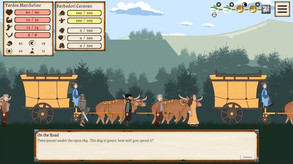
The structure of the game revolves around guiding caravans across a procedurally generated map, making decisions about routes, managing limited resources, and responding to a wide range of events that occur along the journey. Each trip unfolds differently, shaped by the paths chosen and the encounters that arise. These events are presented largely through text, and they form the backbone of the experience. Rather than serving as simple obstacles, they function as narrative moments that explore the lives, struggles, and personalities of the people traveling with you. The result is a game that feels less like a series of missions and more like a collection of interconnected stories.
What makes these interactions compelling is the emphasis on choice and consequence. Decisions are rarely framed in clear-cut terms of right or wrong; instead, they often involve balancing competing priorities, managing relationships, or dealing with uncertainty. The player’s role becomes one of negotiation and empathy, as much as strategy. The people in your caravan are not just background characters—they have their own needs, opinions, and reactions, and how you treat them can influence the outcome of your journey. This focus on human dynamics gives the game a depth that extends beyond its mechanics.
Combat exists within this framework, but it is not the central focus. When conflicts arise, they are handled through relatively simple real-time encounters that feel secondary to the narrative systems surrounding them. The mechanics are functional, but they lack the complexity and refinement found in more combat-oriented RPGs. However, this simplicity aligns with the game’s overall design, as it reinforces the idea that violence is just one part of the journey, not the defining feature of it. The tension comes more from the context of these encounters than from the mechanics themselves.
The writing is one of the game’s strongest elements, carrying much of the emotional and thematic weight. The world is built through a large volume of text, with each event contributing to a broader sense of place and atmosphere. The tone is often subdued and reflective, focusing on everyday struggles, moral ambiguity, and the realities of life on the road. Rather than telling a single overarching story, the game weaves together smaller narratives that gradually create a richer picture of the world and the people within it.
Visually, the game adopts a simple, hand-drawn style that complements its narrative focus. The presentation is minimal, with clean interfaces and limited animation, ensuring that attention remains on the text and decision-making. While it does not aim for visual spectacle, the art style provides enough character to support the tone of the game. It feels cohesive and intentional, even if it lacks the detail or variety of more visually ambitious titles.
One of the more interesting aspects of To Carry a Sword is its openness to customization and expansion. The inclusion of tools that allow players to create and integrate their own narrative content adds a layer of longevity and flexibility. This feature aligns naturally with the game’s structure, as its text-driven design makes it well-suited for community contributions. It also reinforces the idea that the game is as much about storytelling as it is about gameplay.
However, the experience is not without its challenges. The pacing can be slow, particularly for players who are not accustomed to text-heavy games. Progression is gradual, and there are few moments of dramatic escalation, which can make the game feel subdued compared to more action-driven RPGs. Additionally, the procedural nature of the game can lead to variability in quality, with some runs feeling more engaging or meaningful than others.
There are also areas where the mechanics feel less developed than the narrative. Resource management, while present, does not always have the depth needed to create meaningful tension, and some systems can feel inconsistent in how they respond to player choices. These issues do not detract significantly from the overall experience, but they highlight the game’s focus on storytelling over mechanical complexity.
In the end, To Carry a Sword is a distinctive and thoughtful RPG that stands out for its commitment to narrative and character-driven design. It offers a different perspective on what it means to be an adventurer, emphasizing responsibility, connection, and the weight of decisions rather than power and conquest. While it may not appeal to everyone, particularly those seeking fast-paced gameplay or deep mechanical systems, it provides a rich and rewarding experience for players who value storytelling and immersion.
Rating: 8/10