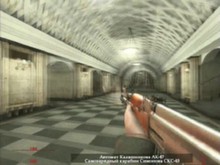
"The Stalin Subway" is a First Person Shooter-style game where the events take place in post-war Moscow. The game allows to plunge into the depressing atmosphere of the Stalin's period and to play as a Soviet officer.
Modeled estimate, not a reported figure. How we estimate →
Media

About


Genres
Stats
All-time low is the lowest price we've recorded for this game since we started tracking it.
Languages: English*, Russian**languages with full audio support
Engagement
Hours played at review time, across 41 reviews with recorded playtime.
Reviews
Themes across 41 recent reviews and how positive each mention is. A keyword signal, not full sentiment analysis.
positive critical· bar length = how often the theme comes up
Reviews
The Stalin Subway is a story-driven first-person shooter developed by Orion Games and published on Steam by ESDigital Games. Originally released in the mid-2000s and later reintroduced to modern digital platforms, the game stands out primarily for its unusual historical setting. Rather than focusing on futuristic warfare or contemporary military conflicts, it transports players to Moscow in the early 1950s during the final years of Joseph Stalin’s rule. The narrative blends Cold War paranoia, political conspiracy, and underground espionage into a campaign that explores both the famous landmarks of Soviet Moscow and the shadowy infrastructure rumored to exist beneath the city. By anchoring its gameplay in a tense period of real-world history, the game attempts to offer an experience that feels more like a political thriller than a conventional action shooter. Players take on the role of Gleb Suvorov, a loyal Soviet officer who becomes entangled in a dangerous plot involving high-ranking military officials and a hidden nuclear device. What begins as a routine investigation gradually evolves into a race against time as Suvorov uncovers a conspiracy that threatens the stability of the Soviet government. The story carries the player through a variety of locations across Moscow, many of which are inspired by real places such as the Kremlin, the Lubyanka headquarters of the KGB, and several iconic stations of the Moscow Metro. One of the most intriguing elements of the game’s setting is the use of the legendary Metro-2 system, a secret underground railway network rumored to connect key government facilities and bunkers. By weaving these locations into the narrative, the game creates an atmosphere filled with secrecy and tension, reinforcing the sense that the player is navigating through hidden layers of Soviet power. Gameplay follows the familiar structure of early 2000s first-person shooters. The campaign is divided into linear levels where players move from one objective to the next while fighting enemy soldiers, solving minor environmental puzzles, and occasionally completing scripted mission sequences. Combat relies on a selection of weapons that reflect the era’s military technology, including pistols, submachine guns, rifles, and heavier equipment such as flamethrowers or anti-tank weapons. The arsenal gives players enough variety to handle different situations, from close-quarters firefights in narrow tunnels to longer-range encounters in open courtyards or industrial complexes. The weapons themselves are relatively simple by modern standards, but they help establish the historical flavor of the game and reinforce its Cold War setting. The level design places a strong emphasis on underground environments, which becomes one of the game’s defining visual themes. Large portions of the campaign unfold in dimly lit metro tunnels, secret bunkers, hidden laboratories, and labyrinthine corridors beneath the city. These locations help build a sense of mystery as players venture deeper into the concealed infrastructure of Soviet Moscow. Occasionally the game shifts the action above ground, allowing players to explore recognizable urban spaces and government buildings that contrast with the darker underground sections. This alternation between public landmarks and secret installations helps maintain a feeling of progression, as if the player is gradually uncovering the hidden machinery behind the Soviet state. Although the core gameplay focuses on shooting and progression through linear levels, the developers included a few additional mechanics intended to add variety. Some missions introduce light stealth elements where players must avoid detection or carefully navigate past patrols. Others incorporate scripted events such as escapes from collapsing environments, timed objectives, or environmental hazards that must be manipulated to proceed. These moments break up the standard firefights and give the campaign a slightly more cinematic tone, though they remain relatively straightforward in execution. Compared to modern shooters, these systems may feel somewhat simplistic, but they were typical of the genre during the period when the game was originally developed. Visually, The Stalin Subway reflects the technological limitations of its era. Character models and animations are fairly basic, and the graphical fidelity does not match the level of detail found in larger AAA shooters released at the same time. However, the environments themselves often capture a convincing sense of place. The Moscow Metro stations, with their distinctive architecture and ornate design, are particularly memorable, and the industrial bunkers and secret facilities effectively convey the oppressive atmosphere of Cold War espionage. Lighting is used to emphasize shadowy corridors and claustrophobic spaces, reinforcing the feeling that much of the story unfolds beneath the surface of everyday life. The game’s pacing can be somewhat uneven, especially in sections where repetitive enemy encounters slow down the narrative momentum. Enemy AI occasionally behaves unpredictably, sometimes reacting slowly or failing to coordinate effectively during firefights. These issues reveal the game’s modest production budget and the technical limitations of its original development. Despite these shortcomings, the campaign remains engaging largely because of its setting and storyline. Players who enjoy historical fiction and conspiracy-themed narratives may find themselves drawn into the unfolding mystery even when the gameplay mechanics feel dated. One of the most interesting aspects of The Stalin Subway is how it blends real historical elements with fictional storytelling. The Cold War atmosphere, Soviet political tensions, and rumored secret infrastructures provide a believable foundation for the game’s narrative, even though the conspiracy plot itself is entirely fictional. By grounding the story in recognizable locations and historical themes, the developers create a sense of authenticity that enhances the overall experience. Exploring secret tunnels beneath Moscow while unraveling a political plot gives the game a distinctive flavor rarely seen in other shooters. In modern terms, The Stalin Subway feels like a relic of an earlier era of PC gaming. Its mechanics are straightforward, its visuals are dated, and its level design reflects the linear style that dominated shooters of the early 2000s. However, it also offers something unusual: a historical thriller set within the Soviet Union that explores an environment rarely depicted in games. For players interested in Cold War fiction or curious about obscure shooters from Eastern European developers, the game provides a fascinating snapshot of a different design philosophy. Overall, The Stalin Subway is not a groundbreaking shooter, but it remains memorable because of its unique setting and narrative premise. Its combination of Soviet political intrigue, underground exploration, and traditional FPS combat creates an experience that stands apart from more conventional military shooters. While its technical limitations and dated mechanics prevent it from reaching the heights of the genre, it still offers an intriguing journey through a shadowy version of Cold War Moscow. Rating: 6/10
Related
Related
Trends
Modeled estimate over time, reconstructed from Steam's monthly review histogram.
Audience
Estimated from the language of this game's reviews — a proxy for where players are, not official Steam demographics.
Related
| Free Fire: 9th Anniversary | $3.8B | 129M | 87% | Free |
| Temple Run 2: Endless Escape | $2.2B | 9.9M | 82% | Free |
| PUBG MOBILE | $2B | 48.6M | 86% | Free |
| Free Fire MAX | $1.7B | 31.4M | 89% | Free |
| Sniper 3D:Gun Shooting Games | $1.4B | 18.2M | 92% | Free |
| Among Us | $1.4B | 13.6M | 78% | Free |
Related
| Tunnet | $62.6K | 715 | 94% | $5.99 |
| Mist Slayer | $62.6K | 378 | 66% | $7.99 |
| Dragon Throne: Battle of Red Cliffs | $62.6K | 248 | 85% | $9.99 |
| Hey Stranger! I Dare You to Love Me! | $62.6K | 238 | 85% | $11.04 |
| Apex Heroines | $62.6K | 136 | 90% | $19.99 |
| Silent Still 2 | $62.6K | 390 | 67% | $4.99 |