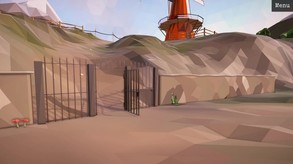
The Journey Back is a first person exploration experience. You gain consciousness after being involved in a car crash. Explore a colorful, stylized 3d world, solve puzzles and find out what happened along the way.
Modeled estimate, not a reported figure. How we estimate →
Media

About
Stats
All-time low is the lowest price we've recorded for this game since we started tracking it.
Languages: English, Dutch, German
Engagement
Hours played at review time, across 34 reviews with recorded playtime.
Reviews
[h1]A nice little first-person adventure[/h1] "The Journey Back" is a short first-person adventure about the aftermath of a car crash. The game does tell a complete story despite its brevity, and I enjoyed it, but it's very straightforward. The game sports 4 different environments and a small multi-stage puzzle in each. Puzzles are pretty easy, as there are very clear cues for each solution, so it's unlikely for players to get stuck. Soft, slow music creates a relaxing, thoughtful atmosphere. The game's graphics are highly stylized and remind me of the very early 3D era, when even the ground was made of distinct mono-colored polygons. I don't really like this particular style (I think it accentuates the imperfections of early 3d implementations in an unfavorable way), but it did not bother me much in this game, the graphics are serviceable. I played through the full game in an hour, so it's definitely a very short experience, but the price is completely adequate for that. If you're looking for a calm, relaxing, easy first-person adventure game that doesn't require a $1000 PC to run, give it a shot. Edit: Seeing that other reviewers reported some bugs and glitches, I should perhaps mention that I did not encounter a single one. I'm not sure if the issues were fixed in the meantime, or if I just got lucky, all I can say is that the experience was completely bug- and glitch-free for me.
I was actually enjoying the game until I got to the creature statues. I got all the gems into the eyes and a big pedestal is supposed to come out of the ground so you can punch in some numbers that you get. I only know this because I watched a walkthrough because I couldn't figure out what I was doing wrong. I wasn't doing anything wrong. The pedestal never came up. I even replayed the level, still nothing. Waste of time. Maybe I should just download it on my phone and it'll probably work there since you can get it on Playstore. Blah. Good thing it was only 99 cents.
Krótka gra przygodowa, w której rozwiązujemy proste łamigłówki, aby dostać się do kolejnego miejsca. Grafika prosta i czytelna, muzyka z czasem robi się irytująca. Przeciętniak, z którym można się zapoznać za te kilka złotych. Polecam tylko graczom, którzy lubią tego typu produkcje, choć tutaj nie znajdą wyzwania.
The Journey ist ein kleines einstündiges Adventure mit simplem Rätseln. Das ganze Spiel ist sehr stimmunsvoll und hat einen tollen sehr entspannten Soundtrack. Dieser sowie das Spiel tragen dazu bei Ruhe und Frieden auszustrahlen. Die Grafik ist zwar nicht die beste, sieht aber trotzdem hübsch und zeitlos aus. Ok, die Story ist im Endeffekt sehr klein, gibt aber viel Stoff zum Nachdenken und Selber Denken. Sie sorgt dafür sich selber einen Reim aus der ganzen Geschichte zu bilden. Von mir einen großen Respekt an den alleinigen Ersteller für so ein kleines Meisterwerk, das für 2 Euro auf jedenfall sein Geld wert ist. Ich kann nur wie schon gesagt sagen, The Journey Back ist ein kleines Meisterwerk, das zwar nicht hohen Umfang hat, aber trotzdem zeigt, was Menschen alles erschaffen können, wenn sie Herz und Seele in ein Projekt wie dieses stecken.
I found the game a bit challenging at times, but it is a quick game about 2 hours to play. About 5 levels long. Much of the game is a hidden item, once you have all the items you're on your way. Enjoyed playing it and I hope they plan to add more to the game and it's puzzles.
The Journey Back is a small, introspective first-person adventure that places atmosphere and personal reflection above spectacle or mechanical complexity. Developed by Erwin Wolf and published by MarWin Studios, the game presents itself as a quiet exploration of loss, memory, and uncertainty, unfolding within a minimalist, low-poly world that feels both abstract and emotionally charged. Rather than guiding the player through a heavily scripted narrative or dense puzzle framework, it invites slow movement, careful observation, and a willingness to engage with ambiguity. The experience begins abruptly with a car accident that leaves the protagonist alone in an unfamiliar landscape, searching for a missing sister. This simple premise serves as the emotional anchor for the entire journey. The game wastes little time explaining itself, instead dropping the player into an open environment where progress is driven by curiosity rather than explicit objectives. This design choice reinforces the feeling of disorientation and quiet unease, encouraging players to piece together meaning through exploration rather than exposition. Visually, The Journey Back adopts a deliberately stripped-down aesthetic. Environments are built from solid colors and simple geometric shapes, lacking detailed textures but gaining a surreal, dreamlike quality as a result. Hills, structures, and pathways feel symbolic rather than realistic, as if the world exists more as a mental space than a physical one. This low-poly presentation may initially seem crude, but it quickly becomes clear that it is an intentional stylistic choice, allowing the game to focus on mood and navigation without visual clutter. Exploration forms the backbone of the gameplay. Players traverse open spaces, follow environmental cues, and gradually unlock new areas by solving light puzzles embedded into the landscape. These puzzles rarely demand complex logic; instead, they rely on observation and spatial awareness. A maze, for example, is less about trial and error and more about recognizing subtle visual patterns within the environment. This approach keeps frustration low but also means that seasoned puzzle fans may find the challenges too simple or fleeting. Narratively, the game unfolds in fragments. Bits of text, symbolic imagery, and environmental shifts hint at deeper emotional themes tied to guilt, grief, and the struggle to move forward after trauma. The story is intentionally understated, leaving room for personal interpretation. While some players may find this ambiguity compelling, others may feel that the narrative lacks resolution or depth. The emotional payoff depends heavily on the player’s willingness to project meaning onto the journey rather than being guided toward a clear conclusion. Sound design plays a crucial role in reinforcing the game’s reflective tone. Ambient music and subtle audio cues accompany exploration, creating a sense of isolation without becoming oppressive. The soundtrack is gentle and unobtrusive, designed to fade into the background while still shaping the emotional atmosphere. Silence is used effectively as well, allowing moments of stillness to carry weight as the player pauses to take in their surroundings. From a technical standpoint, The Journey Back shows its indie origins. Movement and interaction are functional but basic, and animations are minimal. Some players may encounter minor bugs or rough edges, particularly related to saving or collision detection. These issues can briefly interrupt immersion, but they rarely derail the experience entirely. Given the game’s modest scope and pricing, these imperfections feel more like limitations than outright flaws. The game’s length is relatively short, often completed in a single sitting. This brevity works in its favor, as the experience is designed to feel like a self-contained emotional walk rather than a long-term commitment. However, it also limits replay value, as there are few alternative paths or hidden layers to uncover once the journey is complete. The primary reward lies in the initial experience rather than repeated playthroughs. Overall, The Journey Back is best understood as a quiet, meditative indie adventure that prioritizes atmosphere and introspection over challenge or narrative complexity. It will resonate most with players who enjoy walking simulators, minimalist storytelling, and symbolic environments that invite interpretation. While its simplicity and technical roughness may disappoint those seeking a more polished or content-rich experience, it succeeds as a personal, reflective journey that lingers through mood and theme rather than spectacle. Rating: 5/10
Meh walking sim (I facetiously qualify this as a walking sim as the puzzles are too easy). The story doesn't pull me in and the physics can sometimes be uncanny. If you have time to spare and don't necessary want to play a quality game to pass the time, you might like this. Not me though.
That's a tough one. It's short, it's not that challenging and i wished that there would be a plot twist as i knew about 5 minutes in the game what the ending will be like. But i really liked the atmosphere. Some negative points: * The sound when you do something right is really bad and kills it every single time * Games like that require voice acting, spend those few bucks on a voice actor and it would be a game changer For the price, still a recommendation from me.
The Journey Back Positives: + Nice little story + Good puzzles + Some parts are nicely designed + Quite fun to play + Ok variation + Relaxing + The animals + Nice music + Good walking speed Negatives: - Very short - Low FOV - Some head-bob - The way you use your inventory should have been solved easier and better - The graphics are a mixed bag - Size ratio is a bit of sometimes - Bugs Total Score: 7/10
Ein kurzweiliges Spiel (45min) in dem man die ganze Zeit Rätsel lösen muss um Türen zu öffnen. Nett gemacht mit einfacher Grafik. Die Rätsel sollten mit den Tipps im Spiel von jedem zu lösen sein.
Related
Related
Trends
Modeled estimate over time, reconstructed from Steam's monthly review histogram.
Momentum
Pace estimated from the game's recent review growth (our daily snapshots) at its own sales-per-review ratio — a momentum signal, not booked sales.
Audience
Estimated from the language of this game's reviews — a proxy for where players are, not official Steam demographics.
Related
| Desire Gambling House/欲望赌馆 | $1.7K | 81 | 48% | $0.99 |
| Innoquous 5 | $1.7K | 77 | 87% | $0.99 |
| Hidden Kittens: Kingdom of Cats | $1.7K | 56 | 100% | $1.99 |
| My Step Sisters | $1.7K | 145 | 54% | $2.99 |
| My Stepsis is a Futanari | $1.7K | 208 | 75% | $0.99 |
| Finding Xavier | $1.7K | 125 | 91% | $0.99 |