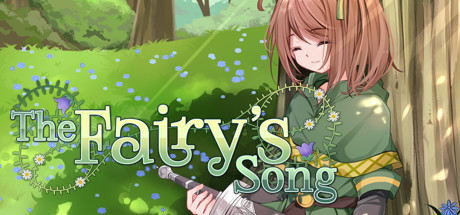
The Fairy’s Song, developed and published by ebi-hime, is a gentle and heartfelt yuri visual novel that blends fantasy, folklore, and introspective character drama into a short but resonant story. Set in the quaint English village of Fenchapel, it follows Marnie, a modern-day goth teenager reluctantly sent to spend a week with her grandmother while her parents are away. Bored, cynical, and detached from the simplicity of rural life, Marnie sees her stay as a punishment rather than an opportunity for reflection. Her grandmother’s talk of fairies, curses, and ancient legends feels childish to her—until a chance encounter in the nearby woods changes everything. There, she discovers Leofe, a woman clad in armor who seems displaced in time, claiming to be a knight of a long-forgotten era. What begins as curiosity soon deepens into a friendship that challenges Marnie’s worldview, eventually evolving into a tender and emotional romance between two women separated by centuries but united by loneliness and longing.
The game’s greatest strength lies in its writing, which captures the contrast between Marnie’s snarky realism and Leofe’s noble sincerity. Marnie initially feels like a familiar archetype—a sarcastic teen who hides her insecurity behind wit and apathy—but the story slowly peels back her layers to reveal a vulnerable young woman searching for meaning. Leofe, in turn, embodies timeless virtue and melancholy; she speaks with the cadence of old tales yet adapts with grace to the modern world around her. Their dynamic feels authentic and intimate, as each learns from the other: Marnie rediscovers empathy and wonder, while Leofe learns to let go of duty and rediscover joy. ebi-hime’s prose is delicate and precise, balancing humor, emotional depth, and mythic beauty without veering into melodrama. It’s a story that unfolds patiently, rewarding readers with moments of quiet revelation rather than dramatic spectacle.
Visually, The Fairy’s Song carries a soft and dreamlike charm that fits its tone perfectly. The backgrounds evoke the lush stillness of the English countryside, with forests and cottages painted in warm, subdued hues that suggest a world gently touched by magic. The character art is expressive and detailed, capturing subtle shifts in emotion that help convey the intimacy of dialogue-driven storytelling. The game’s CG illustrations, while few in number, are thoughtfully composed and highlight key emotional moments—tender exchanges, quiet confessions, and moments of supernatural wonder. The interface is minimalist, keeping focus on the story, while the music—light, melancholic, and atmospheric—underscores the narrative’s themes of nostalgia and rediscovery. Even without voice acting, the combination of art and sound creates an immersive rhythm that pulls the player into Marnie and Leofe’s world.
Structurally, The Fairy’s Song is a kinetic novel, meaning it follows a single, unbranching storyline with no dialogue choices or alternate endings. This design choice allows for tight narrative control, ensuring every scene unfolds with deliberate pacing and emotional precision. However, it also limits interactivity, which may disappoint readers accustomed to visual novels with branching paths or player agency. The linearity places the entire weight of engagement on the writing and presentation, and fortunately, both are strong enough to carry the experience. The pacing is deliberate, and while the early chapters take their time establishing Marnie’s skepticism and Leofe’s otherworldly nature, the gradual buildup makes their eventual emotional connection feel natural and deeply satisfying. The story’s slower first half is balanced by a more intense and mythologically rich conclusion, where the narrative’s fantasy elements—fairies, ancient curses, and lost duty—take center stage.
There are moments, however, when the game’s brevity and pacing work against its ambition. The lore surrounding Leofe’s past and the fairies that shape the story’s mythology is introduced gradually, only to be resolved rather quickly near the end. While the late-game revelations are intriguing, they come with an almost breathless urgency, giving the impression that the story’s world could have benefited from more room to breathe. Similarly, because the game features limited artwork, certain scenes described in text are not visually represented, creating minor disconnects between imagination and presentation. Yet even with these limitations, The Fairy’s Song maintains its focus on emotional authenticity rather than spectacle, relying on atmosphere and character rather than action to sustain its impact.
What ultimately makes The Fairy’s Song memorable is its sincerity. ebi-hime is known for crafting emotionally introspective visual novels—such as Strawberry Vinegar and The Language of Love—and this title fits comfortably within that tradition. The game treats its yuri romance with tenderness and maturity, portraying the growing bond between Marnie and Leofe not as fantasy escapism but as a universal story about understanding, trust, and belonging. Their relationship unfolds through small gestures and quiet moments rather than overt declarations, and by the time the narrative reaches its conclusion, their affection feels as inevitable as it is moving. Thematically, the story reflects on change—on how myths fade into memory, how people evolve, and how love can bridge the divide between past and present.
In its entirety, The Fairy’s Song is less about fairies and magic than it is about rediscovering hope through connection. It is a compact but emotionally rich story told with warmth, wit, and wistful melancholy. For players who enjoy thoughtful, character-driven narratives and beautifully written yuri romances, it offers a deeply satisfying experience despite its lack of interactivity. It lingers not because of dramatic twists or elaborate world-building, but because of its quiet emotional resonance—the kind that stays long after the final line fades from the screen. It’s a story that believes in love as both a force of healing and a bridge across time, and it delivers that message with grace and subtle power.
Rating: 8/10