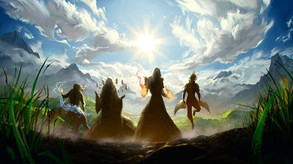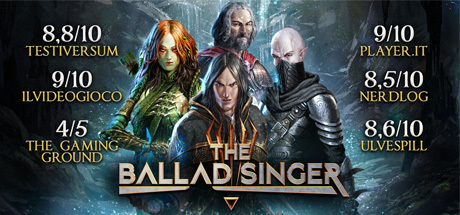
The Ballad Singer is an asymmetric adventure, inspired by RPGs and game books, where you can experience many dynamic stories. Forge the fate of Hesperia through the stories of four different adventurers in a fantasy world completely illustrated and narrated.
Modeled estimate, not a reported figure. How we estimate →
Media

About
Stats
All-time low is the lowest price we've recorded for this game since we started tracking it.
Languages: English*, Italian**languages with full audio support
Engagement
Hours played at review time, across 40 reviews with recorded playtime.
Reviews
Themes across 40 recent reviews and how positive each mention is. A keyword signal, not full sentiment analysis.
positive critical· bar length = how often the theme comes up
Reviews
Che dire, stavo provando dopo una vita questo Gioco, ma dopo tre ore di utilizzo è andato in Crack donandomi solo un bello schermo nero... Nulla da fare
ho trovato un piccolo bug in cui non avevo scelte da fare e quindi non potevo proseguire, qualche errore di battitura nella lingua italiana... per il resto consiglio il gioco; è divertente e la storia è interessante.
Un bel libro game, senza altre pretese. Bei disegni, storia intrigante e dai diversi finali possibili. Consiglio in particolare la storia di Daragast, quella che mi è piaciuta di più.
I'm very impressed. A unique idea, full sound, beautiful illustrations. Many people say - you are constantly dying! Yes it is, but this is part of the story, it makes it unique. The developers have done the impossible. More in the video ... [url=https://www.youtube.com/c/WizardWorm?sub_confirmation=1] Subscribe to my Youtube [/url] [url=https://store.steampowered.com/curator/39973073/] Follow my Curator Page for more RPG Games! [/url] https://www.youtube.com/watch?v=w_HRMnXE2YM
"The Ballad Singer" è un'esperienza che unisce il fascino dei libri gioco con l'immersione dei giochi di ruolo (GDR), portandoci nel meraviglioso mondo fantasy di Hesperia. Fin dal primo momento, ci si sente avvolti da un'atmosfera magica, grazie alle illustrazioni dettagliate che accompagnano ogni pagina e alla narrazione coinvolgente che guida il lettore attraverso le avventure. Uno degli aspetti più affascinanti di "The Ballad Singer" è la possibilità di impersonare quattro personaggi distinti, ognuno con la propria storia, abilità e personalità. Questa varietà non solo arricchisce l'esperienza di gioco, ma offre anche la possibilità di esplorare diverse prospettive e approcci alle sfide che si presentano. Ogni scelta che facciamo ha un impatto significativo sulla trama, rendendo ogni partita unica e stimolante. La narrazione è ben scritta e interamente doppiata, permettendo ai giocatori di connettersi con i personaggi e le loro avventure. Le illustrazioni, ben curate, non solo abbelliscono il libro, ma aiutano anche a visualizzare il mondo di Hesperia, rendendo l'esperienza ancora più immersiva. Inoltre, il sistema di gioco è intuitivo e accessibile, rendendo "The Ballad Singer" adatto sia ai neofiti che ai veterani del genere. La combinazione di narrazione, illustrazioni e interattività crea un'esperienza coinvolgente che tiene il lettore incollato alle pagine. In sintesi, "The Ballad Singer" è un libro gioco che merita di essere esplorato. Con la sua ricca narrazione, personaggi ben sviluppati e un mondo affascinante, offre un'avventura indimenticabile per chi ama il fantasy e i giochi di ruolo. Consiglio vivamente di immergersi in Hesperia e scoprire le storie che attendono di essere raccontate!
Let me preface this by saying this gets a recommendation by the slimmest of margins. [b]My Pros[/b] The background slides are [i]gorgeous[/i], with several different variations of single scenes showing the changes happening as a result of your choice/s. The voice acting is very well done, the different accents and modulation help add to the characters. Four different protagonists (or antagonists, depending) to choose from, with the option to play entirely as one and keep yourself alive through fate points/loading a save and making different choices, or dying and picking a different character. Replayability - see above. That soundtrack is beautiful. I wish it was available to download. The few controls are pretty intuitive, and are able to be changed to your preference. Difficulty levels x 4 (appropriately) which change the amount of fate points, save points, etc you get at the start of a new campaign. [b]My Cons[/b] You can't turn of the narrator. This may not bother you, but it's intolerable for me. An option to nix the narrator and just have the voiced characters would've been appreciated; unfortunately, they [i]all[/i] fall under the one audio option. The "loading" - which isn't actually loading, but it is disruptive. Whether you're making a choice, or simply continuing the story, everything goes black for a second or two before the next background/story slide appear. Even the music cuts off, and sometimes a different score starts playing regardless of whether you've changed scenes or not. Scene changes could've used a smoother implementation. Four main characters. It can be done, I and I'm sure others have played games where there is more than one main character and it works. But in this game, unfortunately having four main characters doesn't feel like a good choice. None of them feel particularly fleshed out; I don't see them as [i]people[/i] and thus aren't invested in them even slightly. I don't know how many times I got one or more of them killed and just went 'moving on'. Secondary characters. Honestly, most of them are MacGuffins. Good voice talent, wasted. The story is... eh. There's a good story in there, and parts if it even shine through occasionally, but it's just so choppy. You often go from one scene to the next with no context of how you got there or why you're there, because all of that context is in another characters route and apparently doesn't affect you? People die, people betray you, people kiss you, [b]you[/b] kiss people and there's just... context? story? character development? where?! The saving. Okay there is an auto save function, and I don't know if it's meant to work this way, but it always saved for me [i]after[/i] I died. Like, reload on a literal death screen. Not helpful. There is a proper save function which is... not always helpful. Firstly, because you can't save whenever you like. If you're not paying attention to the icon and miss it lighting up at the bottom of the screen [i]away from the wall of text[/i] then you'll likely miss your chance to save just before a big decision (and don't always assume what should be a 'big decision' is, apparently choosing between 'fight a dragon' or 'defend yourself' is minor league stuff) Secondly, no I didn't mistype early. You get save [i]points[/i]. A limited amount of saving chances to use up in a game whose premise is all about the choices. And of course, the choices. Some of them are great, and actually work the way you'd assume they would. Some of them are a bit iffy, but if you tilt your head and squint they kind of make sense. Some of them just left me thinking 'why would you give me choice a and choice b, make them almost exactly the same, leave no clue as to which is apparently the right one, and expect me to clairvoyance my way out of this death sentence?' To sum up, is this game frustrating? [i]Yes[/i]. Will I be playing it again sometime soon to finish up what I missed? Ha ha, [b]no[/b]. But did I enjoy myself? Enough to say that I'll come back to this one day.
[h1]Overall: 8,1[/h1] [b] Graphic: 10/10 [/b] The graphics in this game are amazing – there are tons of illustrations. It’s incredible to see how many you can enjoy compared to classic visual novels. The artistic quality is sky-high, and the style is super engaging. The design of the monsters is unique, and I’ve really enjoyed how interesting both the monsters and the characters are. [b] Voiceover: 9/10 [/b] The voice acting in both languages is fantastic – it’s the first indie game where I’ve seen such an effort. I’m used to this quality in AAA games, but for an indie title, it’s pretty rare. Every single choice even comes with its own voiceover. [b] Music: 10/10[/b] The music is one of the game’s best features – the OST is really deep and perfectly ties the story to the visuals. I even used the soundtrack for one of my D&D campaigns, and everyone was surprised it came from a game they’d never heard of. [b] Gameplay: 6/10 [/b] The gameplay is functional – it’s a simple game where you just have to click. I mean, it’s more like an interactive book than a typical video game. I’d give it a 6/10 because everything in this department works fine, though they could have added a bit more depth; still, that’s not really the focus of the game. Choices really change the course of the story and it’s fun to discover every single aspect of the game! [b] Interface: 7/10 [/b] The interface is simple and functional. I did have a bit of a struggle figuring out the icons on the bottom-right of the screen. If you’re wondering what they’re for, they show your save progress and how many “lives” you have left. [b] Story: 7/10[/b] The story is interesting – it might not be mind-blowing, but it’s good. What really stands out is that when one hero dies, the narrative for the next hero follows the choices you made with the first one. I mean, that feature is ♥♥♥♥♥♥♥ incredible. The game can often be found for around €15 and offers hours of quality entertainment. I mean, we’re talking about a small indie game – can you really ask for more?
So I summon an earth elemental to fight fire one. It loses and I die. Later I summon a fire elemental to fight a earth elemental. it loses and I die, Duck u and this game,
The Ballad Singer, developed and published by Curtel Games, is a narrative-focused experience that leans heavily into the idea that choice should not just influence a story but actively reshape it. Set in the fantasy world of Hesperia, the game presents itself less as a traditional RPG and more as an interactive saga, where the player’s decisions continuously alter the direction, tone, and outcome of events. Instead of guiding you along a largely fixed path with occasional branching moments, it constructs a system where nearly every decision carries weight, creating a story that feels fluid and reactive. One of the most distinctive aspects of the game is its multi-protagonist structure. Rather than following a single hero, the narrative unfolds through four different characters, each with their own perspective, motivations, and personal struggles. These individual arcs are not isolated; they overlap and influence one another, forming a web of interconnected stories. This design gives the game a layered quality, where actions taken in one storyline can ripple outward and affect others in subtle or significant ways. It creates a sense that the world exists beyond any single character, reinforcing the idea that events are part of a larger, evolving narrative. The decision-making system is the backbone of the experience, and it is handled with a level of depth that sets the game apart. Choices are frequent and often complex, rarely presenting clear “right” or “wrong” options. Instead, they ask players to weigh risks, consider consequences, and sometimes accept outcomes that are less than ideal. The game’s structure embraces failure as part of the journey—characters can die, and when they do, the story continues from another perspective rather than simply ending. This approach removes the traditional notion of failure and replaces it with a sense of continuity, where every outcome contributes to the broader narrative. The writing plays a crucial role in making this system work. The story draws from familiar fantasy elements—political intrigue, mythical creatures, and personal quests—but presents them with enough detail and variation to maintain interest. Dialogue is extensive and fully narrated, giving the game a theatrical quality that enhances immersion. The narration adds a layer of personality to the storytelling, making it feel closer to listening to a narrated novel than playing a conventional game. Each character is given a distinct voice, both in terms of writing and performance, which helps differentiate their perspectives and keeps the narrative engaging across multiple playthroughs. Visually, the game relies on illustrated scenes rather than fully animated environments, and this choice aligns well with its storytelling focus. Each moment is depicted through detailed artwork that captures the mood and setting, allowing the player to visualize events without the need for complex graphics. The art style complements the narrative tone, creating a cohesive presentation that supports the game’s identity as an interactive story. Combined with a fitting soundtrack and consistent voice work, the overall presentation feels polished and purposeful. In terms of traditional gameplay mechanics, The Ballad Singer remains minimal. There is no open-world exploration or real-time combat; instead, interaction is almost entirely driven by choices and occasional stat-based checks. This makes the experience highly accessible but also narrows its appeal. Players looking for action-oriented gameplay or mechanical depth may find it lacking, while those who enjoy story-driven experiences will likely appreciate its focus and clarity. The game knows what it wants to be and does not attempt to stretch beyond that scope. Replayability is one of its strongest qualities. With a large number of branching paths and multiple endings, each playthrough can reveal new perspectives, outcomes, and character developments. The interconnected nature of the story encourages experimentation, as players may revisit earlier decisions to see how different choices alter the narrative. However, this depth also comes with a trade-off: fully exploring the game’s content requires a significant time investment, and revisiting similar sections can feel repetitive for those less invested in uncovering every variation. There are moments where the game’s ambition reveals its limitations. Not every storyline or character arc carries the same emotional impact, and some relationships or subplots may feel less developed than others. The pacing can also feel uneven at times, particularly during longer narrative sequences where player interaction is limited. These issues do not overshadow the overall experience, but they highlight the challenges of maintaining consistency across such a large and branching narrative structure. Ultimately, The Ballad Singer is a deeply narrative-driven game that prioritizes player agency and storytelling above all else. It offers an experience that feels more like participating in a living story than playing through a predefined sequence of events. While its minimal gameplay and heavy reliance on text may not appeal to everyone, it succeeds in creating a rich, choice-driven world that rewards curiosity and experimentation. For players who value narrative depth and meaningful decision-making, it provides a compelling and memorable journey. Rating: 7/10
The drawings are magnificent, the story is truly immersive and thrilling, I recommend it.
Related
Related
Trends
Concurrent players on Steam, sampled daily since tracking started.
Audience
Estimated from the language of this game's reviews — a proxy for where players are, not official Steam demographics.
Related
| Anomaly 2 | $44K | 1.1K | 79% | $1.49 |
| Dungeon Lord | $44K | 140 | 52% | $14.99 |
| 台北仲夏夜之梦 | $44K | 137 | 72% | $8.99 |
| Dead Man´s Diary | $44K | 85 | 45% | $24.99 |
| The Textorcist: The Story of Ray Bibbia | $44K | 1.7K | 81% | $1.49 |
| Altheia: The Wrath of Aferi | $44.1K | 116 | 74% | $9.99 |