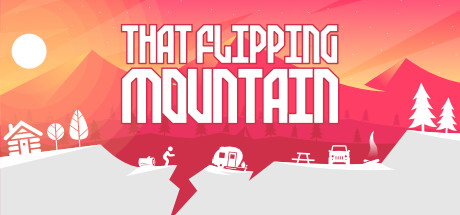
A physics driven parkour game inspired by "Getting Over It" and "Jump King". Flip, ski, and dive yourself up a massive mountain of stuff. Fall down, rage, get up, shake it off, parkour-on!
Modeled estimate, not a reported figure. How we estimate →
Media

About
Stats
All-time low is the lowest price we've recorded for this game since we started tracking it.
Languages: English, German, Spanish - Spain, Czech, Portuguese - Brazil, Russian, Simplified Chinese, Traditional Chinese
Engagement
Hours played at review time, across 40 reviews with recorded playtime.
Reviews
Themes across 40 recent reviews and how positive each mention is. A keyword signal, not full sentiment analysis.
positive critical· bar length = how often the theme comes up
Reviews
Great chill game for late night play
great game
купил по скидке,мне понравилась простая хорошо прорисована только музыка подкачала
if u are a mentally ill guy that loves to suffer then absolutely get it
That Flipping Mountain is a physics-based precision platformer developed and published by Jeff Weber that centers entirely on a single, deceptively simple idea: propel yourself up a massive mountain using momentum, timing, and carefully controlled flips. At first glance, the premise feels almost playful, even minimalistic. You launch your character upward, rotate in midair, and attempt to land cleanly on slopes, ledges, and awkwardly angled terrain. Yet within minutes it becomes clear that the game is less about casual jumping and more about mastering a highly nuanced physics system where every degree of rotation and every fraction of force applied can determine whether you ascend triumphantly or slide helplessly back down. The control scheme is straightforward but surprisingly expressive. Players pull back to build launch power and release to send their character soaring. Once airborne, subtle adjustments influence posture, spin, and landing angle. Success depends on understanding how momentum carries through each jump and how the terrain reacts to your impact. Land at the wrong angle and you bounce awkwardly. Over-rotate and you tumble backward. Under-rotate and you skid down a slope you just spent minutes climbing. The game never overwhelms you with complex button combinations, but it demands precision in execution. Mastery emerges not from memorizing patterns but from developing an intuitive feel for weight, velocity, and timing. The mountain itself acts as a continuous challenge rather than a series of segmented levels. There are no traditional stages, no clean breaks, and no comfortable resets. Instead, the environment stretches upward in a single sprawling ascent composed of ramps, cliffs, narrow ledges, springy surfaces, and unpredictable geometry. Progress feels organic—measured not by checkpoints but by how high you’ve managed to climb without catastrophic error. A single mistake in a precarious section can undo several minutes of progress, sending you sliding down multiple obstacles before you regain control. This design creates an emotional rhythm that oscillates between tension and exhilaration. Every successful landing brings relief; every slip delivers immediate consequence. What gives That Flipping Mountain its staying power is how it transforms frustration into motivation. The game embraces failure as part of its identity. Falls are not framed as punishments but as learning opportunities. Each unsuccessful attempt teaches you something about trajectory or surface interaction. Over time, muscle memory develops and previously daunting sections become manageable. The satisfaction derived from conquering a particularly punishing stretch is immense precisely because the game refuses to hand out easy victories. The climb feels personal, as though you’ve genuinely earned each upward gain through patience and adaptation. Visually, the game adopts a clean and uncluttered 2D aesthetic that keeps focus squarely on movement and terrain readability. The art style does not attempt to distract with elaborate effects or cinematic flair. Instead, it provides clear silhouettes and distinct environmental shapes that make calculating jumps possible. The simplicity of the presentation works in harmony with the mechanics, ensuring that nothing interferes with the core experience. Sound design complements this minimalism, offering subtle audio feedback that reinforces momentum and impact without overwhelming the senses. One of the most compelling aspects of That Flipping Mountain is its psychological dimension. The design fosters a unique relationship between player and environment. As you climb higher, tension increases—not because of enemies or time limits, but because of the growing stakes of a potential fall. The higher you ascend, the more cautious and deliberate your movements become. The game taps into a specific kind of challenge-driven persistence, encouraging players to push a little further with each attempt. This dynamic gives the mountain a near-symbolic quality, representing both obstacle and aspiration. Although the game does not feature a narrative in the traditional sense, it creates its own story through player experience. Each session becomes a personal tale of setbacks and breakthroughs. The absence of external distractions keeps the experience tightly focused on skill development and incremental improvement. For players who appreciate games that revolve around mechanical mastery rather than scripted events, That Flipping Mountain delivers a concentrated and cohesive design philosophy. Ultimately, That Flipping Mountain stands as a strong example of how a focused indie project can extract remarkable depth from a single mechanic. Jeff Weber’s design strips platforming down to its most essential elements—momentum, gravity, and precision—then builds an entire experience around refining those fundamentals. It is challenging without being unfair, punishing without being cruel, and simple without being shallow. For players drawn to physics-driven gameplay and the slow, satisfying process of mastering a demanding system, the climb up this mountain proves to be as rewarding as it is relentless. Rating: 8/10
This game is so fun. I remember seeing it before it came out and it's a shame it didn't get more people trying it. Gets progressively harder but as long as you don't drop it for a while it's never too steep to pass
I love it! Still early on but it's a great challenge game, punishing but fair
殺時間用爬山小遊戲
Its got some fun physics imo. Sometimes it feels unfair however, although I think this can mainly be put down to the level design. A lot of what happens when you fail is you are put down a chute back to an earlier section rather than falling and hoping its not too far
if you played getting over it this is a new rage game for you
Related
Related
Trends
Concurrent players on Steam, sampled daily since tracking started.
Audience
Estimated from the language of this game's reviews — a proxy for where players are, not official Steam demographics.
Related
| Strayed Lights | $35.1K | 484 | 80% | $3.89 |
| Solitaire | $35.1K | 223 | 44% | $9.99 |
| Farm Frenzy: Refreshed | $35.1K | 148 | 82% | $8.99 |
| Prescribe and Pray | $35.2K | 76 | 75% | $11.99 |
| Hade | $35.2K | 332 | 90% | $3.99 |
| Tiny Witch | $35.1K | 113 | 78% | $9.99 |