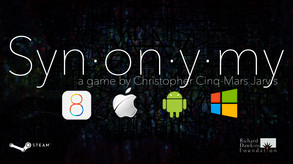
Synonymy is a non-profit, educational word game narrated by Richard Dawkins where players are challenged to find a path between random words through their network of synonyms. By taking the synonym of a word, and then a synonym of that synonym, and so on, you can ultimately arrive at any other word in a language.
Modeled estimate, not a reported figure. How we estimate →
Media

About
Stats
All-time low is the lowest price we've recorded for this game since we started tracking it.
Languages: English**languages with full audio support
Engagement
Hours played at review time, across 41 reviews with recorded playtime.
Reviews
Themes across 41 recent reviews and how positive each mention is. A keyword signal, not full sentiment analysis.
positive critical· bar length = how often the theme comes up
Reviews
I like the concept but think the price is... too much for what it is. You literally click on matching synonyms... and thats it. The execution, however, is terrible - obvious synonyms are missing (e.g. none of distort, disfigure, twist, warp or deform are synonyms for gnarl), and sometimes the synonyms don't make any sense (I think conceal was a synonym for concealment?). As a Review already mentioned: https://steamcommunity.com/id/cxzman/recommended/342890/ Quote: The rules are simple : you're given a target word (say "Silence"), and given a starting word (say "Crash"), and a cloud of synonyms you can pick from. The goal is to get closer and closer to the target word by picking the right words from the words cloud. The thing is, there's not only synonyms in the cloud, but also antonyms, sometimes just analog terms (otherwise you wouldn't get very far)... but not always. So for example starting with "Crash", goind towards "Silence" you could expect to go through "Crack", then "Noise" or "Sound", and then choose the antonym "Silence"... but only IF the game knows that "Silence" is an antonym of "Noise". but when you get, for exempale, to the word "Real" you can choose "Lawful"... and also "Unlawful", but can't pick "Silence" out of "Noise".
Oyun indirimli 3 TL, kartı 9 TL. Diğer kartları da aynı şekilde pahalı. Edit: Öyle 3 liraya 5 köfte devri bitti agalar
[h1]Описание:[/h1] Игра в слова. Выбираем слово и ищем к нему синонимы из предложенных. Все на английском конечно. Зачем? Почему? На игру не похоже и уж точно интересного тут ничего нет. В школе хватило такого в упражнениях из учебников. [h1]Оценка: 2/10[/h1] [h1]Послесловие:[/h1] Если вам понравился этот обзор добро пожаловать в группу http://steamcommunity.com/groups/uojer - тут вы сможете увидеть рекомендованные мною игры, другие обзоры, а также просто пообщаться в хорошей компании
Not Recommended
Очередная "Игра = Покупка ФОНА" А почему? Да потому что на торговой площадке сам фон стоит в ~ДЕСЯТЬ~ раз дороже игры! Ну не бред ли)
Эм, ну, там, я ради фона покупала, что вы от меня хотите, на самом деле, фигня для омерекосов, удалите со стима, пж Еще, блин, 2 часа пришлось отсидеть со включенной этой хренью, чтобы фон дали купить, ну что такое
This is a minimalist mobile ported word puzzle game based on thesaurus synonyms. You are given a word and you must click on 4 different synonyms until you reach the target word. The game deceptively credits Richard Dawkins as a narrator, which is essentially fraud as the game features no narration, so right there the developers are going to burn in hell for sheer lack of ethics there. Aside from that, this is a shonky minimalist mobile port, with no fullscreen option and next to no real gameplay at all. You could do the same thing just putting your finger on words in a dictionary, and if you think that's fun, then great, you don't need to buy this game. Also, if you do have a dictionary lying around at home, it has better graphics than this game. The game also, in a really creepy way, asks for your email address so the developers can stalk you/data harvest and sell your details off. Creepy as. Why did they lie about Richard Dawkins? The whole thing is a confusing mess.
Great game for who is studying English for the second language. Synonymy is a way to understand the connection between words and meanings.
да
Synonymy, developed and published by Christopher Cinq-Mars Jarvis, is a highly unconventional word-based experience that sits somewhere between a puzzle game, an educational tool, and an abstract exploration of language itself. Rather than presenting vocabulary as something to memorize or recall, it transforms words into a network of interconnected meanings, inviting players to navigate that network in search of connections that are not always immediately obvious. It’s a concept-driven game in the purest sense, one that prioritizes intellectual engagement over traditional notions of fun or progression. The core mechanic is deceptively simple. Players are given a starting word and a target word, often with no clear relationship between the two. From there, the objective is to move step by step through a chain of synonyms, gradually bridging the gap between the two endpoints. What makes this compelling is how it reframes language as a space to explore rather than a system to solve. Each word becomes a node in a vast semantic web, and the challenge lies in understanding how meanings overlap, shift, and sometimes stretch in unexpected directions. The experience quickly moves beyond vocabulary recall and into the realm of associative thinking, where creativity and intuition play a larger role than straightforward knowledge. This structure encourages a kind of lateral thinking that is rare even among word games. There is often no single correct path, and the most efficient route is not always the most obvious one. Players are pushed to reconsider familiar words, exploring alternate meanings and subtle nuances in order to progress. This can lead to moments of genuine insight, where a connection suddenly becomes clear and the path forward reveals itself. At the same time, it can also lead to frustration when those connections remain elusive, particularly for players who are less comfortable navigating less common or abstract vocabulary. The scoring system adds another layer to the experience, rewarding players not just for reaching the target word, but for how efficiently they do so. Fewer steps, more precise connections, and quicker completion times all contribute to higher scores, turning each puzzle into a challenge of optimization as well as discovery. This transforms what might otherwise be a purely exploratory activity into something more competitive, especially when combined with global leaderboards and recurring challenges that encourage players to refine their approaches. Presentation is minimalist but purposeful. The visual design focuses on representing words as interconnected elements within a larger structure, reinforcing the idea of language as a network rather than a list. The inclusion of narration adds a distinctive tone, giving the experience a reflective, almost academic atmosphere that aligns with its educational ambitions. However, the interface itself can feel dated and occasionally unintuitive, which may hinder accessibility for new players. Navigating through word options and understanding available paths sometimes requires patience, particularly in more complex puzzles. One of the more challenging aspects of Synonymy is its reliance on a broad vocabulary. The game does little to guide players toward solutions, instead expecting them to draw on their own linguistic knowledge and intuition. This can make it feel rewarding for those who enjoy wordplay and language exploration, but it may also create a barrier for players who are less confident in that area. The difficulty is not artificially imposed—it emerges naturally from the complexity of language itself, which is both a strength and a limitation. In terms of longevity, the game remains focused on its central idea without expanding significantly beyond it. While the core mechanic is strong and thought-provoking, it does not evolve dramatically over time. The experience becomes one of refinement rather than discovery, where players improve their ability to navigate the system rather than encountering new gameplay elements. For some, this consistency is part of the appeal; for others, it may lead to a sense of repetition. Ultimately, Synonymy is a deeply niche but intellectually engaging experience that succeeds in turning language into something interactive and exploratory. It doesn’t aim to entertain in the traditional sense, but rather to challenge how players think about words and their relationships. For those who enjoy word games, abstract puzzles, or educational experiences with a conceptual edge, it offers something genuinely unique. For others, its minimalism and reliance on linguistic intuition may limit its appeal, but even then, it stands as an intriguing example of how games can approach ideas in unconventional ways. Rating: 7/10

Related
Related
Trends
Modeled estimate over time, reconstructed from Steam's monthly review histogram.
Momentum
Pace estimated from the game's recent review growth (our daily snapshots) at its own sales-per-review ratio — a momentum signal, not booked sales.
Audience
Estimated from the language of this game's reviews — a proxy for where players are, not official Steam demographics.
Related
| Spelp | $5.5K | 59 | 90% | $4.99 |
| Loplight | $5.5K | 60 | 88% | $4.99 |
| Mercury Elopement Syndrome | $5.5K | 159 | 85% | $1.99 |
| Crypt Stalker | $5.5K | 109 | 85% | $2.99 |
| ALPAGES : THE FIVE BOOKS | $5.5K | 244 | 36% | $0.99 |
| Spire Horizon Online | $5.5K | 359 | 66% | $3.99 |