Dive into the charming Stories of Mara, an episodic slice of life tale about a diverse cast of characters. Get to know your neighbours and bond with them, but… Could you make them stick together to help each other?
Revenue comes from in-game items and microtransactions, which our price-based model doesn't estimate. Copies below reflect the player base, not paid sales.
Media

About


Stats
Languages: English, Spanish - Spain
Engagement
Reviews
Themes across 40 recent reviews and how positive each mention is. A keyword signal, not full sentiment analysis.
Reviews
Esta novela es una especie de epilogo para los que hemos disfrutado summer in mara, sin haberlo jugado creo que no tiene demasiado sentido. Musica, arte visual y estilo igual de bueno que su juego base, seguiré el rastro a la empresa
Enjoyable read, though some parts for some achievements took a bit of time to figure out. Overall good game.
As someone who LOVED Summer. This was a nice little addition. Which I don't think this is really for anyone UNLESS they've played Summer and they're familiar with the world and characters. If you are and you don't mind a heavily driven and pretty much ONLY a game of dialouge. Then this should be for you. It isn't at all like Summer. Just the familiarity of the characters and the world.
Related
Related
Trends
Concurrent players on Steam, sampled daily since tracking started.
Hours played at review time, across 40 reviews with recorded playtime.
positive critical· bar length = how often the theme comes up
Es un juego breve pero muy bonito, es cierto que no te guía demasiado en cuanto a descubrir cosas (En mi primera partida no interactué con algunos personajes porque no sabía que se podía) Pero en general es un juego disfrutable, una experiencia recomendada
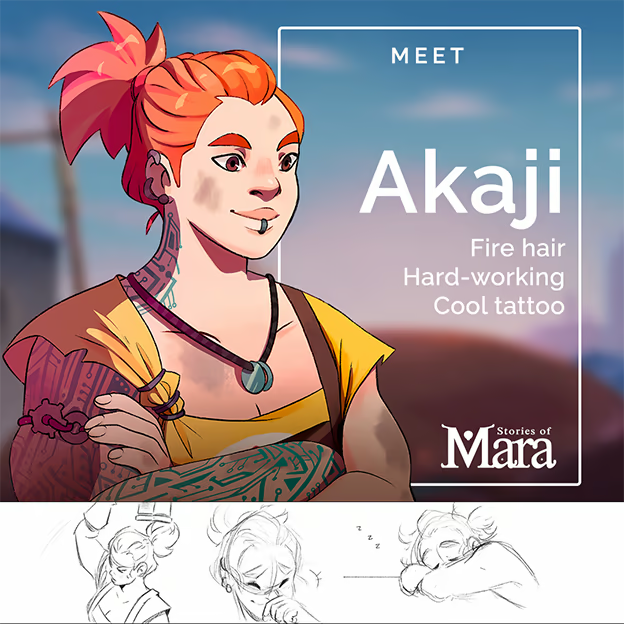
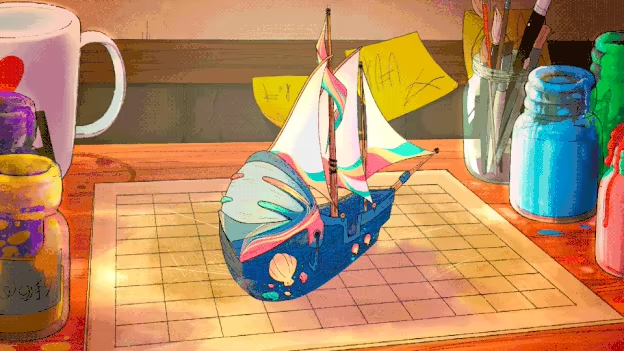
Esta reseña contiene algunos spoilers de la historia de Stories of Mara Una novela visual que sirve para expandir el universo creado en Summer in Mara y que sirve para dar más contexto sobre los personajes que habitan la isla de Qälis y sus vivencias del día a día. Sirve como epílogo a Summer in Mara y de momento sólo está el primer capítulo en el que se desarrolla la historia a través de Akaji. La historia nos sitúa un tiempo después de que Koa salve a Mara, pero un día de repente encuentran su barco destrozado en la playa de Qälis y Koa ha desaparecido. Akaji se muestra bastante preocupada por ella mientas el resto de vecinos le quitan importancia y le siguen haciendo encargos como si no fuera con ellos, pero poco a poco van notando su ausencia y deciden reparar el barco de Koa para ir en su búsqueda. Entre tanto tambien aparece Napopo como herida y desorientada, y Akaji se hace cargo de ella hasta que consiguen su perla y logra recuperarse poco a poco. La historia se queda ahí hasta el siguiente capítulo, pero tiene algo de rejugabilidad si queremos descubrir los diversos caminos de la historia y conseguir todos los logros, ya que Akaji, animada por Litio, comienza a crear maquetas de barcos para ayudar a que se distraiga de la presión del día a día en su herrería y de la preocupación por lo de Koa. Las decisiones que inportan realmente para la trama son estas precisamente, ya que la maqueta del barco se hace cada vez pensando en un personaje en concreto, y según la preferencia del tipo de barco o el color que elijamos la historia nos llevará por una ruta u otra, aunque no afecta a la trama principal sino únicamente al lazo que estrechamos con ese personaje. El gameplay como en toda novela visual es muy sencillo, su interfaz es excelente y muy suavizada, las ilustraciones de los personajes diria que han sido ajustadas para hacerlas de mayor tamaño y se han añadido expresiones faciales, y la BSO ha sido retocada para hacer que sus temas sean aún más calmados para hacerlos más acorde a la lectura, sin embargo se echa de menos algún tema musical más, ya que si no me fallan las cuentas apenas hay 2 o 3 temas, y también se echan en falta alguna mecánica propia de las novelas visuales como avanzar rápido por los diálogos ya vistos en otras rutas para hacerlo más cómodamente rejugable. Lo que me ha chirriado un poco en todo esto es lo de "Elle" refiriéndose a Blu 😓. Desconozco si sigue en desarrollo ya que el lanzamiento de este spin off fue ya hace 3 años y sigue estando sólo el primer capítulo, pero me encantaría que lo continúen ya que es una buena forma de expandir este universo y de conocer mejor a sus personajes que como dije en la anterior reseña, es el punto más fuerte de este universo y de este estudio ya que los personajes son bastante profundos, variados, carismáticos y con una personalidad bastante diferenciada que le da mucha riqueza a este mundo y a las vivencias que van teniendo.
Pas très intéressant. On incarne Akaji qui fait tout pour retrouver( Koa qui a disparu. Mais au moment où on peu enfin partir à sa recherche le jeu prend fin. Décevant. De plus, on ne peut se déplacer qu'en cliquant sur la carte. Le clavier ne sert donc à rien. Il n'y a aucune aventure comme dans Summer in Mara où là on pouvait se balader librement. Et bien là ce n'est pas du tout le cas. Très déçu. Je ne recommande pas :(
"This fish is useless" "So is this conversation". That summarizes Stories of Mara. Getting a technical question out of the way: [b][i]Do four buttons (LMB, Space, Enter, Numpad Enter) forward text?[/i][/b] Shockingly, yes. Many visual novels fail this test. However, there's no autoskip, and the game expects you to replay it. Within the first 9 minutes of dialogue, the first text that is in bold font is [b]"She is a strong girl"[/b], regarding Koa. This conveys to me that the writer is not confident in their storytelling skills. If the adjective applies at all, it would be patently obvious from experiencing the story, but instead, it was used as some sort of social signal. The alternative interpretation is that the town is comedically despondent, which is not better. The second and third usages of bold are less weird, but still weird; for example, the third is an entire sentence. These are meant to highlight goals for the player, that they ought to remember, but... [b]A.[/b] there isn't mechanical freedom for you to possibly lose yourself, and... [b]B.[/b] if you could lose yourself, Akaji should instead tell you, "I should be doing X". In fact, she already does that when visiting unimportant places, except instead of a specific goal X, she merely says "something". Regarding the places, a map is available, allowing you to pick and go to one of many places. As if the storepage and developer messages weren't enough, this hints at the game's intended scope. It also kinda seems like the backgrounds are repurposed concept art, since they don't fit perspective-wise with the characters, but it could just be a misdesign. When Litio first enters Akaji's workship, the BGM changes, and it is unfitting. This musical strangeness didn't recur in the rest of the game. Litio introduces Akaji to the modelmaking of boats as a calming hobby, who soon transforms it into a nagsome duty to be done for others, practiced by her with maximum strategy intended for maximum gain. Akaji makes the most stereotypical boat models for the characters, which you as the player are encouraged to make because of low-information, and... they like them. This reflects the depth of interest to be found in these characters. Even Aquila, who superficially complains about this, likes it, so his complaint doesn't work. It would've been cool if symbolic analogy had been made between the type of boat and the characters, so you learn about boats, and the story. The senile shipmaker guy with as many tall-tales as he has area on the surface of his skin, he could have seen your models and gotten inspired to explain a local islander the player knew little about. [b]BUG:[/b] There's a part where the game shows Akaji as asking Akaji about whether so-and-so is a joke to herself. Contextually, this is meant to have been said by Mayo, but a bug shows it as Akaji. Aquila and Saimi were the most interestingly written characters, but frankly, it would've been better if they were as bad as everyone else. The characters around Akaji respond to her worries, to the injured Napopo, and to the missing Koa, in a way that is NOT believable. The way this is written, everyone in the island is inexplicably despondent and uncaring. They simply are like that. You, the player, are expected to wash the foot of these characters to get the best ending, with little to zero incentive for doing so, except Akaji's strange rumination. As another reviewer wrote: "If they don't care, why should I?" Speaking of rumination, there's a lot of repeating the same information. I thought this story would be about Akaji searching for Koa, but it really is about how she doesn't give herself a break from work, is envious of Koa's enlightened freedom, and wants to leave this allegedly narcissistic island of small differences. What Akaji most loves to do - besides being miserable about overworking herself in her own toil without break for no known reason - is to tell herself, every character she meets, you the player, the wall of her smithy, and the blueness of the sky, that Koa is missing and that she wants validation to be concerned about her missingness. It's so repetitive and drab, you're better off just thinking about your own past, or ruminating on the death of the messiah. On top of that, most of the game is loading in and out of places irrelevant to progressing the story, as you look for where this or that character might currently be at. According to the credits, as well as developer statements from 2021 and 2022, a second chapter is said to be forthcoming. Seeing as it is 2026, the only thing that came were four years. [b]NOTE[/b]: Addressing a misleading statement by "Obey the Fist", there is no content in this game that is unlockable via paying. I hold Chibig at a very high and positive regard, but not this game. It isn't even on their website, though it [url=http://web.archive.org/web/20230519072014/https://chibig.com/stories-of-mara/]used to be[/url], which forces you to wonder whether they are ashamed/unproud of a work viewed by themselves as lesser (due to various unworkable constraints), whether the hiding was a strategic omission tactic to control the impression of visitors, or both. Koa, the one that motivated Akaji, and the only reason I bothered to play this, is seen nowhere in this game, except for the title menu. If you care about the world and characters by Chibig, you will get something out of this, but nowhere close to what the game's premise makes it seem.
[h1]Eine unvollständige Visual Novel zum Nulltarif[/h1] Stories of Mara ist eine unvollständige Visual Novel des spanischen Entwicklers Chibig, welche als eine Art Fortsetzung zum Cozy Game „Summer in Mara“ fungiert. Stories of Mara sollte ursprünglich fünf Kapitel umfassen. Das erste Kapitel erschien am 26.08.2021 auf Steam und steht dort kostenlos zur Verfügung. Die restlichen Kapitel haben jedoch nie das Licht der Welt erblickt. Tatsächlich hat die Mara-Serie inzwischen auch schon ein drittes Spiel in Form des 3D-Platformers „Koa and the Five Pirates of Mara“ erhalten, womit man wohl klar sagen kann, dass für Stories of Mara höchstwahrscheinlich keine Updates mehr erscheinen werden. Ob man jedoch dennoch Spaß mit dem kostenlosen Erstkapitel haben kann, erfahrt ihr im folgendem Test. [h1]Gefrustete Schmiedin[/h1] Stories of Mara findet einige Zeit nach den Ereignissen von „Summer in Mara“ statt. Koa beschließt für einige Zeit alleine auf Reise zu gehen, ihre kleine Freundin Napopo soll hingegen zurückbleiben und die gemeinsame Heimatinsel hüten. Danach schwenkt das Spiel zur Schmiedin Akaji über, welche so langsam aber sicher an der Masse an Arbeitsaufträgen frustriert. Eines Tages wird sie an den Strand von Qälis gerufen, denn ein verlassenes, beschädigtes Schiff wurde angespült. Es handelt sich um das Schiff von Koa! Damit steht für Akaji fest, dass Koa in Not ist und Hilfe benötigt. Sie plant in See zu stechen, um nach ihrer kleinen Freundin zu suchen. Doch dafür muss freilich erst einmal das Schiff repariert werden. Sehr zu Akajis Leidwesen zeigen sich die anderen Einwohner von Qälis wenig beeindruckt von der aktuellen Situation. Sie gehen davon aus, dass mit der taffen Koa schon alles in Ordnung sei, und dass sie ja gut auf sich selbst aufpassen könne. Dieses apathische Verhalten ihrer Nachbarn verstärkt Akajis Frustration und lässt sie über ihre aktuelle Lebenssituation zweifeln. Nur Akajis Piraten-Freund Litio erkennt ihre düstere Gemütslage und ermuntert die Schmiedin dazu sich ein schönes Hobby zu suchen – das Basteln von Modellschiffen. Doch dann verschärft sich die Situation, als auch noch Koas Freundin Napopo an den Strand von Qälis gespült wird. Was Akaji für Konsequenzen ziehen wird, müsst ihr jetzt freilich selbst herausfinden. Allerdings sei noch mal darauf hingewiesen, dass Stories of Mara eine unvollständige Visual Novel ist, und die Handlung daher ziemlich abrupt endet. Da die VN kostenlos ist, mag man diesen Umstand freilich verzeihen können. Problematischer ist jedoch die Tatsache, dass die VN Vorkenntnisse zu „Summer in Mara“ voraussetzt. Die VN macht nämlich nicht die geringsten Anstalten die Spielwelt oder die Charaktere näher zu beleuchten. Dies liegt ganz einfach daran, da dies ja bereits im Vorgänger geschehen ist. Wer diesen nicht gespielt hat, hat einfach Pech gehabt. So scheint zumindest die Attitüde der Entwickler. Aber auch für diejenigen, welche „Summer“ gespielt haben, ist „Stories“ nicht unbedingt übermäßig interessant. Sämtliche Charaktere im Spiel sind schon aus dem Vorgänger bekannt, und abgesehen von Akaji macht niemand eine Charakterentwicklung durch oder dergleichen. Sie legen die selben Verhaltensweisen und Marotten an den Tag, die man bereits kennt. Aufrechte Fans des Vorgängers dürften sich dennoch darüber freuen, einen Großteil der Qälis-Einwohner wiederzusehen. Und immerhin ist die VN kostenlos. [h1]Unerwarteter Wiederspielwert[/h1] Visual Novels bieten freilich kein typisches Gameplay. Man liest halt Textboxen und erfreut sich am Artwork. Stories of Mara hat dann aber doch etwas mehr Substanz zu bieten. So gibt es ein paar Choice & Consequences-Situationen sowie Multiple-Choice-Dialoge, welche erlauben Akajis Verhalten zu bestimmen. Ob die Schmiedin nun freundlich und hilfsbereit oder apathisch und unsensibel reagiert, liegt in eurer Hand. Dementsprechend bietet die VN dann auch drei verschiedene Varianten des Endes an. Außerdem bekommt man eine Inselkarte von Qälis geboten, auf derer man zwischen zehn verschiedenen Ortschaften auswählen kann (technisch gesehen gibt es elf Orte, aber die Bank ist grundsätzlich ausgegraut und kann nicht besucht werden). Natürlich ist die Reihenfolge des Storyfortschritts mehr oder weniger vorgegeben, aber es gibt auch ein paar alternative Routen und einige optionale Aufgaben zu entdecken. Letztere kann man auch leicht verpassen, was ärgerlich ist, wenn man das beste Ende anstrebt. Ehrensache, dass Achievements angeboten werden, um den Spieler zu motivieren sämtlichen Inhalt der VN zu begutachten. Der erste Spieldurchlauf ist mit ca. 75 Minuten auch sehr überschaubar. Für 100 % Achievements habe ich mich etwa 3 Stunden mit Stories of Mara befasst. Die VN bietet leider nur einen einzigen automatisch speichernden Saveslot. Diesen muss man manuell über das Optionsmenü löschen, wenn man einen neuen Run starten möchte. Man kann spätere Durchläufe glücklicherweise beschleunigen, denn es gibt einen Button, mit dem sich die Textboxen im Zeitraffer abspulen lassen. Seltsamerweise wird der Zeitraffer-Button nur über Controller angeboten. Auf der Tastatur habe ich diese Funktion vergebens gesucht. Die Zeitraffer-Funktion wird auch in keinster Weise von der VN kommuniziert. Ärgerlich ist auch, dass der Controller-Support nur partiell ist. Die Navigation auf der Inselkarte funktioniert z.B. nur via Maus. Man merkt also auch an anderer Stelle, dass Stories of Mara ein unfertiges Produkt ist. [h1]Grafik und Sound[/h1] Wie schon der Quasi-Vorgänger, wurde auch Stories of Mara mit der Unity-Engine erstellt. Und dies ist durchaus ein Problem, da die Engine Ladezeiten nach sich zieht, die nicht so recht zu einer Visual Novel passen wollen. Es ist jedenfalls reichlich bizarr, wenn ein paar Artworks dieselben Ladezeiten erfordern, wie eine 3D-Welt. Wir reden zwar nur von ein paar Sekunden Ladezeit, aber störend ist es dennoch. Unabhängig davon ist der Artstil identisch zum vorherigen Spiel. Die Charakterartworks mit ihren variablen Gemütslagen wurden sogar eins zu eins aus „Summer in Mara“ übernommen. Bei den Hintergründen für die Ortschaften und den Story-Sequenzen handelt es sich jedoch um neue Zeichnungen. Wie gehabt gefällt der Artstil, welcher den fernöstlichen Anime- und Manga-Stil mit europäischen Einflüssen mischt und somit einen eigenständigen Stil erzeugt. Auch der Soundtrack wurde eins zu eins aus Summer in Mara übernommen. Die Melodien des spanischen Komponisten Paco Mitos passen wunderbar zum tropischen Inseln-Setting mit quirligen Cartoon-Charaktere. Aber es wäre natürlich schön gewesen, wenn man ein paar neue Tracks kreiert hätte. Die Ambient-Soundeffekte sind in Ordnung und leisten ihren Dienst. Leider bietet die VN keine Sprachausgabe. Die Charaktere geben zwar immer wieder Geräusche in Form von Gekicher oder „Oohs“ und „Aahs“ von sich, aber das ist freilich kein Ersatz für eine vernünftige Synchronisation. Letztere hätte dem Spiel übrigens sehr gut getan. Eine deutsche Textübersetzung hat man sich dieses mal übrigens gespart. Die Texte stehen nur auf englisch oder spanisch zur Verfügung. [h1]Pro und Kontra:[/h1] Pro: - ist kostenlos - charmantes Artdesign und schöner Soundtrack - Wiederspielwert durch Choice & Consequences, alternative Enden und Achievements Kontra: - unvollständige Story. Von den geplanten fünf Kapiteln wurde nur das Erste veröffentlicht - erfordert Kenntnisse zur Handlung von „Summer in Mara“ - keine Sprachausgabe - bietet nur partiellen Controller-Support. Und den Zeitraffer-Button für die Textboxen findet man nur auf dem Controller, was soll das? - keine deutsche Textübersetzung - bietet nur einen einzigen automatisch speichernden Spielstand Wertung: 65 von 100 Punkte
☀️
玩完其他作品很喜欢这个世界观和角色们,想来这继续看故事,但不管是存档问题还是各种bug,各方面来说制作都太敷衍了,剧情线也相当一般,不仅不完整,而且可以说是没有任何有趣或深入的角色刻画:( 失望之作
Audience
Estimated from the language of this game's reviews — a proxy for where players are, not official Steam demographics.