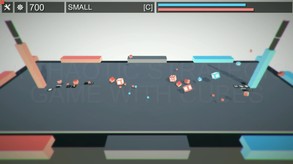
A chaotic strategy game with cubes! You have to choose and build deployments to destroy the Mothercube with So Many Cubes
Modeled estimate, not a reported figure. How we estimate →
Media
About
Genres
Stats
All-time low is the lowest price we've recorded for this game since we started tracking it.
Languages: English
Engagement
Hours played at review time, across 40 reviews with recorded playtime.
Reviews
Themes across 40 recent reviews and how positive each mention is. A keyword signal, not full sentiment analysis.
positive critical· bar length = how often the theme comes up
Reviews
Broken, unenjoyable game with no tutorials, mispriced towers, broken achievements and overpowered minigun spamming strategy
So Many Cubes from exagongames is built around a concept that is immediately eye-catching in its simplicity and absurdity: a battlefield populated entirely by cubes, each acting as a semi-autonomous unit in a chaotic struggle to destroy a central target known as the Mothercube. On paper, it presents itself as a hybrid between real-time strategy and physics sandbox, where players deploy different cube types and watch as they interact, collide, and unleash various effects. It’s the kind of idea that feels deliberately experimental, almost like a prototype meant to explore emergent behavior rather than deliver a tightly controlled competitive experience. The core gameplay loop revolves around selecting from a roster of cube types and deploying them strategically across a small arena. Each cube has its own behavior, whether that’s offensive capabilities, defensive traits, or unique movement patterns. There are also modifiers and temporary boosts that can influence the outcome of matches, adding another layer of potential complexity. In theory, this system should create a dynamic environment where understanding each cube’s strengths and weaknesses allows for thoughtful planning and varied strategies. Early sessions can be entertaining as players test different combinations and observe how the cubes interact, often producing unpredictable and sometimes amusing results. However, the game’s reliance on unpredictability quickly becomes one of its biggest drawbacks. While chaos is clearly a deliberate design choice, it often overshadows any meaningful sense of strategy. Battles can devolve into visual noise, with dozens of cubes clashing in ways that are difficult to follow or control. Instead of carefully orchestrating a plan, players often find themselves reacting to randomness or simply deploying large numbers of units in the hope that something works. This lack of clarity undermines the strategic layer, making victories feel less like the result of skill and more like the outcome of fortunate circumstances. Another issue lies in how the game communicates its mechanics. So Many Cubes does very little to guide the player or explain how its systems function in detail. The interface is minimal to the point of being unhelpful, and understanding the nuances of each cube type often requires trial and error. This creates an initial barrier to entry that can be frustrating, especially for a game that already leans heavily on chaotic interactions. Without clear feedback or intuitive design, it becomes difficult to develop a sense of mastery or confidence in the gameplay. Balance is also inconsistent across the available cube types. Some units feel disproportionately effective, capable of overwhelming the opposition with minimal effort, while others seem underpowered or unreliable. This imbalance discourages experimentation, as players quickly identify a handful of strategies that work and stick to them. As a result, the variety that should be one of the game’s strengths ends up feeling superficial, with many options existing more as novelties than viable choices. Visually, the game embraces a stark, minimalist aesthetic that matches its abstract premise. The cubes themselves are simple geometric shapes, and the environments are sparse and functional. While this keeps the action readable at a basic level, it also contributes to the overall lack of identity. There is little in the way of visual progression or environmental diversity, which makes extended play sessions feel repetitive. The audio design follows a similarly understated approach, providing basic sound effects and background elements that do their job without adding much personality. In terms of content, So Many Cubes feels limited, especially considering its Early Access status. The number of maps is minimal, and while there are a few different modes to explore, they do not significantly change the core experience. The lack of ongoing updates or meaningful expansion further reinforces the impression that the game was never fully developed beyond its initial concept. What remains is a small sandbox with interesting ideas but insufficient depth to sustain long-term engagement. Ultimately, So Many Cubes stands as a reminder that a strong concept alone is not enough to carry a game. Its cube-based combat system has moments of chaotic fun, particularly for players who enjoy experimenting with unconventional mechanics, but these moments are inconsistent and often overshadowed by the game’s shortcomings. The absence of polish, clarity, and balance prevents it from evolving into a truly compelling strategy experience. For most players, it will likely feel more like an abandoned experiment than a finished product, offering brief curiosity but little lasting appeal. Rating: 3/10
A chaotic strategy game with cubes! You have to choose and build deployments to destroy the Mothercube with So Many Cubes
So bad
Yes.
нет
Only buy this game for the trading cards. As of now, the game has been deserted and is not worth playing. Achievements do not work, crappy UI, and poor game design. The idea had some potential...
An interesting concept, unfortunately abandoned. In it's current state, it's playable but the User Interface is not user-friendly; the spawn mechanics (i.e. spawn types tied to different keys and no cost display) feel like a hassle to navigate, which makes it more frustrating than fun. If you have the game already, you've probably noticed that the achievements don't work. A player (The Distinguished Gent) has created a file to correct the Steam achievement API integration. Important Note: Achievements pop upon closing the game, not while playing. Here's the Gent's guide: https://steamcommunity.com/sharedfiles/filedetails/?id=2805838814
Achievements don't work, and the game is only a good idea that is mostly unbearable to play.
2 € me parece carísimo.
Related
Related
Trends
Concurrent players on Steam, sampled daily since tracking started.
Momentum
Pace estimated from the game's recent review growth (our daily snapshots) at its own sales-per-review ratio — a momentum signal, not booked sales.
Audience
Estimated from the language of this game's reviews — a proxy for where players are, not official Steam demographics.
Related
| Street Dog Legend | $9.6K | 70 | 100% | $3.99 |
| Ghostory | $9.6K | 71 | 93% | $7.99 |
| Orcdom | $9.6K | 72 | 89% | $4.99 |
| Drawing From Memory | $9.6K | 244 | 91% | $1.94 |
| Evasion | $9.6K | 71 | 69% | $19.99 |
| Peachleaf Pirates | $9.6K | 74 | 66% | $6.99 |