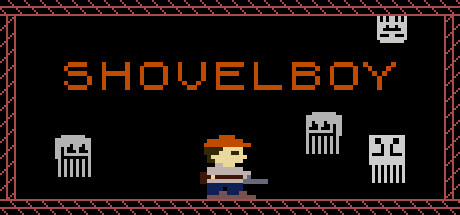
SHOVELBOY is a retro-inspired 2D platformer created and published by LGV that embraces the simplicity and challenge of classic arcade games. Built around a minimal but focused gameplay loop, the title places players in control of a small pixelated hero whose objective is to navigate a series of compact levels in search of hidden shovels. Rather than presenting a large narrative adventure or expansive environments, the game concentrates on delivering tightly designed stages that test reflexes, timing, and precision. Its design philosophy reflects an appreciation for early platforming titles where skillful movement and persistence were the primary tools required for success.
The premise of the game is intentionally straightforward. Players guide the protagonist through a series of platforming challenges with the goal of finding and collecting a shovel in each level. The shovel acts as the key to progression, allowing the character to dig forward and unlock access to the next stage. While the story itself remains minimal, the concept provides a simple structure that keeps the focus on gameplay. Each level essentially becomes a small obstacle course where the player must reach the shovel while avoiding hazards and enemies.
The gameplay mechanics are built on classic platforming principles that will feel familiar to fans of old-school games. Players control the character’s movement across platforms, jumping over obstacles and carefully navigating the terrain. The character’s movement is responsive and intentionally uncomplicated, emphasizing clean and predictable controls. One notable mechanic included in the game is the ability to perform a double jump, which expands the player’s mobility and allows for more precise navigation through vertical areas or dangerous sections of the level.
Each level functions almost like a miniature puzzle that must be solved through movement and careful positioning. The environments are relatively small, but they are designed to present specific challenges that require attention and precision. Early levels serve as a gradual introduction to the game’s mechanics, helping players understand the movement system and basic hazards. As players progress further, the layouts become more complex and the margin for error becomes much smaller.
Hazards play a significant role in shaping the gameplay experience. Spikes placed along the ground, walls, or ceilings instantly eliminate the player if touched, forcing careful navigation through narrow passages and tricky platforming sections. The game also features several types of enemies that add additional pressure to each level. Some enemies wander unpredictably around the stage, while others remain stationary and fire projectiles toward the player. Certain enemies actively pursue the character, creating moments where players must react quickly to avoid being caught.
These dangers are often placed strategically in combination with the level geometry, creating sequences where players must make precise jumps while avoiding multiple threats at once. Later levels introduce more demanding patterns that require careful timing and familiarity with the movement mechanics. The difficulty gradually increases throughout the game, encouraging players to refine their technique and approach each challenge with greater confidence.
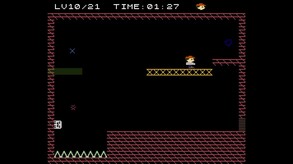
The game features a total of twenty-one handcrafted levels that form the core progression of the experience. Each stage introduces new configurations of platforms, hazards, and enemies that test the player’s abilities in different ways. While the levels are relatively short, their design encourages repeated attempts as players learn the layout and gradually improve their performance. This structure makes the game feel similar to classic arcade experiences where mastering a level often requires multiple tries.
Another aspect that reinforces the arcade influence is the life system. Players begin their run with three lives, and losing all of them ends the attempt. The game offers two difficulty settings that influence how this system behaves. In Easy mode, players are allowed to continue even after losing all their lives, making the experience more forgiving and accessible. Hard mode removes this safety net and requires players to restart from the beginning if they fail, creating a much more demanding challenge that rewards careful play and persistence.
Speedrunning elements are also built into the design. A timer records how long it takes players to complete their run, encouraging them to replay the game in order to achieve faster times. This feature adds a competitive aspect to the experience, particularly for players who enjoy optimizing their movement and discovering the most efficient routes through each level. Leaderboards allow players to compare their completion times with others, turning the game into a race for the best performance.
The environments themselves feature a variety of platform types that influence how players approach each stage. Some platforms remain stationary and provide reliable footing, while others move horizontally or vertically, requiring precise timing to land safely. Certain surfaces may collapse after the player steps on them, forcing quick decisions about the next jump. These environmental mechanics introduce additional variety and help prevent the stages from feeling repetitive.
Visually, SHOVELBOY adopts a deliberately simple pixel-art style that pays tribute to early platform games from the 1980s and 1990s. The character sprites, enemies, and environments are composed of bright colors and blocky shapes that evoke the aesthetic of classic consoles and home computers. This retro presentation gives the game a nostalgic charm while ensuring that important gameplay elements remain easy to recognize during fast-paced action.
The sound design complements the visual style with straightforward audio effects and a retro-inspired soundtrack. Each action, from jumping to collecting the shovel or colliding with enemies, is accompanied by clear sound cues that reinforce the player’s actions. The music maintains a simple but energetic tone that supports the gameplay without distracting from the challenges on screen.
Because of its compact structure, SHOVELBOY is not intended to be a lengthy or complex adventure. Instead, it functions as a concentrated platforming challenge that players can complete in relatively short sessions. The design encourages replayability, as players return to levels to improve their timing, avoid mistakes, and achieve faster completion times.
This minimalist approach may not appeal to players seeking expansive worlds, narrative depth, or a wide variety of mechanics. However, the simplicity is also part of the game’s charm. By focusing on precise movement and carefully designed obstacles, the game delivers a pure platforming experience that highlights the satisfaction of mastering difficult challenges.
Ultimately, SHOVELBOY succeeds as a small but focused tribute to the era of classic arcade platformers. Its tight controls, compact levels, and gradually increasing difficulty create a gameplay loop that rewards patience and skill. While it may not offer the scale or complexity of larger platforming games, it provides a nostalgic and engaging experience for players who appreciate the straightforward challenge of traditional retro-style platformers.
Rating: 6/10