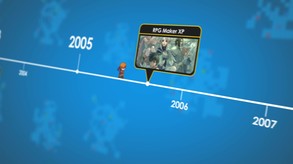
For the first time, RPG Maker 2000 is available in English! Since its debut 15 years ago, the beloved game-making engine has introduced untold amounts of users to the wonders of game design and continues to be a powerful, user-friendly tool.
Modeled estimate, not a reported figure. How we estimate →
Media

About
Genres
Stats
All-time low is the lowest price we've recorded for this game since we started tracking it.
Languages: English
Engagement
Hours played at review time, across 40 reviews with recorded playtime.
Reviews
Themes across 40 recent reviews and how positive each mention is. A keyword signal, not full sentiment analysis.
positive critical· bar length = how often the theme comes up
Reviews
fajne
cool for making games but 2003 is better (i have that also )
aker 2000
just get 2k3
A nostalgia bomb for old RM fans. It's still fun to use after all these years, and it's a solid enough starter engine for new game makers.
RPG Maker 2000 developed by Gotcha Gotcha Games in collaboration with KADOKAWA and Yoji Ojima, and published by Gotcha Gotcha Games on Steam, stands as one of the most influential and historically significant entries in the long-running RPG Maker lineage. While newer engines in the series boast scripting layers, plugin ecosystems, and high-resolution outputs, RPG Maker 2000 occupies a very specific and enduring niche: it is a focused, tightly structured, and remarkably accessible tool that distills the essence of classic 16-bit era Japanese role-playing games into a form that almost anyone can use. Its Steam release gave an official English localization to a tool that had already shaped an entire underground generation of hobbyist developers, and in doing so preserved a foundational piece of indie game development history. What makes RPG Maker 2000 immediately compelling is its clarity of purpose. The engine is built around a database-driven workflow that centralizes nearly every component of game creation: actors, classes, skills, items, enemies, animations, tilesets, and system settings are all defined within organized menus. Rather than writing code, creators construct logic through an event command system—an interface that allows conditional branches, switches, variables, movement routes, dialogue triggers, and battle events to be layered visually. For newcomers, this means the intimidating barrier of programming is replaced with a structured, rule-based sandbox. For experienced users, the same event system becomes a powerful puzzle box capable of complex mechanics, minigames, cutscenes, and branching narratives when used creatively. The visual identity of RPG Maker 2000 is inseparable from its appeal. Projects run at a modest 320×240 resolution and rely on 16×16 tiles, reinforcing a distinctly retro aesthetic that evokes early console RPGs. The default assets—character sprites, chipsets, monster graphics, and battle animations—lean into that nostalgic charm, offering a cohesive baseline that allows creators to build functional prototypes quickly. Yet the engine is far from locked into its stock presentation. Users can import custom sprites, music, sound effects, and graphical elements, meaning that while the resolution and structural limits remain fixed, artistic identity is flexible. The tension between constraint and creativity often results in surprisingly inventive projects that feel handcrafted rather than overproduced. Combat in RPG Maker 2000 uses a traditional front-view battle system. Characters are not displayed on screen during combat by default; instead, players view enemies head-on while issuing commands through menus. This design choice aligns closely with classic console RPG conventions and simplifies presentation, allowing developers to focus on balancing skills, status effects, and encounter pacing rather than elaborate battle choreography. Through event commands and battle conditions, creators can still inject drama—scripted boss phases, dialogue mid-fight, environmental hazards, and variable-driven transformations. Although later RPG Maker versions introduced side-view systems and scripting extensibility, many purists appreciate the clean, straightforward structure found here. One of the most important aspects of RPG Maker 2000 is how it teaches design discipline. Its limitations are not incidental; they are formative. Without native scripting or plugin architecture, developers must think carefully about systems design, pacing, and resource management. Workarounds become lessons in logic. A clever use of switches can simulate reputation systems. Variables can create custom damage formulas or branching questlines. Because the tool does not overwhelm users with features, it encourages a deeper understanding of fundamental RPG mechanics. In that sense, RPG Maker 2000 often feels less like software and more like a design classroom embedded in an editor. Performance and compatibility are generally stable on modern Windows systems through the Steam release, though users accustomed to high-resolution scaling and widescreen support may find the fixed resolution archaic. Fullscreen behavior can feel dated, and the UI reflects early-2000s software design philosophies. However, these elements also contribute to its authenticity. For many longtime creators, opening the editor is an almost archival experience—like stepping into a preserved creative workspace from another era. That sense of continuity is powerful, especially for those who began their development journey with unofficial translations years ago and can now use a licensed, localized version. Community support remains another pillar of its longevity. Decades of tutorials, archived forums, resource packs, and fan-made tools exist around RPG Maker 2000. Even though newer engines have taken center stage, the historical footprint of this version ensures that knowledge is abundant and accessible. Many early indie RPGs and cult classics were built on its foundation, and its influence can still be seen in the structure of contemporary RPG Maker titles. The Steam edition allows projects to be exported and shared more seamlessly, keeping the creative pipeline alive for modern audiences. In evaluating RPG Maker 2000 today, it is essential to understand what it is not. It is not a cutting-edge engine for 4K graphics, advanced scripting frameworks, or cross-platform deployment. It does not compete with modern game engines in technical ambition. Instead, it offers a deliberate, focused environment for crafting traditional 2D role-playing games with minimal friction. For hobbyists who value immediacy and nostalgia, for educators teaching fundamental game design logic, or for veteran developers revisiting their roots, it remains deeply relevant. Ultimately, RPG Maker 2000 endures because it captures a specific moment in game development history while still functioning as a viable creative tool. Its interface may be simple, its resolution modest, and its features comparatively restrained, but within those boundaries lies a surprisingly expansive creative playground. It invites creators to tell stories, design dungeons, script dramatic confrontations, and experiment with systems—all without writing a single line of code. In an era dominated by sprawling engines and technical excess, there is something refreshing about a tool that does exactly what it promises: empower anyone to build a classic role-playing adventure from the ground up. Rating: 7/10
i cant make my character 2.5 tiles tall. automatically makes it unusable. ignore my playtime :3 edit: i decided to get rpg maker 2003 since its very similar while having more features. i would personally recommend getting 2003 > 2000 so this review being a "bad review" is less of a joke now- but either way i liked my experience with this thing!
it is completely stripped of all graphics, sounds and music. it is a bare engine, requiring the user to dig out the RTP themselves.
The true classic! I used RPG MAker 2003 more back in the day, but this one has the best character designs, monsters and tiles.
good for more snes styled games. Kinda lackluster compared to XP, VX ace, Mz, or MV but its pretty good for being like the first one
Related
Related
Trends
Modeled estimate over time, reconstructed from Steam's monthly review histogram.
Momentum
Pace estimated from the game's recent review growth (our daily snapshots) at its own sales-per-review ratio — a momentum signal, not booked sales.
Audience
Estimated from the language of this game's reviews — a proxy for where players are, not official Steam demographics.
Related
| Clink | $5.4K | 113 | 73% | $1.49 |
| FURRY SEX: Cabaret 💋🔞 | $5.4K | 476 | 71% | $0.90 |
| BORIS RUSSIAN BEAR | $5.4K | 437 | 86% | $0.49 |
| 100 hidden cups | $5.4K | 433 | 42% | $0.59 |
| IHF Handball Challenge 12 | $5.4K | 83 | 63% | $2.99 |
| Battle Time | $5.4K | 220 | 77% | $0.99 |