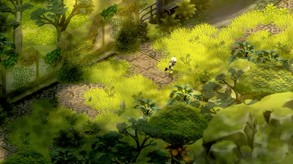
Retro Machina is a single-player action and exploration game set in a retro-futuristic universe. Experience the journey of a little robot as it solves intricate puzzles and begins unraveling the mysteries of a world long forgotten.
Modeled estimate, not a reported figure. How we estimate →

About
Only one city remains on the planet, and it’s only robots who inhabit it now. Protected by a glass dome, Endeavor rises above the once lively area and worker robots are trying their best to keep it going. In order to maintain it, every robot has to do its job perfectly and any imperfections found are being discarded.
Thrown to a junkyard for a malfunction, a single robot worker is on a quest to get itself fixed. But the city sees this loyal worker as a threat now, so all the robots and defenses that protect Endeavor have turned against their former colleague. With the unique ability to control various machines of the city, including any robots that are in the way, this little Robot is on a mission to fix himself and find intelligent life.
Yet it seems that there is no intelligent life left. Only the robots programmed to keep the city nice and clean for people who are nowhere to be found.

Long ago humans vanished leaving behind only their robotic creations. Now the world they left behind is falling apart. Is there anyone out there to help you fix it and discover what happened to the people who used to live here?
Alone in the world, the little robot has a special trick up his sleeve: the ability to hack and gain control of any other machines. Use them as you like: you can make them fight each other, explore unreachable places, solve puzzles, or just accompany you in your journey. There are dozens of robots with different abilities for you to explore.
The art style of Retro Machina is based on illustrations from the science fiction books of the twentieth century. Set in the retro-futuristic universe, the game is inspired by the work of such legendary people as Jacque Fresco, one of the most famous futurists in the world.
From underground facilities to the golden streets of Endeavour, the last city on the planet, your journey will take you across a whole region filled with new challenges, new robots, and mysteries to explore.
Stats
All-time low is the lowest price we've recorded for this game since we started tracking it.
Languages: English, Portuguese - Brazil, French, German, Spanish - Spain, Korean, Portuguese - Portugal, Russian, Simplified Chinese, Italian, Japanese
Engagement
Hours played at review time, across 40 reviews with recorded playtime.
Reviews
Themes across 40 recent reviews and how positive each mention is. A keyword signal, not full sentiment analysis.
positive critical· bar length = how often the theme comes up
Reviews
An Action Adventure that's flawed but makes up for that with it's Retro-Futuristic art direction. Retro Machina, developed by Orbit Studios, is best described as a Action Adventure game that mixes both combat and puzzles. The game follows a little robot, who's name loses me, as he stumbles outside the floating City of Endeavor and now has to explore the abandoned locations nearby to find a way to fix himself. Along the way he fights hordes of hostile robots, solve puzzles, and smash every currency holding box in existence. While having the special ability to control a lot of things, enemy robots included. It's a gameplay loop that has it's flaws but is able to make a pretty alright experience overall. Gameplay of Retro Machina takes place on 3 different large maps, and each usually task you to find 4 keys to unlock the door to the boss. While you aren't technically railroaded to each key generally the game guides you literally to obtain each one. Here you're often put up against both enemy encounters and more traditional puzzles but a very important aspect is in play here, you're able to manually control almost every single robot and machine in the game. This is most notably featured in the puzzles as you, yourself aren't able to do a lot of the things you need to progression on your own so you simply just use your foe's and environment's abilities to your advantage. While is this pretty solid for the puzzle solving, in combat it's a bit finicky as you still control both you and your target at the same time and you can't simply jack into a enemy and attack it as that'll damage you. But you'll likely want to learn how to use this system effectively as the robot kinda lacks in combat options with only a simple 3 hit combo and dodge move, with a jetpack added early on but mainly just used for exploration. It can be further frustrating as the controlling jack doesn't automatically target the closest target so it's very likely in the heat of combat, for example, instead of controlling a healing bot you accidentally control something else. You also, thanks to upgrades, are able to get 3 special moves that run on their own energy but you'd likely only use the electricity move as it damages and stuns while the others only provide a shield which can be handy in specific scenarios, and a spin move that I didn't even bother using cause it's not the stun move or dodging. This leads into the puzzles, in which mainly you use your special control ability to make enemy robots or machinery move since they can actually solve the puzzles. It's a perfectly fine system but it does get really tedious when you have to keep disconnecting, reconnecting, and making sure the game auto-locks the right control target during some of the puzzles. But each area does have a distinct puzzle gimmick so you're always put up against something new with your existing set of tools. Lastly there are collectables in the form of upgrade orbs, images, or text logs placed or hidden all over the world. Some more cleverly hidden than others. Style wise, Retro Machina prides itself in it's 1950s Retro Futurism artstyle in a isometric view point and it absolutely sells that artstyle. Everything from the world, designs, and even little things like the collectables absolutely fit with that artstyle. It's also very distinctly different than other Retro Futurism styled games I've played like Bears in Space, or the Fallout series. Especially considering this game and the latter example both have a post-apocalyptic tone, albeit in highly different directions. Each of the 3 areas including the prologue area each have a fairly distinct theme, such as a city of the future, a metropolis built on the ocean, or a mountain lab. As such they are a joy to look at while you're running through the world with a decent amount of original artwork and very logical uses of reusing assets. Really it's only a big issue when the isometric perspective they're going with kinda makes the bare-bones platforming a bit harder than it probably should be. But intern does make for a interesting view point, AND great way to hide secrets for the most part. Overall, Retro Machina was a interesting time to say the least. I certainly did enjoy parts about it but I couldn't stop myself from noting out flaws in the game's core design that mostly led to mildly frustrating and/or tedious aspects that weighs down a otherwise pretty solid game. I really feel like a sequel that explores one or both of the endings to this game that is not only able to still capture the game's incredible art direction but iron out the flaws and improve the existing gameplay loop would be superb. Likewise I'm glad I pulled this game out of the "pile of games I got for free during a promotion or elsewhere" pile and gave it a fair chance. Wasn't even too tedious to 100% just with some of the level design being linear and lack for counters telling you what areas still have what to collect. I guess you could say the Machinas were so Retro.
очень классная по сюжету игра, с очень классной музыкой и визуалом. иногда не понятно куда идти и что делать :p
Retro Machina is an isometric action-adventure that blends exploration, environmental puzzles, and light combat into a cohesive experience defined as much by its atmosphere as its mechanics. Developed by Orbit Studio and published by SuperGG.com, it takes place in a world where humanity has mysteriously vanished, leaving behind a network of robots still dutifully following long-abandoned directives. You control a small service robot that begins to malfunction—an anomaly in a system built on routine—and is subsequently cast out into the wider world. From there, the game unfolds as a quiet journey through a forgotten civilization, where discovery and interpretation take precedence over explicit storytelling. The structure of the game revolves around interconnected areas that gradually open up as new abilities are acquired. Exploration is a constant focus, with environments designed to encourage curiosity through hidden pathways, optional upgrades, and subtle visual cues. While the progression path is ultimately guided, there is enough freedom to make the act of moving through the world feel engaging. At times, however, navigation can become slightly confusing, particularly when backtracking is required or when environmental design does not clearly indicate the next objective. This can occasionally disrupt the otherwise steady flow of exploration. Puzzle-solving forms the core of the gameplay, and it is here that Retro Machina establishes its identity. The central mechanic—hacking and controlling other robots—allows players to interact with the environment in creative ways. Instead of relying on traditional switches or keys, the game encourages players to think in terms of systems, using different machines to overcome obstacles or manipulate the world. This mechanic is versatile and often satisfying, particularly when puzzles require chaining multiple actions together. However, the reliance on this single concept means that the variety of puzzles is somewhat limited, and over time, the sense of discovery can give way to familiarity as similar patterns repeat. Combat is present but clearly secondary to the rest of the experience. The player character has access to basic melee attacks, a dodge mechanic, and a small selection of upgrades that expand combat capabilities. While functional, the combat system lacks the depth and responsiveness needed to make encounters consistently engaging. Enemy interactions can feel repetitive, and the limited moveset reduces the sense of progression in this area. That said, combat is rarely the main focus, and it generally serves to complement the exploration and puzzle-solving rather than define the experience. Where Retro Machina truly stands out is in its presentation. The visual style draws heavily from retro-futuristic design, combining clean geometric shapes with soft, vibrant colors to create a world that feels both nostalgic and timeless. Environments are detailed without being cluttered, and the use of lighting and color helps guide the player while reinforcing the game’s tone. There is a quiet contrast between the bright, almost optimistic aesthetic and the underlying sense of abandonment, giving the world a melancholic quality that lingers throughout the journey. The soundtrack supports this atmosphere with subtle, ambient compositions that enhance immersion without drawing attention away from the gameplay. The narrative is delivered primarily through environmental storytelling and scattered logs, allowing players to piece together the history of the world at their own pace. This approach avoids heavy exposition, instead encouraging interpretation and reflection. While this method aligns well with the game’s tone, it also means that the story can feel distant or understated, particularly for players who prefer more direct character development or narrative structure. The emotional impact is subtle rather than immediate, relying on the player’s engagement with the world rather than scripted moments. Progression is tied to upgrades that enhance the robot’s abilities, providing incremental improvements that make exploration and combat more manageable. These upgrades are useful but do not significantly alter the way the game is played, resulting in a consistent experience from beginning to end. While this consistency helps maintain cohesion, it also contributes to a sense of repetition, as new mechanics are introduced sparingly. The game’s main weakness lies in its lack of variety over time. While its core systems are solid, they do not evolve enough to sustain a strong sense of novelty throughout the entire experience. Puzzle mechanics, enemy encounters, and environmental challenges begin to repeat, and the absence of major gameplay shifts can make later sections feel less impactful. Combined with occasional navigation issues, this can lead to moments where the pacing feels slower than intended. Despite these shortcomings, Retro Machina succeeds in delivering a polished and visually distinctive experience. Its strength lies in its cohesive design, where each element—exploration, puzzles, and atmosphere—works together to create a unified whole. It may not reach the depth or complexity of larger titles, but it offers a focused journey that is both accessible and memorable. In the end, Retro Machina is best appreciated as a game that prioritizes style, atmosphere, and thoughtful design over mechanical ambition. It provides a steady and engaging experience that captures the player’s interest through its world and presentation, even if it occasionally struggles with repetition. For those who enjoy exploration-driven adventures with a strong visual identity, it offers a satisfying journey through a world that feels both serene and quietly melancholic. Rating: 8/10
심심한 시나리오가 아쉽고 간단한 퍼즐 재미 있음 좀 맵 뱅뱅 돌게하는게 피로도가 강함 탐험 싫어하면 비추
想吃一坨就玩吧,千分之一概率的大便游戏,万中无一
Um jogo que a primeiro momento não se dá nada por ele mas se mostra uma grata surpresa de bom.
No clear direction or path to follow. The map has areas above and below and objectives that aren't very clear. Enemies respawn when you die, reminds me of Dark Souls. Controls are wonky, can't target objects properly to remote control them. Tedious puzzles that reset when you clear the area. Frustrating fighting where hoards of robots are thrown at you if you die it resets. Overall i thought this was going to be a chill puzzle game. it turned out to be pure frustration.
had fun the first level then the backtracking in level 2 was too much.
Consiglio questo gioco a tutti gli esploratori amanti di enigmi e combattimenti , impegnativi ma mai frustranti tipo rogue like che io dedesto . si gioca bene con il controller , bello lo stile america anni 50 . il mio voto è un bel 8.5 .
Ambientación retrofuturista estupenda. Diseño de mapas que premian la exploración. Aunque el combate es un poco fácil. Merece muchas más reseñas de las que tiene.
Related
Related
Trends
Modeled estimate over time, reconstructed from Steam's monthly review histogram.
Momentum
Pace estimated from the game's recent review growth (our daily snapshots) at its own sales-per-review ratio — a momentum signal, not booked sales.
Audience
Estimated from the language of this game's reviews — a proxy for where players are, not official Steam demographics.
Related
| Project Real | $13.7K | 66 | 85% | $5.99 |
| Halu - The Fracture | $13.7K | 60 | 95% | $5.99 |
| Black Dragon Mage | $13.7K | 183 | 73% | $3.83 |
| PRIMITIVE HEARTS | $13.7K | 88 | 64% | $7.49 |
| Shadows of Soldiers | $13.7K | 50 | 80% | $9.99 |
| Cosmonator | $13.7K | 101 | 88% | $6.99 |