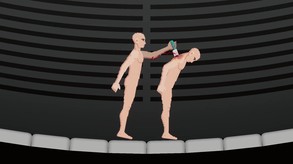
Regular Human Workshop, developed and published by Dead Joker, is a physics-driven sandbox that thrives on player creativity, experimentation, and a touch of dark humor. Rather than guiding players through structured objectives or narrative beats, the game hands over a set of interactive systems and lets curiosity take the lead. At first glance, it presents a simple 2D environment populated with humanoid ragdolls and an assortment of tools, weapons, machines, and environmental hazards. However, beneath that simplicity lies a surprisingly flexible simulation framework where cause and effect govern every interaction. The appeal of the game does not come from completing missions, but from discovering what is possible within its systems and pushing those boundaries further with each session.
The ragdoll physics form the backbone of the experience. The human figures in the game react dynamically to forces, impacts, and environmental changes. They stumble, collapse, and contort in believable ways when subjected to explosions, gunfire, crushing machinery, or even simple gravity shifts. This responsiveness gives weight to experimentation. Dropping a character from a height, constructing elaborate traps, or testing weapon prototypes produces outcomes that feel grounded in the game’s simulation rules. There is a tactile quality to how objects collide and interact, making even small-scale experiments satisfying. While the violence can be graphic, it is presented in a stylized sandbox context that emphasizes mechanical interaction over narrative consequence.
Beyond simple destruction, Regular Human Workshop shines when players begin building. The game includes a range of components that can be connected through input and output logic, enabling the creation of automated systems. Pistons, buttons, sensors, and power elements can be wired together to produce functioning machines. With patience and creativity, players can construct factories, contraptions, elaborate execution devices, or even complex mechanical puzzles. This automation layer elevates the experience from a straightforward physics toy to something closer to a 2D engineering playground. Watching a machine you designed operate successfully within the physics constraints of the game can be surprisingly rewarding, especially when everything works as intended without collapsing into chaos.
The inclusion of a slow-motion feature further enhances experimentation. Being able to reduce time allows players to observe intricate interactions in detail, whether that involves the structural integrity of a collapsing build or the chain reaction of an explosive device. This tool encourages learning through observation. It transforms chaotic scenes into analyzable sequences, revealing how force distribution, object mass, and timing influence the outcome. For players who enjoy tinkering and refining their creations, this feature adds a layer of precision and control that deepens the sandbox’s longevity.
One of the strongest aspects of Regular Human Workshop is its support for community content through the Steam Workshop. Players can share their custom creations, from detailed machinery to new character skins and weapon designs. This community-driven expansion significantly broadens the game’s scope. Even if a player exhausts their own ideas, browsing and testing others’ creations introduces fresh inspiration and challenges. The constant influx of user-generated content helps keep the experience from feeling stagnant and demonstrates the flexibility of the game’s core systems. It also reflects a healthy and engaged player base that values creativity and experimentation.
Visually, the game adopts a clean, functional style that prioritizes clarity over spectacle. The environments are minimalistic, which helps highlight the interactive elements without unnecessary distractions. Sound design complements the physics interactions with impactful effects that reinforce the weight of collisions and explosions. While it may not boast high-end graphical polish, its presentation effectively supports the sandbox nature of the gameplay. Performance is generally stable, allowing even larger contraptions to operate smoothly unless pushed to extreme complexity.
Regular Human Workshop ultimately caters to a specific type of player—those who enjoy open-ended experimentation, physics simulations, and constructing elaborate systems without the pressure of objectives. It does not offer a guided campaign or narrative-driven progression. Instead, it provides a toolkit and invites players to define their own goals. For creative minds who appreciate building, breaking, and analyzing how systems respond under stress, the game offers hours of engaging sandbox play. Its strength lies in its freedom and the satisfaction derived from manipulating a reactive world according to one’s imagination.
Rating: 8/10