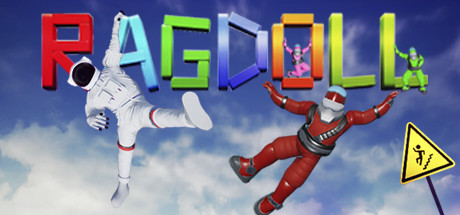
Ragdoll: Fall Simulator is a compact physics sandbox that embraces a very simple idea and makes that simplicity the center of the experience. Instead of providing a conventional campaign, storyline, or series of mandatory objectives, the game gives players a ragdoll character, a collection of environments, and the freedom to create ridiculous accidents. Developed and published by Andreev Worlds and Gamesforfarm, it is essentially a digital physics playground built for players who enjoy experimentation, slapstick destruction, and watching unpredictable collisions unfold.
The basic gameplay revolves around launching a character and observing how the ragdoll body reacts to everything it encounters. Limbs flop independently, momentum carries the character across surfaces, and obstacles can dramatically alter a seemingly predictable trajectory. There is little emphasis on precise character control once a situation is underway. Instead, much of the amusement comes from setting events in motion and seeing what the physics simulation produces. A straightforward fall can turn into a chain of impacts, awkward rotations, and unexpected interactions with surrounding objects.
One of the most distinctive aspects of the game is its refusal to impose meaningful restrictions on the player. There are no traditional missions demanding that levels be completed in a particular way. Players can select an environment and experiment according to their own curiosity. This creates an immediately accessible sandbox because there is virtually no pressure to learn complicated rules before having fun. It also means that enjoyment depends heavily on the player's willingness to invent personal challenges and experiment repeatedly. Anyone expecting an elaborate progression system may find the experience lacking direction, while players who enjoy creating their own entertainment are more likely to appreciate the freedom.
The collision simulation is naturally the most important part of the experience. Dynamic objects allow environments to participate in the chaos instead of merely serving as scenery, while the ragdoll system creates exaggerated physical reactions that fit the game's comedic personality. The physics are presented with enough seriousness to make momentum and collisions recognizable, but the results frequently become absurd enough to produce the slapstick comedy that defines the game. Randomized characters also provide some visual variation between experiments.
Optional detailed physics settings add more depth than the premise initially suggests. Players interested in tinkering with the simulation can adjust its behavior and see how different configurations affect their experiments. This is arguably where Ragdoll: Fall Simulator becomes more interesting as a sandbox. Rather than repeatedly performing exactly the same stunt, players can manipulate conditions and attempt increasingly strange scenarios. Even the menu is described as dynamic, reflecting the developer's attempt to make physical movement and playful unpredictability part of the game's overall personality rather than limiting those qualities to the levels themselves.
The selection of levels is equally important because environments effectively function as collections of opportunities for collisions. Different layouts provide new surfaces and obstacles to interact with, encouraging experimentation with launch angles, momentum, positioning, and movable objects. The freedom to choose levels without being locked into a rigid campaign also makes the game suitable for brief sessions. Players can enter, create a few spectacular crashes, experiment with the physics, and leave without worrying about losing narrative or strategic progress.
Visually, the game favors a straightforward stylized 3D presentation rather than attempting to compete through elaborate graphical detail. This works reasonably well because the focus remains on readable movement and physical interaction. The character needs to tumble convincingly, obstacles need to be clearly identifiable, and impacts need to look entertaining. The visual simplicity therefore complements the sandbox design, although players searching for richly detailed environments or sophisticated character animation outside the ragdoll behavior will find the presentation comparatively modest.
The biggest weakness is longevity. Ragdoll physics can generate many amusing situations, but the novelty naturally becomes less powerful after players have experimented extensively with the available environments and objects. Without a substantial campaign or deeper progression structure, there is less external motivation to continue once personal experimentation starts feeling repetitive. Steam Achievements provide some additional goals, but they do not fundamentally transform the free-form nature of the experience. The game works considerably better as something to revisit occasionally than as a simulation demanding dozens of hours of sustained progression.
Steam Deck compatibility is less straightforward. The Steam listing does not currently present Ragdoll: Fall Simulator as officially Steam Deck Verified or Playable, and the available platform information identifies it primarily as a Windows game. Steam's review filtering acknowledges Steam Deck play but currently shows no matching reviews under the primarily-played-on-Deck filter. Consequently, it should be treated as an unverified Steam Deck title rather than one with guaranteed handheld compatibility. Proton may potentially allow it to run, but prospective Deck players should expect that some manual experimentation or compatibility adjustments could be necessary instead of assuming a fully validated experience.
Ultimately, Ragdoll: Fall Simulator understands exactly what kind of game it wants to be. It is not trying to disguise a small physics playground as a large simulation. Its appeal comes from freedom, dynamic interactions, collision physics, random characters, adjustable simulation settings, and the inherent comedy of watching a ragdoll suffer spectacularly improbable accidents. Its limited structure and potential repetition prevent it from becoming a particularly deep experience, but those shortcomings matter less when it is approached as an experimental physics toy rather than a traditional objective-driven game. For players who enjoy uncomplicated sandboxes where causing chaos is the primary reward, it offers a pleasantly focused form of entertainment.
Rating: 7/10