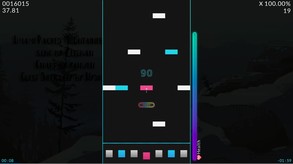
Developed and published by Swan, Quaver is a free-to-play rhythm game that has steadily established itself as one of the most impressive community-driven entries in the genre. Instead of relying on a fixed catalog of songs or a scripted single-player campaign, it delivers a platform where players can compete, create, and continually discover new content made by the community. The game's open-source foundation reflects its philosophy of constant improvement, allowing it to evolve through both developer support and player contributions. From the outset, Quaver emphasizes precision, accessibility, and long-term replayability, making it equally appealing to newcomers looking for an introduction to rhythm games and experienced players chasing difficult charts and leaderboard rankings.
At its core, Quaver offers two gameplay styles through its dedicated 4-key and 7-key modes. Both demand quick reflexes, accurate timing, and consistent execution, but each caters to different skill levels and player preferences. The controls are highly responsive, ensuring that every successful note feels rewarding while every missed input serves as valuable feedback for improvement. The gradual increase in chart complexity creates a satisfying learning curve, encouraging players to refine their technique over time. Separate leaderboards for each mode further strengthen the competitive aspect by allowing specialists to measure their progress against others without forcing everyone into a single ranking system. This balanced structure helps maintain a healthy competitive environment while motivating players to continually improve.
The feature that truly separates Quaver from many rhythm games is its enormous emphasis on user-generated content. Rather than limiting players to a predefined soundtrack, the game provides a comprehensive editor that allows anyone to create note charts for virtually any compatible song. Players can upload their creations, share them with the community, and even submit them for ranking consideration. This system ensures that the available library of playable content continues expanding long after release. Since fresh songs and custom maps are constantly being introduced, Quaver avoids the content drought that often affects traditional rhythm games. The editor itself is approachable enough for beginners while offering enough flexibility for experienced creators to produce highly polished and challenging charts.
Customization plays a major role in the overall experience. Quaver allows players to modify nearly every aspect of the gameplay interface through an extensive skinning system, making it easy to personalize both appearance and functionality. Whether someone prefers a minimalist layout for competitive play or a more visually distinctive design, the available customization options provide impressive flexibility. Skins can also be shared with other players through the Steam Workshop, strengthening the game's creative community. Alongside visual customization, replay functionality allows players to analyze their own performances or study top-ranked competitors to identify techniques that can improve their own gameplay. These features transform Quaver into more than a simple rhythm game, giving players valuable tools for continuous learning and refinement.
The online features contribute significantly to Quaver's longevity. Multiplayer lobbies support large groups of players competing simultaneously, creating energetic sessions where every note contributes to the final rankings. Global leaderboards, ranked maps, achievements, and community interaction provide strong incentives to keep returning. The game's open-source nature also gives players confidence that it will continue evolving through regular updates and community feedback. This collaborative development approach helps keep the experience fresh while ensuring that player suggestions remain an important part of the game's future direction.
Visually, Quaver favors clarity over spectacle. The interface is clean, organized, and designed to maximize readability during fast-paced gameplay, avoiding unnecessary visual distractions that could interfere with note recognition. While it may not feature cutting-edge graphical effects, this restrained presentation ultimately benefits gameplay by keeping the player's focus where it belongs. Another advantage is its modest hardware requirements, allowing the game to run smoothly on a wide range of systems across Windows, macOS, and Linux. This accessibility makes it easy for virtually anyone interested in rhythm games to jump in without needing powerful hardware.
Despite its many strengths, Quaver is not entirely without drawbacks. The heavy reliance on community-created maps means that the quality and difficulty of available charts can vary considerably, requiring players to spend some time finding maps that match their preferences and skill level. Beginners may also encounter a steeper learning curve than expected, especially when transitioning into more advanced charts or exploring the demanding 7-key mode. Fortunately, these challenges become part of the rewarding progression system, as consistent practice leads to noticeable improvements in both skill and confidence.
Quaver succeeds because it understands that a rhythm game thrives on replayability, creativity, and competition. Its polished mechanics, extensive customization, thriving community, robust creation tools, and endless supply of player-generated content combine to create an experience that remains engaging long after the first few sessions. Rather than depending on expensive downloadable music packs or scripted campaigns, it empowers its community to shape the game's future while providing an excellent technical foundation for competitive play. For anyone seeking a rhythm game with exceptional longevity, flexible customization, and a passionate player base, Quaver stands as one of the finest free-to-play options currently available on Steam.
Rating: 9/10