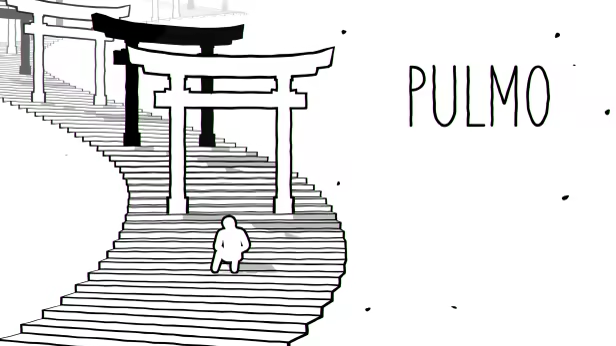
PULMO is a casual puzzle game where you control a lone character in a world full of faceless crowds.

Modeled estimate, not a reported figure. How we estimate →
About

PULMO is a casual puzzle game where you control a lone character in a world full of faceless crowds.

PULMO is the ideological continuation of ALVEOLE and the second part in a trilogy about the human journey. Our project explores human behavior in a society where everyone will find their own meanings. Your goal is to change the environment around you to influence people's behavior by solving spatial puzzles. The crowd in the game acts according to its own rules, sometimes helping, sometimes interfering, but always reacting to your actions.
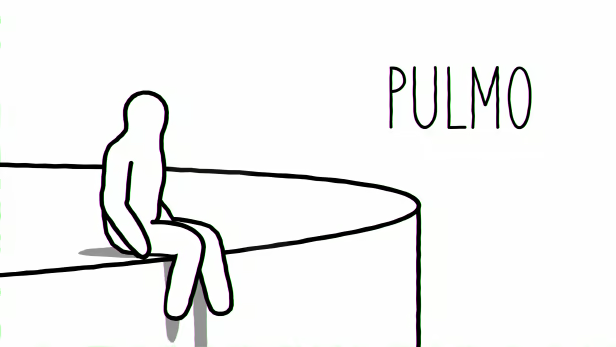
Take control of the fate of a lone wanderer, challenging the silent crowds in a series of mysterious trials. There is no rush here, no victory or defeat - just a quiet dialog between you and the game. Follow this short but meaningful journey, absorbing every moment like the last ray of sunset.
FEATURES:
Unique art style combining 3D graphics and minimalistic hand-drawn style.
High-quality music and audio accompaniment for full immersion in what is happening.
Unsimilar puzzles with different complexity.
Cutscenes and levels with deep narrative.
Each cutscene has been worked out to the last detail.
«No matter how large the crowd around you may be, you will be left alone in the last moment. No matter how rich you may be, you will be a beggar in the end. No matter how dazzling your luck may seem, its wings will turn to dust. No matter how much joy you sow on your way, the harvest will be bitter.»
Stats
All-time low is the lowest price we've recorded for this game since we started tracking it.
Languages: English, French, Italian, German, Spanish - Spain, Japanese, Korean, Polish, Portuguese - Brazil, Russian, Simplified Chinese, Thai +3 more
Engagement
Hours played at review time, across 40 reviews with recorded playtime.
Reviews
Themes across 40 recent reviews and how positive each mention is. A keyword signal, not full sentiment analysis.
positive critical· bar length = how often the theme comes up
Reviews
10 одиночеств из 10. Всем советую побыть наедине с собой. Хорошая музыкальное сопровождение
J'ai adoré. Le jeu est très étrange et les sensation sont bizarre, mais j'ai beaucoup aimé.
Мне понравилось 10/10
A minimalistic little game where you control a nameless, faceless, completely ordinary human silhouette as it moves through life’s challenges, human traits, and encounters with other people. The game takes you through 10 stages in order, each one representing a challenge you need to figure out using nothing more than the four keys that let you move around the screen. There are no words and the game never tells you what to do, but the solutions are usually easy to understand. Most of the time, your goal is simply to keep your character somewhere on the screen while different obstacles are thrown your way. Each situation reflects a human concept. In one stage about focus, you have to stay inside a moving spotlight. In another about ego, other people copy your movements and you need to trick them into falling over the edge. Completing a stage triggers a short animation that smoothly leads into the next one. The whole experience is quite brief though. It takes around 40 minutes to finish, or even less if you move quickly. After beating a stage, you can replay both the level and its animation from the main menu, and finishing the entire game only unlocks a simple music player. At that point, you could easily close the game since there isn’t much more content. However, if you want to collect all the achievements, you will need to replay the stages and approach them differently. For example, in the wind stage you have to keep the tumbleweed on the screen, while in the water stage you must never let your character sink below chest level. A few of these challenges can be a little annoying, but none of them take very long to complete.
This can hardly be called a game but it's half an hour of a special experience. I like this kind of stuff. That's why the mere view of the store page attracted me. (played on the deck)
"One of the puzzles made me PULMOYHAIROUT" PULMO is a really stylish little puzzle game with some cool visual ideas and a relaxing vibe. A few of the crowd-navigation puzzles were genuinely satisfying to figure out. Unfortunately, level 9 or 10 completely killed the momentum because it stopped feeling like problem solving and started feeling like wandering around hoping I would find the correct path, which I never did. There’s a solid concept here and if that one puzzle was more of a puzzle and less of a swamp of misdirection I probably would have finished the game. [url=https://www.youtube.com/live/bIiAvd6XKtk?t=1m28s]Gameplay[/url]
An unusual 20-minute experience that makes you think about your place in society. The puzzles themselves are intuitive and not too challenging. I would add the ability to select a level to replay, like they did with the memories. The built-in player was a particular pleasure after completing the game. I would ask the developers to add a few more graphics settings. A good experience for a good price.
nice and short, relaxing and inspiring
Это действительно сложно назвать полноценной игрой. Крайне небольшое интерактивное приключение с аллегориями. На любителя, зайдёт далеко не всем.
PULMO is a deeply atmospheric indie puzzle adventure that focuses less on traditional gameplay excitement and more on emotional reflection, symbolism, and quiet immersion. Developed by Emil Ismaylov and Denis Petrov and published by North Lab, the game creates a surreal experience built around loneliness, conformity, and the relationship between individuals and society. Rather than guiding players through a straightforward narrative filled with dialogue and exposition, PULMO communicates almost everything through visuals, environmental interaction, music, and abstract symbolism. The result is a slow, contemplative journey that often feels closer to interactive art than a conventional puzzle game. From the moment the game begins, PULMO establishes an unusual and emotionally distant atmosphere. Players control a solitary figure wandering through strange environments populated by silent crowds that move and react collectively. These crowds become central to both the gameplay and the thematic identity of the experience. Instead of directly commanding them, players manipulate the environment itself to influence how groups behave and move. This creates a puzzle structure built around observation and indirect control rather than traditional logic-solving. There is a constant feeling that the player is interacting with systems larger than themselves, which fits perfectly with the game’s recurring themes of individuality and isolation. Visually, the game is striking despite its minimalist design philosophy. The environments combine sparse 3D spaces with hand-drawn visual elements that create a dreamlike atmosphere filled with ambiguity and emotional tension. Characters lack distinct identities or facial expressions, reinforcing the sense of anonymity that runs throughout the entire experience. Every area feels symbolic rather than literal, as though players are moving through emotional states, fragmented memories, or abstract representations of social structures instead of physical locations. The restrained art direction works remarkably well because it constantly leaves room for interpretation. The soundtrack and sound design are equally important to the experience. PULMO relies heavily on quiet ambient music, environmental sounds, and carefully placed silence to maintain its emotional tone. The soundtrack rarely dominates scenes aggressively, instead blending gently into the background to create feelings of melancholy, uncertainty, and introspection. Some sequences become powerful precisely because of how little sound is present. The game encourages players to slow down and absorb its atmosphere rather than rushing toward objectives or dramatic moments. Gameplay revolves around environmental puzzles and crowd manipulation. Players interact with pathways, switches, barriers, platforms, and environmental systems that alter how crowds move throughout each area. The puzzles themselves are generally straightforward mechanically, but the challenge often comes from understanding how the game wants players to interpret the environment. There are no timers, combat systems, or heavy punishments for failure, allowing players to experiment freely without pressure. This relaxed structure helps maintain the meditative pacing the game is clearly aiming for. One of the most interesting aspects of PULMO is how its gameplay reinforces its thematic ideas. The crowds frequently behave unpredictably, sometimes helping progress and other times becoming obstacles or distractions. Solving puzzles often requires influencing large groups indirectly rather than controlling situations directly. This creates a subtle feeling of tension between individual agency and collective movement that mirrors the game’s larger philosophical themes. The mechanics may appear simple at first, but they work effectively because they support the emotional tone of the experience rather than distracting from it. Narratively, the game remains intentionally abstract from beginning to end. There is no clearly explained plot or definitive interpretation offered to players. Instead, meaning is communicated through symbolic imagery, environmental transitions, visual metaphors, and emotional atmosphere. Themes involving loneliness, mortality, identity, and social pressure appear repeatedly throughout the journey, but the game never forces a single interpretation. This ambiguity is one of PULMO’s greatest strengths for players who enjoy introspective storytelling and symbolic experiences. The game trusts players to draw their own emotional conclusions rather than delivering direct answers. However, that same abstract design will not appeal to everyone. Some players may struggle to connect with the intentionally vague storytelling or slower pacing. Certain puzzles can become confusing because the game rarely provides explicit guidance, occasionally making progression feel unclear rather than thoughtfully mysterious. Players expecting traditional puzzle logic or strong gameplay feedback may become frustrated during sections where the intended solution feels overly obscure. The pacing is another aspect that will divide audiences significantly. PULMO moves very slowly and deliberately, often prioritizing mood over mechanical engagement. There are long stretches where very little happens beyond walking, observing, and quietly manipulating the environment. For players willing to embrace that meditative rhythm, the game becomes immersive and emotionally powerful. Others may simply find it uneventful or lacking in meaningful interaction compared to more gameplay-focused puzzle adventures. The relatively short runtime also limits how deeply some of the game’s ideas are explored. While the concise structure prevents the minimalist gameplay from becoming repetitive, there are moments where the mechanics and symbolic themes feel like they could have been developed further. Certain concepts appear briefly before the game moves on too quickly, leaving players wanting more exploration of its systems and narrative ideas. Despite these flaws, PULMO succeeds because of how fully it commits to its artistic vision. The game never tries to become a conventional puzzle adventure or an action-driven experience. Instead, it focuses entirely on creating atmosphere, emotional ambiguity, and philosophical reflection through minimalistic design. Every aspect of the experience, from the visual presentation to the pacing and sound design, works together toward that goal. For players who appreciate experimental indie games, symbolic storytelling, and emotionally driven experiences, PULMO offers something genuinely memorable. It may not provide constant excitement or traditional gameplay satisfaction, but it delivers a thoughtful and immersive journey that lingers emotionally long after completion. The game’s quiet restraint becomes its greatest strength because it trusts atmosphere and interpretation to carry the experience instead of relying on spectacle. PULMO ultimately feels like an interactive meditation on loneliness, human connection, and the struggle between individuality and conformity. Its slow pacing and abstract structure will naturally limit its appeal, but for the right audience, the game offers a haunting and surprisingly moving experience that stands apart from more conventional puzzle adventures. Rating: 8/10
Related
Related
Trends
Concurrent players on Steam, sampled daily since tracking started.
Audience
Estimated from the language of this game's reviews — a proxy for where players are, not official Steam demographics.
Related
| Little Jack's Adventures | $2.1K | 94 | 64% | $0.99 |
| iaidoka_interlude | $2.1K | 93 | 71% | $0.99 |
| I Am Caligula | $2.1K | 62 | 65% | $0.99 |
| Real Drift | $2.1K | 100 | 46% | $0.69 |
| Honked: a clown noir | $2.1K | 50 | 98% | $2.99 |
| Pink Rage Otome | $2.1K | 70 | 59% | $0.99 |
Related
| Euro Truck Simulator 2 | $421.6M | 932.3K | 97% | $19.99 |
| Stardew Valley | $258.9M | 881.6K | 99% | $14.99 |
| Garry's Mod | $228.7M | 1.3M | 97% | $9.99 |
| Factorio | $140.6M | 232.3K | 98% | $35.00 |
| Human Fall Flat | $109.3M | 225.6K | 95% | $19.99 |
| American Truck Simulator | $103.7M | 194.2K | 97% | $19.99 |