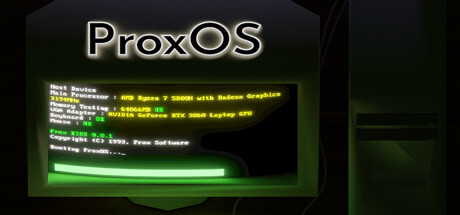
Step into a time portal to 1993. While your friends are battling it out in the latest FPS adventures, you got the opportunity to learn the newest trend, programming. Turn on your CRT monitor and learn to write code, compete with others in challenges or write minigames.
Revenue comes from in-game items and microtransactions, which our price-based model doesn't estimate. Copies below reflect the player base, not paid sales.
Media

About
Genres
Stats
Languages: English
Reviews
I find the 'game' very entertaining, and even though I've only played up to 'primes' in my two hours, there are some points of feedback I'd like to give. The files are all saved as .txt files, this seems quite unnecessary, and makes it a bit harder to manipulate from outside the game. There is no (call)stack, so you need to put in quite a bit of effort to make complex programs. In order to use functions, you need to save the program counter, increment the stack pointer, and jump into the function manually. And when you want to return from the function, you need to do all of it again in reverse order. In 'real' assembly there are 'push', 'pop', 'call', and 'ret' instructions. It would be a huge quality-of-life improvement if these instructions were added. Similarly, being able to index a register with constants would be a nice-to-have, too. For example .varName 3 movi RvarName 5 Would be very helpful for readability. Another feature that feels missing is printing ASCII to the console. There is a console, why not let me print to it? The last feature that I'd love to see, is a way to 'include' other files. Writing everything in one big file is a bit annoying, so being able to write a "/lib/thing" file, and then, for example, include it using "@/lib/thing" in another file, would make writing code for this a lot faster, and more workable. I also do not believe audio volume should be part of the 'advanced' settings, especially when the background 'music' is noise. Then, the way windows are resized is also not immediately obvious. It only seems to work in the bottom right corner of the window. Over-all, I find it a very fun environment to work with. I like the challenges that are included, especially Game of Life, I think it is something that really feels like a "Wow, I've actually made something worthwhile" moment.
Related
Related
Trends
Concurrent players on Steam, sampled daily since tracking started.
⠀
ProxOS is the kind of project that quietly sidesteps conventional expectations of what a “game” should be and instead presents itself as a self-contained computing environment disguised as one. Developed and published by slojanko, it places players inside a fictional operating system inspired by early personal computing, where the primary activity is not exploration, combat, or even puzzle-solving in the traditional sense, but programming. From the moment you begin, it becomes clear that this is less about playing in a world and more about understanding a system—one that invites curiosity, patience, and a willingness to engage with logic at a fundamental level. At its core, ProxOS revolves around writing code in a simplified, assembly-like language and executing it within a simulated machine. The experience is intentionally low-level, emphasizing how instructions are processed rather than abstracting them away. You interact with a basic editor, compile your code, and observe how it behaves within the constraints of the system. Success is not measured through flashy outcomes but through correctness and efficiency—getting a program to run as intended becomes its own reward. This design creates a uniquely satisfying loop for those who enjoy problem-solving, where each working solution feels earned rather than given. The game’s structure is largely open-ended, offering a sandbox that encourages experimentation rather than prescribing a fixed path. There are challenges and objectives available, often tied to optimizing code or solving specific problems, but they serve more as suggestions than strict requirements. Players are free to explore the system, create their own programs, and push the limits of what the environment allows. This freedom gives ProxOS a sense of depth that goes beyond its minimal presentation, but it also places the burden of engagement entirely on the player. Without intrinsic motivation to explore or learn, the experience can feel directionless. A defining aspect of ProxOS is its commitment to a retro aesthetic, both visually and functionally. The interface mimics the look and feel of early computing systems, complete with simple graphics, limited resolution, and a focus on text-based interaction. This is not merely a stylistic choice—it directly shapes how the game is played. The constraints of the system, including its limited processing power and minimal tools, force players to think carefully about how they structure their code. For those with an interest in computing history or low-level programming, this adds a layer of authenticity that is rarely seen in modern titles. However, this same authenticity creates a steep learning curve. ProxOS does very little to ease players into its systems, offering only basic guidance before expecting them to experiment and figure things out on their own. For those without prior experience in programming, especially at a low level, the initial barrier can be significant. Even for experienced users, the lack of clear direction or structured tutorials can make the early stages feel opaque. This is a game that assumes a certain level of curiosity and persistence, and it does not attempt to simplify itself for accessibility. The interface reflects this philosophy, prioritizing function over convenience. While everything you need is present, navigating the system can feel unintuitive at times, particularly when managing multiple tools or interpreting error messages. These friction points are not necessarily accidental—they contribute to the feeling of working within a real, somewhat imperfect system—but they can also interrupt the flow of experimentation, especially when you are trying to understand why something isn’t working. In terms of content, ProxOS offers depth through possibility rather than volume. There are no expansive worlds to explore or long narratives to follow. Instead, the content emerges from what you choose to do within the system. Whether you are solving predefined challenges, optimizing code for efficiency, or simply experimenting with ideas, the experience evolves based on your level of engagement. This makes it highly replayable for those who enjoy tinkering, but it also means that players looking for structured progression may find it lacking. What makes ProxOS particularly interesting is how it blurs the boundary between game and tool. It adopts the framework of a game—complete with challenges and a contained environment—but its primary function is educational and exploratory. It encourages a mindset that is closer to learning or experimentation than to traditional play. For the right audience, this can be deeply rewarding, offering a sense of accomplishment that comes from understanding rather than from completion. At the same time, this identity limits its appeal. ProxOS is not designed to entertain in a conventional sense, and it does not attempt to broaden its accessibility to reach a wider audience. It is focused, deliberate, and unapologetically niche, which is both its greatest strength and its most significant limitation. In the end, ProxOS stands as a unique and thoughtful experiment that challenges the boundaries of what a game can be. It offers a deeply engaging experience for those willing to invest the time and effort to understand its systems, but it demands a level of interest and patience that will not resonate with everyone. For players drawn to programming, logic, and the inner workings of computing, it provides something genuinely distinctive. Rating: 7/10
1993'e giden bir zaman portalına adım atın. Arkadaşlarınız en yeni FPS maceralarında mücadele ederken, siz de en yeni trend olan programlamayı öğrenme fırsatını yakaladınız. CRT monitörünüzü açın ve kod yazmayı, mücadelelerde başkalarıyla rekabet etmeyi veya mini oyunlar yazmayı öğrenin.
ProxOS is retro aesthetic zack-like coding problem puzzler. You are presented with an virtual computer with programming utilities to solve coding problems in assembly like language. The retro feel is masterfully done, reminding me of Comet 64 while the actual coding feels more like Zacktronics EXAPUNKS. ProxOS leans more into the simulation side and pseudo assembly is more detailed and thus more complex, e.g. the add command requires to specify data type-- addi for integer or addf for floating. The complexity is more taxing, requiring some effort to understand the assembly-like language before attempting to solve problems. I do not think that I would have understood this game without first playing EXAPUNKS because both games have terse documentation. The concise instructions does not work as well in ProsOS because the psuedo assembly language is more detailed. I am a beginner level programmer (I can make a a todo list app in JS) and I have to really think hard to understand the docs. Ultimately ProxOS is a well designed game and a clear labor of love. This is a programmer making a programming problem games for programmers. It's niche, complicated and exceptionally beautiful in execution. Hey, it's free ... low risk, give it a try.
Incredible. Absolutely Phenomenal.
Really cool game!
Cool game, I like programming in assembly, will probably make some more projects (idk maybe BF interpreter or some more games)
免费 没中文 没成就 普罗克斯系统 快来体验《普罗克斯系统》,感受 30 年前开发者的生活!这款模拟操作系统为你提供学习汇编编程所需的一切。与朋友比拼,用巧妙的方法解决难度不断提升的挑战。 特色: 可编写汇编代码,并在最新的 32KHz 处理器上运行 一流的代码编辑器,附带调试工具 自定义皮肤与挑战关卡 支持画面输出与键盘输入,可编写交互程序 由 “邻居” 亲手撰写的使用手册 无作弊的在线排行榜 支持超频…… 还有更多?我可没拿钱来透露隐藏功能
Momentum
Pace estimated from the game's recent review growth (our daily snapshots) at its own sales-per-review ratio — a momentum signal, not booked sales.
Related
| 2 3 4 Player Mini Games | $686.3M | 1.4M | 87% | Free |
| No Man's Sky | $636.2M | 412.8K | 85% | $59.99 |
| Pizza Ready! | $576.7M | 2.7M | 88% | Free |
| DayZ | $532.6M | 466.5K | 78% | $49.99 |
| Phone Case DIY | $493M | 913.8K | 87% | Free |
| Hearts of Iron IV | $478.6M | 373.3K | 90% | $49.99 |