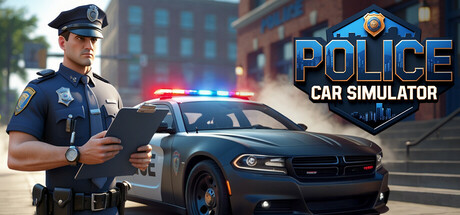
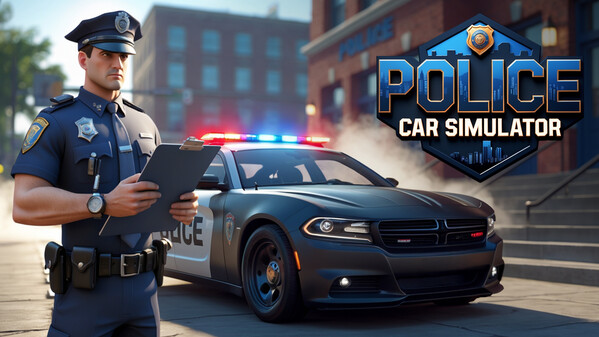
Police Car Simulator, developed by Yusuf Islam Seyhan and Samet Acar and published by Inspector Studios, is an indie driving simulator that attempts to recreate the experience of patrolling the city streets behind the wheel of a police cruiser. It’s a concept that holds immediate appeal: the thrill of pursuit, the authority of flashing lights, and the technical precision of driving under pressure. However, while the premise sounds promising, the execution ultimately struggles to deliver the depth or polish that such a simulation demands. What emerges is a game that captures the surface of its theme but falters when it comes to realism, structure, and technical refinement.
At its core, Police Car Simulator gives players control over a police vehicle and drops them into an open city filled with missions and activities. The game’s main loop revolves around driving from one objective to another—responding to incidents, patrolling neighborhoods, or chasing down suspects. There are several car handling modes to choose from, including arcade, drift, and simulator settings, designed to accommodate different driving preferences. In theory, this flexibility should make the gameplay engaging, but in practice, the differences between these modes are minimal, and the handling physics never quite feel convincing. Cars tend to float unnaturally over the road, collisions lack weight, and environmental feedback is minimal. The driving feels serviceable for casual play, but anyone looking for authentic physics or nuanced vehicle control will find it lacking.
The city itself provides the main playground for the player’s patrols, yet its design is more functional than immersive. Streets often feel empty or repetitive, and traffic AI operates on simple patterns that fail to simulate realistic urban behavior. Civilian vehicles react awkwardly to collisions or sirens, and environmental details are sparse. While the developers clearly aimed for a sense of freedom and exploration, the world feels static and lifeless, more like a backdrop than a living ecosystem. The inclusion of features such as refueling stations, garages for repairs, and weather conditions hints at a broader simulation ambition, but these systems are only lightly implemented. They exist more as visual indicators than as meaningful mechanics that impact gameplay.
Mission design follows a straightforward structure, with tasks ranging from traffic stops to responding to emergency calls. Unfortunately, the variety of objectives is limited, and repetition sets in quickly. Many missions follow nearly identical patterns: drive to a waypoint, trigger an event, and return to base. There is little sense of escalation or evolving challenge, which makes the experience feel more like a driving sandbox than a genuine simulation of police work. There’s no investigative layer, suspect interrogation, or procedural depth—elements that could have elevated the experience beyond mere driving. The absence of a progression system or meaningful rewards further compounds the sense of monotony. Players can switch between vehicles and environments, but these options offer aesthetic variation more than gameplay evolution.
Visually, Police Car Simulator sits firmly within the lower indie spectrum. The graphics are functional but unremarkable, with flat textures, simple lighting, and limited environmental detail. The cars themselves are decently modeled and feature the expected details such as flashing sirens and reflective decals, but the overall presentation lacks cohesion. The city’s scale is ambitious, but its design feels more like a prototype environment than a polished urban setting. The performance is acceptable on most hardware, given its modest system requirements, though occasional frame drops and pop-in textures can occur. Sound design fares slightly better: the wail of sirens and the hum of engines are suitably loud and atmospheric, even if they loop repetitively. Unfortunately, the lack of ambient sound and voice feedback leaves the world feeling sterile.
Technical issues and control frustrations are also recurring complaints. Some players report erratic vehicle behavior, where cars reverse unexpectedly or controls become unresponsive during certain maneuvers. Hit detection is inconsistent, and mission triggers occasionally fail to activate, forcing restarts. These problems, while not game-breaking, detract from the immersion and make the game feel unfinished. The user interface is minimal but serviceable, with clear mission indicators and simple navigation tools. Yet, the lack of customization options—particularly for controls and camera perspectives—limits player comfort, especially for those using steering wheels or advanced setups expecting a full simulation experience.
Where Police Car Simulator succeeds is in its accessibility and casual appeal. It’s easy to pick up, requires minimal hardware, and provides short bursts of driving entertainment for those who simply want to cruise around with flashing lights and sirens. Its low system requirements and simple structure make it approachable for younger players or those new to driving simulators. There’s also a certain charm to its earnest ambition—it’s clear that the developers aimed to deliver a playable, affordable version of the police driving fantasy. Unfortunately, the execution doesn’t fully support that ambition, leaving the experience feeling more like a prototype than a complete product.
In the end, Police Car Simulator is a game that offers flashes of potential but struggles to reach the realism or depth its title implies. It’s not without entertainment value for those seeking a light, casual police-themed driving game, but its unrefined physics, repetitive missions, and lack of polish make it difficult to recommend for anyone craving true simulation. The developers show glimmers of vision in the inclusion of weather systems, physics modes, and urban patrol mechanics, but these ideas need stronger technical and design foundations to shine. As it stands, Police Car Simulator is a modest experiment that delivers surface-level satisfaction but falls short of being a convincing representation of life behind the wheel of a patrol car.
Rating: 4/10