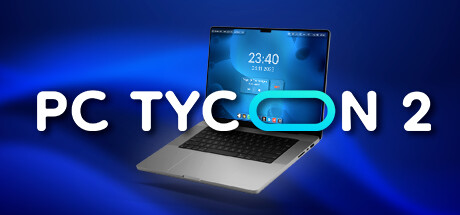
Start with one tiny office and a big idea, and grow it into a global computer company. Design your own CPUs, GPUs and laptops, launch your own OS, and outsmart your rivals. A laid-back tycoon that's easy to get into and hard to put down — made by one indie dev.
Modeled estimate, not a reported figure. How we estimate →
Media

About
Genres
Stats
All-time low is the lowest price we've recorded for this game since we started tracking it.
Languages: English, French, Italian, German, Spanish - Spain, Polish, Portuguese - Portugal, Russian, Turkish, Ukrainian, Hindi, Arabic +3 more
Engagement
Hours played at review time, across 41 reviews with recorded playtime.
Reviews
Themes across 41 recent reviews and how positive each mention is. A keyword signal, not full sentiment analysis.
positive critical· bar length = how often the theme comes up
Reviews
не зашло
PC Tycoon 2, developed and published by Insignis Games, is a business management simulator that places players in control of building a technology company from a small startup into an industry giant. Focused heavily on computer hardware production, market competition, research development, and long-term planning, the game expands on traditional tycoon formulas by giving players direct influence over both technological innovation and corporate growth. Rather than simplifying the experience into basic financial decisions, it creates a management system where product development and business strategy work together to drive progression. The central appeal comes from the fantasy of creating a computer technology empire from the ground up. Players begin with limited resources and gradually grow their company by designing hardware products and expanding operations over time. Processors, graphics cards, memory modules, storage devices, and other components form the foundation of the experience, allowing players to shape products according to personal priorities rather than simply purchasing upgrades through menus. One of the stronger features involves the amount of customization available throughout progression. Hardware creation goes beyond simple statistics by allowing players to influence development decisions directly. Building components feels rewarding because products become part of a larger ecosystem shaped by player strategy. Growth feels personal rather than automated because success depends heavily on planning and decision-making. The simulation extends beyond individual computer parts by introducing complete product development systems. Players can build laptops, monitors, and full computer systems while also developing operating systems that interact with the broader company structure. This wider scope helps strengthen immersion because the experience evolves beyond managing isolated products and instead focuses on building a complete technology brand. Research becomes one of the game's most important long-term systems. Technological advancement drives progression forward, requiring players to carefully consider how resources are allocated. Development choices influence future opportunities, creating situations where prioritizing one direction may slow advancement elsewhere. The result creates meaningful decision-making that rewards strategic thinking rather than simple expansion. The depth of progression systems helps maintain engagement over longer sessions. Technology upgrades unlock gradually while business expansion introduces new possibilities for growth. Watching a small operation slowly develop into a major technology corporation creates a satisfying sense of accomplishment that strengthens player investment. Financial management plays an equally important role throughout progression. Expanding operations requires balancing budgets carefully while investing in research, production, staffing, and infrastructure improvements. Poor planning creates setbacks, while efficient management opens opportunities for stronger market performance. The game consistently reinforces the importance of balancing ambition with sustainability. Competitor systems add another layer of challenge by preventing the experience from becoming predictable. Rival companies continue developing products and competing for market position rather than existing as passive obstacles. This creates pressure that encourages adaptation and long-term planning. Strategies that work initially may require adjustments as competitors evolve alongside the player. Business growth becomes visually rewarding as offices expand and facilities improve over time. Progress feels tangible rather than existing purely through spreadsheets and numerical increases. Watching company infrastructure grow alongside product development strengthens immersion and reinforces the larger goal of building a successful corporate empire. Another notable strength comes from the ability to assemble complete computer systems using internally developed hardware. This feature creates stronger connections between research decisions and final products. Building complete systems helps reinforce the fantasy of managing a technology company because innovations no longer exist purely inside statistics menus but instead contribute toward tangible outcomes. The interface focuses heavily on functionality and accessibility. Large management simulations can often overwhelm players through excessive complexity, but PC Tycoon 2 generally succeeds at presenting information clearly. Systems remain detailed without becoming unnecessarily confusing, allowing players to focus more on strategy rather than fighting menu structures. The learning curve naturally becomes one of the game's larger challenges. New players unfamiliar with management simulators may initially find the amount of available systems intimidating. Product development, financial planning, staffing decisions, and research management all require attention simultaneously. However, players willing to invest time learning those mechanics will likely discover that complexity becomes one of the game's strongest qualities. Replay value remains strong because different approaches produce different outcomes. Some players may prioritize aggressive technological innovation while others pursue expansion through financial dominance or acquisitions. The freedom to shape company identity encourages experimentation across multiple playthroughs. PC Tycoon 2 succeeds largely because it understands exactly who it is built for. Insignis Games creates a simulation designed specifically for players who enjoy long-term planning, technology management, and business growth systems. It avoids sacrificing depth in favor of simplicity and instead rewards patience and strategic thinking. Players interested in technology-focused simulations, business strategy games, and management experiences built around meaningful progression systems will likely find substantial value here. The combination of hardware development, company building, and market competition creates a satisfying gameplay loop that grows stronger over time. A rewarding technology management simulator that successfully combines business strategy, product development, and long-term planning into an engaging experience that consistently rewards thoughtful decision-making and creative company building. Rating: 8/10
War ganz witzig freu mich schon auf weitere Spiele
Für den zeitvertreib ist das ein voll cooles game. kann ich nur empfehlen. (gibt es auch fürs handy, kostenlos.)
nice i like it. its easy to do by using ram just to say
Es un buen juego
PC Inputs wont work.
играл много в мобильную версию думал тут что-то лучше но нет. в целом норм, и предложение хочется чтобы можно было устроить гонку технологии с друзьями добавьте что-то в этом духе
Como la mayoría de estos juegos, tiene un bucle jugable súper adictivo. Por desgracia, la ejecución tiene demasiadas aristas. Le doy un voto positivo porque me costó 60 céntimos en un bundle y le he echado unas 15 horas, pero es una experiencia muy poco pulida. Es una pena, porque con algo más de trabajo se podría haber conseguido algo muy chulo. No recomiendo tratar de "completar" el juego comprando todas las compañías porque llega un punto en el que la progresión se vuelve soporíferamente lenta. En ese momento, el interés se pierde y solo es una cuestión de cuántas horas quieres pasar delante de la pantalla esperando a que suban los números.
Eigentlich cooles Spiel, aber wenn man einmal nicht genug Geld hat bekommt, man kein Save irgendwie. Hab jetzt Stunden gewasted und das zum 2ten Mal. Schade
Related
Related
Trends
Modeled estimate over time, reconstructed from Steam's monthly review histogram.
Momentum
Pace estimated from the game's recent review growth (our daily snapshots) at its own sales-per-review ratio — a momentum signal, not booked sales.
Audience
Estimated from the language of this game's reviews — a proxy for where players are, not official Steam demographics.
Related
| Writer's Rush | $88K | 425 | 76% | $5.99 |
| Kohan II: Kings of War | $88K | 286 | 94% | $9.99 |
| Sorry! I surrounded beauty! | $88K | 411 | 86% | $5.99 |
| Suicide Guy Deluxe Plus | $88K | 502 | 80% | $8.99 |
| Roulette Hero | $88K | 317 | 94% | $9.99 |
| GW: Legacy | $88K | 128 | 62% | $15.99 |
Related
| 7 Days to Die | $425.3M | 403.6K | 87% | $44.99 |
| Mount & Blade II: Bannerlord | $309.8M | 294K | 88% | $49.99 |
| RimWorld | $176.7M | 243.3K | 98% | $34.99 |
| Squad | $166.4M | 240.5K | 81% | $39.99 |
| Don't Starve Together | $164.7M | 539.6K | 95% | $14.99 |
| Satisfactory | $164.4M | 275.9K | 97% | $27.99 |