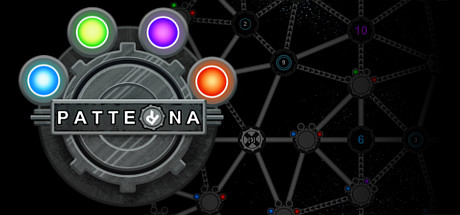
Patterna is a logic puzzle game for people who think that HexCells is far too easy. It features a highly customizable random level generator, a level editor, more than 70 levels, and an enchanting minimalist soundtrack by Alex Cottrell.
Modeled estimate, not a reported figure. How we estimate →
Media

About
Genres
Stats
All-time low is the lowest price we've recorded for this game since we started tracking it.
Languages: English, German, Russian, Simplified Chinese, Traditional Chinese
Engagement
Hours played at review time, across 40 reviews with recorded playtime.
Reviews
Themes across 40 recent reviews and how positive each mention is. A keyword signal, not full sentiment analysis.
positive critical· bar length = how often the theme comes up
Reviews
This is indeed very much inspired by Hexcells. There are more mechanics, but it follows the same rule that every level has a solution that can be figured out without guessing. If you liked Hexcells, get this, you'll like this one too. Visuals are very utilitarian, I think revamping those would go a long way in making this game a lot more successful. It currently doesn't look like a game that's worth $10, but I think it is. The tutorial is not that great. I would have preferred a tutorial that was more "baked" into the game, there's too much text for my liking. Stay the course, just give it 10 minutes to go through a few levels and it'll get you hooked. Music is ok, a bit repetitive. Overall, a great puzzle game with some execution flaws on the outside.
SHORT VERSION: This is a very well crafted numerical puzzler. While it has a bit of an initial difficulty hump to get over due to somewhat complicated rules, it will reward you with a good ten or so hours' worth of premade levels and a puzzle randomizer that does a good job of extending its longevity. Recommended with great confidence for other fans of more number-based puzzle games. LONG VERSION This is the rare occasion where my scanning of the Steam new releases every day pays off. Patterna as far as I can tell has received little press or reviews, but it happened to mention that it was inspired by Hexcells in its store description. That was enough to get me to try the demo, which was enough for me to pick up the game. It isn’t really a ton like Hexcells, although it does share some of the same DNA. It’s also rather tricky to explain. This was updated later but initially the tutorial was fifty or so stages long and it is undeniable that there is a bit of an initial hump to get over. I couldn’t even follow the couple videos showing off the game before playing through said tutorial. The basic goal is to mark every node in a puzzle as either pattern or non-pattern. In the vast majority of puzzles these nodes are all interconnected via a web of connecting lines in a variety of patterns. There are a few sources of info upon which to determine the orientation of the nodes. In the bottom left corner there are a pair of numbers, the larger number indicating how many nodes have yet to be marked and the smaller (or when near finished even) number indicating how many of those nodes are pattern ones. Above those may be one of four colors (which can be customized for those who are colorblind or just like to mess with the colors). These will have two numbers associated with each of them that function the same way as the aforementioned ones, just relating to those nodes with a marker of that color on them. It is worth noting that some puzzles may have no colors, some just a few, and others where the number will change as you progress. The other main source of info is on the nodes themselves. Pattern nodes may have a number on them that indicates how many pattern nodes are connected in sequence without a non-pattern break. Worth noting here is that some connecting lines only transmit info one direction, so while a pattern node can continue to “count” while going along an arrow way it will not register a connection if trying to go against it. Meanwhile non-pattern nodes can contain a wider array of info. A number on a non-pattern node indicates that said number of nearby nodes are pattern ones. A single circle around the number indicates that said number only relates to those nodes within one connection of that particular node. If it instead has two or three circles around the number, then the range expands to every node within two or three connections of it. Said numbers may also be within brackets or a pair of dashes. If in a bracket then all the of pattern nodes indicated within that range must all be connected, while if within dashes then there must be at least one break between them. On top of this as you unveil more nodes as either pattern or non some of them will likely give you additional bits of info. This can be any of the bits of info mentioned in the previous paragraph, but occasionally one of the non-pattern ones will unveil a colored number. When you get one of these a number of the unmarked nodes will suddenly get a marking of that color and said color will also appear on the bottom left. Fortunately the game does give you a few tools to help make dealing with all of this easier. By clicking on one of these numbered nodes every node they can possibly affect becomes highlighted in one of four colors, as up to four nodes can be activated as such at a given time. This is a handy way to see which nodes’ info overlaps as often that is the key to solving part of the puzzle. I must note to be careful with the pattern node highlighting as it shows not only all the ones the pattern can extend to but also the ones one node removed as if you know it will be three nodes long you also know the fourth node must be non-pattern. Just because you see the number 3 for example on a pattern node doesn’t mean that there are going to be three nodes in the highlighted range that will be marked as pattern; it could be less if marking one node connects you to another pattern group, it could be more as certain perimeter ones can end up being pattern ones while not actually connecting to the numbered group. An update also gave one the ability to preliminarily mark a node as pattern or not so you can see how it’d affect things without having to commit to it first. This is profoundly useful at times. Now, that’s a lot of typing up just to get the rather complicated basics established. It can also mostly be skipped (shoulda mentioned that beforehand…). What is ultimately important is how strong the puzzles designed around those basics are, and I must say that the ones in Patterna are on average very well realized. They are broken into groups based around a given concept or arrangement that have their own difficulty curve, which range from “not too hard” to “oh god my brain!”. If I had to level a complaint against them it is that some of them felt like they had to be brute forced after a certain point, although it is certainly possible that if I was a bit more clever that would have been less common. Even with that this is a very strong set of puzzles that should challenge a player for likely a good ten or so hours. What nudges it to a higher level is that it has a random puzzle generator that regularly produces puzzles that may lack a layer of refinement seen in the better premade ones but that are nonetheless on average pretty good in their own right. I’m generally not a big fan of randomized design, and even in Hexcells Infinite the random ones left me feeling a bit cold, but they work well here and you are given a decent amount of options to tweak before generation. There is also a Steam workshop integration that is collecting dust as… well the game has gotten like zero press. And that ends up being a shame as this is pretty strong numerical puzzler all things considered. My Steam playtime puts me at about 30 hours after a few weeks, and while that is inflated due to me minimizing and doing something else on the computer from time to time it really sunk its hooks into me. If you like these type of puzzlers then I would strongly recommend at least giving the demo a shot as I’d hate to see such a good game never get a legit chance to find its audience. Also still worthy of a write-in award nomination.
[h1]A Logic Puzzle Game[/h1] https://youtu.be/sgvDUkMo0iA + This is a great logic game for those really looking for a challenge, and want something more complex than similar games like HexCells + Nice relaxing soundtrack - Overly complex and confusing to learn. The tutorial throws in far too many mechanics all at once. I personally had to play through the tutorial a few times to really understand what was going on. - The tutorial is far too long. I believe the tutorial itself is 52 levels long, and will take over 30mins to get through. - Some nodes can not be activated until another condition is met. I found this to be very odd and isn't explained very well.
Just wayyyy too convoluted and complex to be any fun. Even if the mechanics are similar it's nothing like Hexcells or (most of) Tametsi. You go through the tutorials (which are like half the levels in the game) mostly fine, then the actual levels begin and you immediately hit the wall. Every. Single. Level. You open it and basically stare at it for hours because there's bloody nothing you can do to progress at all. I feel like I must figure out and solve the whole level at once simultaneously every time. This includes making assumptions based on assumptions based on other assumptions to see if there's a pattern. There's no drawing mode like what Tametsi has though. I've been "solving" levels by drawing over screenshots in MS Paint for a long while and it's simply not fun at all. Even when I do manage to understand and crack a level it doesn't feel rewarding at all. Because you click the next level and instantly run into another wall yet again. Since nodes are not made of grids but rather graphs it is often incredibly hard to really understand what connects to what in the puzzle overall. I just find it next to impossible to truly perceive. And when one-way connections are involved it's basically kiss your gaming goodbye. Like, I code for a living, I know graphs, I've beaten Hexcells trilogy + Globesweeper + majority of Tametsi, yet here I spend most of the time just looking at an MS Paint screenshot slowly getting more and more sad and irritated. I don't see why I should endure it anymore or recommend anyone else to go through it either. You probably came here because you want more of Hexcells or Tametsi. But it's not gonna be that. It's so, so much worse in terms of difficulty and fun. If you only played Hexcells you are not even remotely ready for this, and only if you totally breezed through Tametsi you might stand a chance. It seems that many people who left positive reviews didn't even remotely progress deep into the game either - except for a niche couple people who are clearly the target audience. But you aren't. :)
別に絵が完成するわけではないが、お絵かきロジックみたいに一定のヒントを元に各マスが白か黒かを推理して開けていく理詰めパズル。 ただヒントの出し方の種類がやたら多くて、マインスイーパならヒントは「隣接する8マスの中に爆弾がn個」だが、パイプで接続されているマスの中に白がn個やら、色ランプが灯っているマスの中に白がn個やら、隣接とそのひとつ隣までの中に白がn個やら、挙句接続が一方通行でA→Bは隣接している扱いだがB→Aは断絶しているものと見做したり、ヒントが扱う範囲が変動しまくってすげぇややこしい。 幸いヒントの数字をクリックすると当該部分を色分けしてくれる上に、正解の白マスを開ける度にヒントの数字も自動で減っていって数え間違える心配はないので操作自体は快適。 間違ったとこを開けると即座にミス判定が出るのでクリア実績が欲しいだけならデタラメにクリックしまくって正答が判ってからリトライすれば誰でもノーミスクリア可能なわけだが、どこで考え方を間違ったのか、どういう論理でどこを開示してヒントを増やすべきだったのかを一問一問じっくり悩むと暇つぶしとしてはすごい優秀。Hexcellsシリーズが好きならこれもイケるはず。 こういう片手で操作が足りるゲームは歯磨きしながらやるのに向いてるけど、これ長考はじめると手も止まってて口の中涎だらけになる。
This puzzle game is not for everyone (you should have probably more than 16 years and strong logic in mind) but it's an amazing one! I played a lot of puzzle game but this one is unique, very clever and differents mechanics. I didn't met any bugs. Really worth the price. I saw a negative review: "Overly complex and confusing to learn. The tutorial throws in far too many mechanics all at once. I personally had to play through the tutorial a few times to really understand what was going on" -> From my point of view, yes it's complex (sometimes very) but the interest is here and you have to always figure out without guessing (NO random click here). The tutorial explain step after step the differents mechanics from easy to complex configuration "The tutorial is far too long. I believe the tutorial itself is 52 levels long, and will take over 30mins to get through" -> "Introduction" is 29 chapters long but after you have new mechanics and it's mandatory to explain them. For me the "tutorial" is merged with the game itself and you have explanation for each new elements. Not really negative. "Some nodes can not be activated until another condition is met. I found this to be very odd and isn't explained very well" -> You probably missed the most clever part of this puzzle game. As I already said previously "you have to figure out without guessing". You can activate them because you can't logically validate your hypothesis (that's why you have ???? when you click on some nodes and later you can activates because you discovered more information to AFFIRM you can do it 100% recommended for me if you like good & hard challenges - sorry for english errors, it's not my mother language - Short version in french: Puzzle game très intelligent mais difficile (pas de place au hasard ici) uniquement réflexion et déduction. Si vous aimez ce genre de jeu, foncez! il vaut largement son petit prix! Pas de bug rencontré en 5H de jeu
Stupidly complicated. Maybe I'm just too dumb for this but I played Hexcells and Tametsi well and really tried with this one. I feel I understand the rules completely based on the tutorials but then you get hit with a level and suddenly the rules don't seem to work anymore. The rules are basically so complex that they can't even keep up with them enough to make them clear. F*** this game.
Very difficult, but fulfilling game if you are into that kind of thing. Like a far more difficult version of Hexcells.
Did you like Hexcells but felt that there weren't enough ways it could bend your brain? Do you want to try Minesweeper's evil step-uncle? Does staring at an array of circles trying to figure out what bit of information you're missing sound like a great way to spend some time? If you answered yes to all of these, Patterna is your game. This is now my go-to game for a short bit of mental exercise. I can pop up a random puzzle and spend 2 to 5 minutes working through it, or failing at it. Hardcore mode adds that little frisson of worry where one wrong click will cause you to lose the level and get an entirely new one in its place.
Great puzzle game, carries on where Minesweeper left off. Every puzzle is soluble without guessing, and you can choose your level of difficulty.
Related
Related
Trends
Concurrent players on Steam, sampled daily since tracking started.
Audience
Estimated from the language of this game's reviews — a proxy for where players are, not official Steam demographics.
Related
| Beetle Uprising | $6.2K | 99 | 75% | $2.49 |
| True Game | $6.2K | 52 | 88% | $7.99 |
| Blood Night | $6.2K | 109 | 96% | $1.99 |
| Abnormal1999:Sector 49 | $6.2K | 134 | 96% | $2.99 |
| 猎人物语 | $6.2K | 103 | 64% | $2.99 |
| Wave Mechanics | $6.2K | 50 | 86% | $4.99 |
Related
| 7 Days to Die | $425.3M | 403.7K | 87% | $44.99 |
| Euro Truck Simulator 2 | $421.6M | 932.6K | 97% | $19.99 |
| Mount & Blade II: Bannerlord | $309.8M | 294K | 88% | $49.99 |
| Palworld | $279.6M | 448.8K | 94% | $20.99 |
| The Forest | $254.8M | 678.6K | 96% | $19.99 |
| Stardew Valley | $243.6M | 1M | 98% | $14.99 |