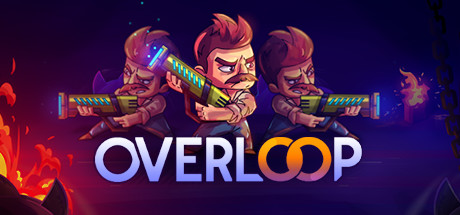
A puzzle-platformer set in a dystopian world where the invention of a cloning device has messed things up, big time. Armed with a clone gun and a mighty fine mustache, the chore of saving THE WHOLE OF CIVILIZATION rests on your shoulders. Don’t blow it.
Modeled estimate, not a reported figure. How we estimate →
Media

About
Genres
Stats
All-time low is the lowest price we've recorded for this game since we started tracking it.
Languages: English, Simplified Chinese, French, Russian, Ukrainian
Engagement
Hours played at review time, across 41 reviews with recorded playtime.
Reviews
Themes across 41 recent reviews and how positive each mention is. A keyword signal, not full sentiment analysis.
positive critical· bar length = how often the theme comes up
Reviews
[i]Overloop[/i]’s short story is riddled with intriguing, yet simplistic puzzles that evolve at a steady pace. Puzzles are spaced out and provide breathing room to soak in the beautiful pixel scenery, complemented by the soothing soundtrack.
C'est un bon petit jeu indépendant, j'ai pris énormément de plaisir pendant sa courte période.
美术9 音乐8 玩法8.5 剧情8.5 创新9 非常简短的解谜佳作,克隆人送死开路的玩法比较新颖,关卡设计很不错,故事结局也很有意思,就是体量太小了
Puzzle platformer featuring a focused design. Has a surprisingly great story with some elements which might kick you in the feels. That said, aside from a single collection sidequest for the 'true' ending, about the only other thing to do is to try to 100% a new run slot with the absolute minimum of sacrificed clones (each slot tracks that across all attempts and replays in that slot). The latter self-challenge probably won't appeal to most, so at 2 to 3 hours with minimal to no replayability that makes it a bit too short for $12 full price. On sale at ~$5 or less, it feels more reasonable for it to be a one-and-done game, that price point being balanced a bit more towards feeling like it is not overstaying its welcome with repeating mechanics instead of being too short for ~$5.
AWESOME SHORT PUZZLE GAME
Short but fun story
Nie za trudna, taka szybka na kilka godzin... Bardzo fajna gra z przesłaniem. Końcówka daje do myślenia zwłaszcza dzisiaj. Polecam
Overloop is a tightly designed 2D puzzle-platformer that takes a deceptively simple mechanic—self-cloning—and builds an entire dystopian adventure around it. Developed by Charge Games and published on Steam by Digerati and Doyoyo Games, the title places players in the boots of an eccentric inventor whose own cloning technology has spiraled out of control. What begins as a clever industrial breakthrough becomes a societal catastrophe, and the game leans into that absurdity with a satirical tone that consistently balances dark sci-fi themes with playful humor. From its opening moments, Overloop establishes itself as both a thoughtful puzzle experience and a lighthearted commentary on corporate ambition gone wrong. At the heart of the gameplay is the Quantic Matter Replication Device, a cloning gun that allows the protagonist to create up to several duplicates of himself at any time. These clones are not AI companions in the traditional sense; they are expendable tools. The player must carefully position, sacrifice, and coordinate them to navigate environmental hazards, activate switches, weigh down platforms, and bypass traps. What makes this mechanic compelling is how the game gradually introduces new environmental variables that require increasingly creative applications of cloning. Early levels gently teach the fundamentals—such as stacking clones to reach higher platforms—while later stages combine timing, hazard avoidance, and spatial reasoning into more layered challenges. The puzzles rarely feel unfair, but they consistently demand attentiveness and experimentation, rewarding players who think a few steps ahead. The level design is compact yet deliberate. Each stage functions almost like a self-contained brainteaser, with a clear objective and a set of environmental constraints that encourage efficiency. Death is frequent, but it is also frictionless; instant respawns maintain a smooth pacing loop that encourages trial and error without frustration. This design philosophy ensures that Overloop remains accessible even when solutions require multiple failed attempts. Because clones can be created and destroyed at will, there is an underlying sense of controlled chaos that never overwhelms the player. The mechanics remain intuitive, and the game avoids overcomplicating its systems, which is one of its strongest design decisions. Visually, Overloop embraces pixel art that feels modern yet nostalgic. The environments range from industrial laboratories to surreal dystopian landscapes, each rendered with clear silhouettes and readable hazard design. Character animations are expressive in a minimalist way, especially the slightly comical movement of the protagonist and his identical copies. The art direction reinforces the game’s tone: grim subject matter—mass cloning, corporate irresponsibility, societal collapse—is presented with vibrant colors and exaggerated details that prevent the atmosphere from becoming overly bleak. The soundtrack complements this aesthetic with energetic and slightly quirky compositions that keep the pacing lively without distracting from puzzle solving. Narratively, the game unfolds through brief dialogues and environmental storytelling rather than lengthy exposition. The plot centers on the unintended consequences of cloning technology, but it treats its themes with a tongue-in-cheek sensibility. There are subtle jabs at corporate culture and blind technological optimism, yet the writing avoids heavy-handed moralizing. Instead, it uses absurd situations and eccentric characters to frame its commentary. The result is a story that adds flavor and context without slowing down gameplay. Players are motivated to progress not just to solve the next puzzle, but to see how the bizarre world continues to unravel. In terms of scope, Overloop is relatively concise. It does not aim to be an expansive metroidvania or a sprawling narrative epic. Instead, it delivers a focused experience that can be completed in a handful of hours. For some players, this brevity may feel limiting, especially those who prefer longer campaigns or escalating endgame challenges. However, the game’s compact structure also means that its ideas remain fresh from start to finish. There is little filler, and each mechanic introduced serves a clear purpose. Optional achievements and completionist goals provide some replay value, encouraging players to refine their strategies or revisit earlier levels with improved efficiency. Technically, the game runs smoothly and maintains consistent performance, which is critical for a precision-based platformer. Controls feel responsive, and the simplicity of the input scheme allows players to focus on puzzle logic rather than mechanical complexity. The user interface is minimal and unobtrusive, reinforcing the clean, streamlined presentation. Overloop avoids unnecessary systems such as skill trees or complex inventories, which keeps the experience cohesive and centered on its core mechanic. Ultimately, Overloop succeeds because it commits fully to its cloning concept and builds every element of the game around it. The puzzles are inventive without becoming overwhelming, the narrative is clever without overstaying its welcome, and the presentation strikes a balance between charm and dystopian satire. While it may not redefine the puzzle-platformer genre, it offers a polished and thoughtfully constructed experience that stands out through its focused design and distinctive premise. For players who appreciate compact indie titles that emphasize clever mechanics and efficient storytelling, Overloop delivers a satisfying and memorable journey through a world caught in an endless loop of its own making. Rating: 9/10
Классная игра с прикольной механикой клонирования
机械复制时代——劳动力、物资、权力与自然
Related
Related
Trends
Modeled estimate over time, reconstructed from Steam's monthly review histogram.
Momentum
Pace estimated from the game's recent review growth (our daily snapshots) at its own sales-per-review ratio — a momentum signal, not booked sales.
Audience
Estimated from the language of this game's reviews — a proxy for where players are, not official Steam demographics.
Related
| Miami Paradise | $62.4K | 176 | 71% | $13.99 |
| Neyyah | $62.4K | 233 | 85% | $14.99 |
| Samawa Idle | $62.4K | 612 | 66% | $4.99 |
| Metroplex Zero: Sci-Fi Card Battler | $62.4K | 129 | 97% | $19.99 |
| RitualSummon | $62.4K | 274 | 76% | $10.99 |
| Good Kill! | $62.4K | 129 | 73% | $13.99 |
Related
| 7 Days to Die | $425.3M | 403.5K | 87% | $44.99 |
| Mount & Blade II: Bannerlord | $309.8M | 293.9K | 88% | $49.99 |
| Palworld | $279.6M | 445.8K | 94% | $20.99 |
| Clair Obscur: Expedition 33 | $263.7M | 178K | 95% | $47.99 |
| The Forest | $254.8M | 678.5K | 96% | $19.99 |
| Ready or Not | $238.1M | 338.9K | 78% | $49.99 |