Spot anomalies and uncover hidden clues to escape an office where overwork turns strange and experiments happen more often than coffee breaks.
Modeled estimate, not a reported figure. How we estimate →
Media

About
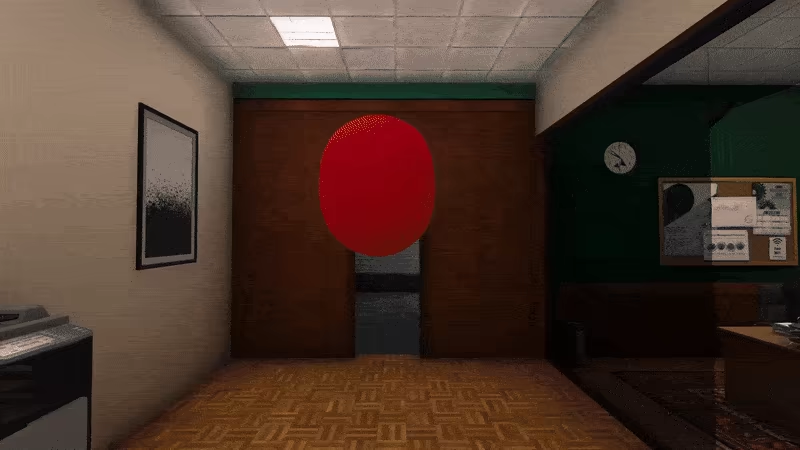
Office After Hours is a 1-2 hours light horror experience with scary and funny anomalies set in a mysterious story.
Your boss has insisted on extra overtime and now you're stuck in the office after work. Keep an eye out for strange occurrences and you might find your way home.

During your shift, the office will change and you will discover a lot of work, coffee and, if you are lucky, the office pet.
To escape from Endless Solutions, you must find clues that will give you access to new areas and reveal new secrets.
Can you find all the numbers and collect the story-related items?

30 Story based anomalies
40+ Anomalies in total
~1-2 hours (+overtime)
Discover 7 major anomalies - one hiding 4 smaller ones. References to other anomaly games.
No punishment for missing anomalies, just pure exploration and fun encounters. (~15–25 min)

Genres
Stats
All-time low is the lowest price we've recorded for this game since we started tracking it.
Engagement
Reviews
Themes across 40 recent reviews and how positive each mention is. A keyword signal, not full sentiment analysis.
Reviews
If you're looking for a challenging "spot the anomalies" game, Office After Hours, unfortunately, is not going to satisfy that itch. The game is, frankly, very easy, and most of the anomalies are very obvious. However, that does not make this a bad game. The anomalies themselves are varied and interesting, and unlike most anomaly games, there is an actual plot to discover. It's clear that this is a labor of love by the dev. (They even have a crossover mode that, while short, is a shout-out to other anomaly games.) In particular, I enjoyed the "Hell" segments, as they added a bit of uniqueness that helps set this apart from other anomaly games, and helped break up the loop of, "Enter office. Search for anomaly. Search for number code or collectable. Repeat." I also appreciate that, once you have beaten the main story, you are able to view not only how many more anomalies you have left to find in the post game, but also you can choose to re-triggered anomalies you've already identified, either to go back and get a missed collectable (which it also identifies if you missed one or not), or just for fun. Overall, it was plenty worth the price.
Related
Related
Trends
Concurrent players on Steam, sampled daily since tracking started.
Languages: English*, German, Simplified Chinese, Japanese, Korean, Vietnamese, Spanish - Spain, Russian, Portuguese - Brazil, French, Turkish*languages with full audio support
Hours played at review time, across 40 reviews with recorded playtime.
positive critical· bar length = how often the theme comes up
Office After Hours builds on the now-familiar anomaly-hunting formula popularized by Exit 8, but gives it a distinct identity through its office/lab setting and layered progression. Instead of simply spotting environmental inconsistencies, the game adds collectibles and bits of environmental storytelling that slowly reveal more about Endless Solution as a workplace. This added context helps the setting feel less abstract and more grounded, giving the anomalies a stronger sense of place. One of the game’s most defining features is its structure. After correctly identifying a set number of anomalies, you report back to your boss and complete a small minigame to progress. While simple, this break in pacing—along with recurring elements like the ducks and hidden collectibles—helps the experience stand out from similar titles in the genre. Most anomalies are fairly easy to spot, which makes the game approachable but may reduce tension for seasoned players. The frequent appearance of anomalies and the optional hint system strike a comfortable balance between challenge and accessibility. The main campaign took me around two hours to complete, and the game offers solid replay value afterward. You can freely revisit levels to track down missed anomalies, ducks, and collectibles, with clear progress tracking to guide completionists. Beyond the story, Crossover Mode adds a lighter, more playful spin with reference-heavy anomalies that feel more experimental. Overall, Office After Hours is a well-executed anomaly game with enough unique ideas to justify its place in the genre, especially at its sale price. — The Ember Archives https://store.steampowered.com/curator/45601239/
I highly recommend this game, one of the best anomaly games out there. If you encounter a problem, just contact the developer and they'll fix it, which is amazing. I recommend it to any fan of anomaly games. Great fun, and the anomalies are interesting and surprising :)
A solid 5/5 game that was waaaay better than I expected. My only regret is that I didn't know all the game references in the crossover mode. I also appreciate the game alerting to what anomalies you miss if you fail to find one. Overall, if you like anomaly games, get this one. It's worth the buy. It's about 1 hour to beat the game normally and 2.5 to unlock everything roughly.
Окей, да, это был довольно интересный игровой опыт на пару вечеров. Теперь давай то же самое, но про завод.
gut
It was a fun puzzle game with some eeriness to it. Also, a decent short story. For a smaller dev, this was great!
Es ist sehr facettenreich für ein Exit8 game mit witzigen Anomalien. Ist ein netter Zeitvertreib, hat auch viele Nebenmissionen die einen schon fordern das Game nochmal anzupacken. Für mich war aber recht früh schon Schluss.
LMAO this is hilarious. Great references and the reason that immediatly made me write this revirew I won't spoil here.
Office After Hours is a compact indie horror-adventure developed and published by gameandcode that takes an everyday workplace and slowly twists it into something unsettling, surreal, and quietly memorable. Rather than relying on combat or elaborate mechanics, the game builds its identity around observation, atmosphere, and the creeping sense that something is fundamentally wrong with a place that should feel routine and safe. By grounding its horror in the familiar setting of an office after closing time, it creates a strong emotional contrast that fuels both tension and curiosity throughout its short but focused runtime. The premise is simple yet effective: after staying late at work, you find yourself unable to leave because strange anomalies have begun appearing around the office. Desks, hallways, lights, and mundane objects subtly change, distort, or behave in ways that defy logic. Your task is to explore the building, identify these irregularities, and piece together what is happening behind the scenes. The game leans heavily into the idea of environmental storytelling, using visual clues and spatial inconsistencies to communicate its narrative rather than explicit exposition. This approach makes the player feel like an active observer rather than a passive recipient of the story. Gameplay centers on careful exploration and anomaly detection. There is no combat, no timers pushing you forward, and no harsh penalties for missing something on the first pass. Instead, the experience rewards patience and attention to detail. Some anomalies are immediately obvious, while others are subtle enough to blend seamlessly into the environment, encouraging players to slow down and truly examine each room. Progression is tied to discovering story-relevant anomalies and collecting clues that unlock new areas, creating a steady sense of forward momentum without overwhelming the player with objectives. One of the game’s strengths lies in its variety of anomalies. While the core mechanic remains consistent, the ways in which the environment breaks down are diverse and often imaginative. Visual distortions, impossible layouts, unsettling figures, and moments of absurdity coexist within the same space, preventing the experience from becoming predictable. The game balances unsettling imagery with moments of dark humor, making it feel eerie without becoming relentlessly oppressive. This tonal balance helps sustain engagement and gives Office After Hours a distinct personality within the anomaly-spotting subgenre. The narrative unfolds gradually as you uncover more anomalies and clues scattered throughout the office. Rather than delivering a single shocking revelation, the story builds through implication, allowing players to connect the dots themselves. Themes of corporate identity, routine, and isolation quietly surface beneath the surface-level mystery, adding depth without demanding interpretation. The choice to limit overt storytelling keeps the experience immersive, as the office itself becomes the primary narrative device. Visually, the game opts for realism grounded in simplicity. Fluorescent lighting, neutral color palettes, cubicles, meeting rooms, and empty corridors form a believable office environment that becomes increasingly unsettling as anomalies accumulate. The lack of visual excess works in the game’s favor, making even small changes stand out sharply against the otherwise mundane backdrop. Sound design complements this approach, using ambient noises, subtle audio cues, and occasional unsettling effects to heighten tension without relying on loud or frequent jump scares. Despite its relatively short length, the game offers meaningful replay value. With a substantial number of anomalies to find, players are unlikely to uncover everything in a single playthrough. This encourages revisiting spaces with fresh eyes, especially once you understand how subtle some changes can be. Additional modes and optional content further extend the experience for players who enjoy thorough exploration and completionist goals, making the game feel denser than its runtime might suggest. Ultimately, Office After Hours succeeds because it understands its scope and plays to its strengths. It does not attempt to be a sprawling horror epic or a mechanically complex puzzle game. Instead, it delivers a tightly crafted experience built around observation, atmosphere, and a clever use of setting. For players who enjoy anomaly-spotting games, environmental horror, or short narrative-driven experiences that linger in the mind after completion, it offers a satisfying and memorable journey. Its ability to transform the monotony of office life into something quietly disturbing makes it stand out as a thoughtful and confident indie horror title that proves effective scares do not require excess, only careful design and restraint. Rating: 7/10
Audience
Estimated from the language of this game's reviews — a proxy for where players are, not official Steam demographics.
Related
| Galaxy Reavers | $25.5K | 205 | 69% | $4.99 |
| Dark Quest | $25.5K | 205 | 77% | $4.99 |
| Her Last Piece | $25.5K | 131 | 97% | $11.99 |
| Knights of Messiah | $25.5K | 154 | 53% | $7.99 |
| Alien Shooter: Revisited | $25.5K | 869 | 64% | $4.99 |
| SKYSAVIOR Helicopter Services | $25.5K | 55 | 100% | $12.99 |
Related
| 7 Days to Die | $425.3M | 403.5K | 87% | $44.99 |
| Euro Truck Simulator 2 | $421.6M | 932.1K | 97% | $19.99 |
| Mount & Blade II: Bannerlord | $309.8M | 293.9K | 88% | $49.99 |
| The Forest | $254.8M | 678.5K | 96% | $19.99 |
| Project Zomboid | $239.1M | 460.8K | 94% | $19.99 |
| No Man's Sky | $230.9M | 412.1K | 85% | $23.99 |