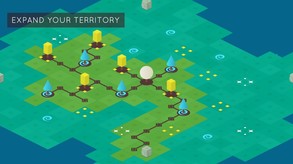
Nanuleu, developed and published by Selva Interactive, is a meditative yet surprisingly intense fusion of real-time strategy and tower defense that invites players into a world where nature itself becomes both weapon and shield. The game presents an abstract but meaningful struggle between growth and decay, expansion and defense. It places you in control of a network of magical trees that must flourish across a hexagonal map while fending off waves of dark corruption spreading from the edges. What sets Nanuleu apart is not its scale or complexity, but its purity of design—every mechanic is distilled to its essence, and every decision carries a sense of natural balance and consequence. It’s a strategy game that feels alive, organic, and contemplative even in the heat of conflict.
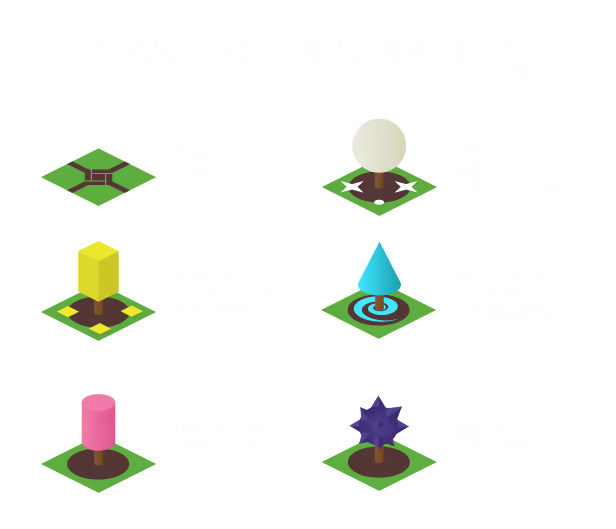
At the start of each match, you are given a single Life Tree, the heart of your network, and from it, you send out roots that reach toward nearby tiles. These roots serve as lifelines, linking together the different types of trees you can plant. Some trees, such as Water and Mineral Trees, act as economic engines, gathering essential resources. Others, like Protectors and Warriors, serve as your main line of defense, casting ranged attacks to halt the encroaching shadow. The core of Nanuleu’s design lies in this interconnectedness—your network thrives only when its parts remain bound together. Lose a section of your root system, and entire chains of trees become useless. This simple rule transforms what could have been a conventional tower defense experience into something that feels dynamic and fragile, where growth and vulnerability are two sides of the same coin.
The beauty of Nanuleu’s gameplay lies in its rhythm. It begins quietly, as you lay out roots and establish resource trees, watching your network expand across the serene landscape. The soft visual style, with its muted earth tones and minimalistic lines, encourages a false sense of calm. But as the minutes pass, enemies begin to emerge, creeping across the edges of the map and corrupting the ground as they go. The tension builds not through speed or chaos, but through proximity—an ever-closing circle of darkness that forces you to decide whether to expand your reach or fortify your defenses. This balance between offense and preservation defines the experience, and every choice feels meaningful because of the game’s interconnected structure. Each move forward is a risk, every expansion a potential weakness, and each defensive placement a trade-off in resource management.
The aesthetic presentation of Nanuleu complements its strategic elegance. The visuals are minimalist but cohesive, using color and shape to communicate function and emotion. The trees shimmer with life, their roots pulsing faintly as they stretch outward. The enemies, represented as creeping dark shapes or corrupted nodes, are visually distinct but not intrusive. The soundtrack reinforces this tranquil yet uneasy tone, composed of ambient electronic and natural sounds that ebb and flow with your progress. Even when the battlefield becomes tense, the game never overwhelms with noise or spectacle—it invites focus, reflection, and a kind of strategic mindfulness. This restraint gives Nanuleu a timeless, meditative quality rarely found in the genre, recalling the quiet minimalism of games like Rymdkapsel or Eufloria, but with its own organic rhythm.
Beneath the simplicity of its interface lies a carefully tuned difficulty curve. Early rounds ease you into the mechanics, allowing you to learn through experimentation rather than tutorials. As you progress, the enemies grow more aggressive, and the resource economy becomes tighter, demanding greater efficiency in your network design. Success depends on understanding spatial relationships and anticipating the enemy’s path rather than reacting to it. The procedural generation of maps ensures that each playthrough feels distinct, forcing players to adapt rather than memorize. Yet this same randomness can occasionally lead to frustration, as an unfavorable layout or poorly timed attack wave can punish even a strong opening. Still, the challenge feels fair for the most part, rewarding patience, adaptability, and a clear understanding of the ecosystem you’ve created.
While Nanuleu’s mechanics and atmosphere are compelling, the game’s limited scope is its most notable weakness. With only a handful of maps and modes, the experience is relatively short-lived, and once you’ve mastered the system, there’s little new content to uncover. The lack of upgrades or long-term progression means that replayability depends more on player enjoyment of the core loop than on any sense of advancement. For some, this will be part of the appeal—a game that delivers satisfaction through mastery of its simple but elegant rules. For others, especially those accustomed to the sprawling tech trees and persistent unlocks of modern strategy titles, the brevity may feel underwhelming. Nanuleu is best viewed as a focused experience, a minimalist strategy game that values refinement over expansion.
Despite its small scale, Nanuleu succeeds in delivering a deeply satisfying sense of strategic flow. It captures the duality of nature—how growth depends on structure, how strength emerges from balance, and how destruction can spread like disease if not contained. Every decision matters because the game’s ecosystem is both literal and metaphorical: the player must nurture, defend, and adapt in a living system that mirrors the fragility of real environments. Its meditative pacing, tactile visuals, and thoughtful design make it stand out among indie strategy games, offering something more emotional than mechanical. It’s not just about winning; it’s about maintaining harmony in a system that constantly threatens to collapse.
In the end, Nanuleu is a quiet triumph of minimalist design—a small, self-contained world that feels larger than it appears. It doesn’t rely on spectacle or complexity to engage the player; instead, it earns attention through elegance and intent. Each session becomes a reflection on control, sustainability, and the delicate balance between expansion and protection. For players who appreciate strategy that demands both thought and intuition, Nanuleu offers a serene yet challenging experience that lingers long after the final tree falls.
Rating: 7/10