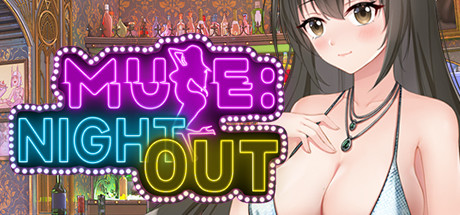
Muse: Night Out is a small-scale, casual indie title developed by Gemini Stars Games and published by Happy Max that centers on light social encounters framed around a stylized night out in urban nightlife settings. From the outset, the game makes it clear that it is not aiming for mechanical depth or narrative complexity, instead presenting a relaxed, arcade-like experience built around short interactions, chance-based challenges, and character collection. It occupies a niche space between casual minigame compilations and visual character-focused experiences, appealing primarily to players looking for something simple, visually engaging, and easy to play in short sessions.
The core gameplay loop is built around a series of brief encounters with different characters, each represented through illustrated portraits and short interaction scenes. These encounters are resolved through simple minigames that rely heavily on guessing, probability, or rock–paper–scissors-style logic rather than skill-based execution. Success unlocks new characters and advances the player’s progress through the night, while failure carries little penalty beyond retrying. This structure keeps the game approachable and stress-free, allowing players to experiment freely without fear of losing progress or being locked out of content.
Presentation plays a significant role in the game’s appeal. The visual style is colorful and expressive, leaning into an anime-inspired aesthetic that emphasizes character design over environmental detail. Backgrounds depicting bars, clubs, and nightlife locations serve as thematic scenery rather than interactive spaces, reinforcing the sense that the game is about encounters rather than exploration. Character artwork is the main attraction, offering variety in personality and appearance that helps maintain interest even when the underlying mechanics remain consistent.
Narratively, Muse: Night Out uses only the lightest framework to contextualize its gameplay. There is no overarching story arc or deep character development; instead, narrative elements exist mainly as flavor text and brief dialogue exchanges that accompany character unlocks. The “night out” premise functions as a loose excuse to move from one interaction to the next rather than a storyline with rising stakes or emotional payoff. For players seeking a story-driven experience, this minimalism may feel underwhelming, but for those focused on casual play, it keeps the pace brisk and uncomplicated.
Pacing is one of the game’s more defining traits. Early sessions tend to feel lively, with frequent unlocks and new characters providing a steady sense of progression. Over time, however, repetition becomes more noticeable, as the core minigame mechanics rarely change in meaningful ways. Once the novelty of meeting new characters fades, the experience leans heavily on personal enjoyment of the art style and atmosphere rather than evolving gameplay systems. This makes the game best suited for short bursts of play rather than extended sessions.
Progression outside of character unlocking is minimal. There are achievements and gallery-style rewards that encourage completion, but there are no complex customization systems, branching paths, or long-term strategic decisions. This reinforces the game’s identity as a low-commitment experience designed for accessibility rather than mastery. Players can jump in, play a few encounters, and step away without feeling pressure to optimize or manage resources.
Reception to Muse: Night Out reflects this narrow focus. Players who enjoy casual, chance-based gameplay and character-centric presentation often find it charming and relaxing, while those looking for depth, variety, or narrative substance tend to view it as repetitive. The game does little to disguise its simplicity, which can be seen either as honesty in design or as a lack of ambition, depending on player expectations.
Ultimately, Muse: Night Out succeeds on its own terms as a lightweight, visually driven casual game. It offers a relaxed, approachable experience built around short interactions and stylized characters, with minimal friction or complexity. While it is unlikely to satisfy players seeking meaningful gameplay systems or storytelling depth, it provides a niche form of entertainment for those who enjoy low-pressure progression, simple minigames, and the aesthetic appeal of a playful night-out theme.
Rating: 5/10