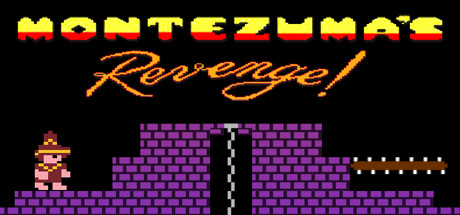
Montezuma's Revenge developed and published by Normal Distribution LLC is a modern re-release of a foundational platforming adventure that remains deeply rooted in its original design philosophy. Rather than reshaping itself to meet contemporary expectations, it preserves the structure, pacing, and challenge of the classic experience, presenting players with a game that feels closer to a historical recreation than a reinvention. This approach gives it a unique position in today’s landscape—less a modern platformer and more a window into how early exploration-driven games were built.
The core gameplay revolves around navigating a sprawling, multi-room pyramid filled with traps, enemies, and collectible items. Each room acts as a self-contained challenge, but together they form an interconnected labyrinth that rewards careful observation and persistence. Progression is not strictly linear; instead, players must locate keys, tools, and other items to unlock new paths, often revisiting earlier areas with a better understanding of the layout. This structure creates a strong sense of discovery, where advancement feels earned through exploration rather than guided progression.
Movement is deliberate and demands precision. Jumping across platforms, climbing ladders, and avoiding hazards require careful timing, and mistakes are often punished immediately. This strict approach to control and physics reinforces the game’s emphasis on mastery, but it can also feel rigid compared to modern platformers. Much of the challenge comes from learning through failure—memorizing enemy patterns, understanding room layouts, and refining movement over repeated attempts. For players who appreciate this kind of trial-and-error progression, it can be deeply satisfying, but it may prove frustrating for those expecting more forgiving systems.
One of the defining aspects of the experience is how it blends platforming with light puzzle-solving. Managing a limited inventory adds an extra layer of decision-making, as players must choose which items to carry and when to use them. This introduces a subtle strategic element that complements the exploration, encouraging players to think ahead rather than simply react to immediate obstacles. The balance between movement, resource management, and navigation gives the game a distinct rhythm that sets it apart from more action-focused platformers.
Visually, the game adopts a clean and updated presentation while maintaining the simplicity of its origins. Environments are designed for clarity, ensuring that hazards, platforms, and interactive elements are easy to identify. While it does not aim for high levels of graphical detail, the updated visuals make the experience more approachable without losing its retro identity. The overall aesthetic feels functional rather than expressive, but it serves the gameplay well by keeping the focus on navigation and precision.
At the same time, the decision to remain faithful to the original design brings certain limitations. The lack of modern conveniences—such as generous checkpoints, smoother movement systems, or clearer guidance—can make the experience feel unforgiving. Pacing is largely dictated by the player’s ability to learn and adapt, which means progress can be slow and occasionally repetitive. These elements are intentional, but they may limit the game’s appeal to a more niche audience.
Despite these challenges, Montezuma’s Revenge retains a sense of importance and identity that goes beyond its moment-to-moment gameplay. It stands as an example of early design ideas that would later influence entire genres, particularly in how it approaches non-linear exploration and environmental progression. Playing it today offers not just a challenge, but also an appreciation for the foundations of modern platforming and adventure games.
In the end, this is a game that asks players to meet it on its own terms. It rewards patience, observation, and persistence, offering a structured but demanding experience that values mastery over accessibility. While it may not resonate with everyone, those who are willing to embrace its old-school design will find a game that is both challenging and historically significant.
Rating: 7/10