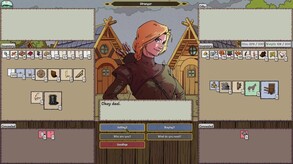
Become a medieval merchant and master the arts of bartering, haggling, and investing, Explore 20 markets, barter with 200 characters, and trade in over 1,800 items in a dynamic bartering and haggling system that will challenge and reward.
Modeled estimate, not a reported figure. How we estimate →
Media

About
Stats
All-time low is the lowest price we've recorded for this game since we started tracking it.
Languages: English*, Polish**languages with full audio support
Engagement
Hours played at review time, across 41 reviews with recorded playtime.
Reviews
Themes across 40 recent reviews and how positive each mention is. A keyword signal, not full sentiment analysis.
positive critical· bar length = how often the theme comes up
Reviews
I actually would recommend this game for heavy merchanting enthusiasts, but not for normal players. Credit where credit is due, I've never played another merchanting game where currency itself is part of the bartering process. Usually, money is synonymous with value and it's just an abstract number on the screen. Vendors/towns may have a limited supply of money, but that's about it. So that was cool. Also, the sheer amount of stuff people barter with in the course of normal gameplay was fun as well. However, the game feels badly made and somewhat incomplete. First of all, the UI design is awful. There should permanently be a button for "make me an offer for my stuff", a button for "make me an offer for your stuff", and a button for "let's trade". Not one button which changes function depending on what's in the trade windows. So many times, I accidentally offer a trade that's really bad because when you spend hours clicking away at the game, sometimes you slip up and fail to completely clear absolutely everything from a trade window. Which leads to my next point - the countless ways the game is clunky and would be greatly improved with simple quality of life updates. A button for "clear all" to remove everything from a trade window. An "offer all" button when trading or transferring stuff in/out of warehouses. Also some icon-based buttons to show only items of a certain category. When you have dozens of constantly changing items in your inventory, it's annoying to have to scan constantly. Also, you should be able to access your warehouse at night when you figure out how much Silver you need for a journey. You should also be able to edit your Myth deck at night, not have to play a game during the day in order to construct it. Not having a gallery of "collected" items, nor a profile book of everyone you've met, was a massive missed opportunity, especially when the journal explicitly tracks how many you've seen/missed. The world also feels very static. Nothing ever happens, and I mean that unironicly. It's not so much a sandbox as it is a concrete box painted a sandy colour. Your actions have zero impact on the world and its people, even when you complete quests like "Aid the Resistance". You can have made 10000 trades with someone, and they'll treat you exactly the same as when you trade them the first time. There are also barely any economic fluctuations at the local level. In other merchanting games which involve travelling around, you're strongly incentivized to because once you buy all the cheap goods in an area, they'll take a while to regenerate, so you take your buying-and-selling someplace else for a while. In MotSK, you can clear someone out and they'll return the next day with a small stack of gold coins. Farmer, blacksmiths, etc all refresh their stock overnight. Maybe not completely, but enough to the point where a new player could just sit in the starting village and wheel and deal for months of in-game time and not feel anything wrong. Everyday, there will be a long line of customers waiting to trade. The developers were either too lazy to code in a gradual recovery mechanic for the customers (who should either have depleted stocks to trade with or just not show up at all), or they didn't do it on purpose because they were worried about new players getting softstuck in an area if they didn't have enough money to travel to a new location. And that could have been solved any number of ways, such as travelling cost waivers for players below a certain amount of freight and under certain conditions/requirements or something. Related to the lack of stock depletion and lack of incentive to travel, there's also no daily costs. It costs money and time to travel, but it costs neither time nor money to just stay in place, trading the same people over and over. I hate that. There's also no progression beside establishing warehouses in different cities and just making your convoy bigger, until you reach the point where it's not profitable to keep increasing its size. There are no new mechanics or systems to unlock. As another reviewer pointed out, the bartering system may be a cool mechanic, but it's also the ONLY mechanic. (Aside from the Myth minigame). You don't have to gather special gear to deal with bandits or a hostile environment, you don't have to gather certain resources for intermittently generated tasks/challenges, and you don't have to gather resources or reputation to unlock new functions. Aside from warehouses. That's it. You could be hours and hours into the game and you'll be doing the exact same thing as when you first started, except you now have more capital, horses, and maybe some warehouses to store your stuff. Game was fun, but also frustrating. EDIT (at +32 hours): My verdict remains the same. The game lags when you have a lot of items. Quest events sometimes don't trigger properly. Of the dozens of characters you meet, only one of them changes their interactions with you due to a quest. Everyone else treats you the same whether you just started out, or whether you are King of Coin. I cannot assign items to "always hide this item" and I have to re-hide it every time I go in and out of a place which allows it. This game had a lot of potential and didn't capitalize on most of it. Everything that they do do right just makes me ask why they didn't do a lot more of it and instead, left much of the world so bland.
I'm negotiating cofounder equity in a spice trading business with a dragon who hoards gold to punish humanity by providing them with credit. 10/10
Just here to say DLC would be great, please have more of my money.
Truly merchant experience. You trade things without knowing it's price. No idea if you are being duped or not. Cool stuff. Game can be short or longer if you going for achievements. Fun first playthrough and kinda fun 1 year challenge run. Other hard achievements are repetetive nonsense but I still recommend it for merchang-game enjoyers.
A fantastic, weirdly addicting trade sim ever so slightly reminiscent of "Frontier", an old web game. This game had no business being as fun and time-consuming as it was. Certainly not for everyone, but scratching a very specific itch I didn't know i had.
I've tried to play it for longer than 30 mins and it ends up freezing and forcing me to quit via steam. I'd love to keep at it but its basically a paperweight of a game with how little I can get done. The content (although very lacking in guidance and a more linear explanation of the use of currency) does feel like a solid trading game as a merchant, I just wish I could actually play it.
Merchant of the Six Kingdoms, developed by Cory Long and published by GooseGames, is a remarkably focused economic sandbox that transforms the often-overlooked fantasy of medieval trade into a deep, systems-driven experience. Instead of casting players as warriors, kings, or chosen heroes, the game places them in the role of an ambitious merchant navigating a network of markets spread across six distinct realms. The premise is deceptively simple: buy low, sell high, and grow your fortune. Yet beneath that straightforward objective lies a surprisingly intricate web of negotiation mechanics, character behaviors, fluctuating item values, and risk-reward calculations that reward patience, observation, and strategic thinking. It is a game that finds drama not in combat, but in conversation and commerce. At the center of the experience is its bartering system, which goes far beyond static price tags and automatic profit indicators. Each trader has preferences, personalities, and situational motivations that influence how deals unfold. Successful negotiation requires paying attention to what a merchant values, what they are willing to part with, and how bundles of goods can be structured to create mutually acceptable exchanges. This transforms trading from a mechanical click-and-confirm process into a kind of economic puzzle. Players must constantly evaluate inventory combinations, consider long-term gains over immediate profit, and identify opportunities where undervalued goods in one region can become highly desirable in another. Over time, this loop becomes deeply engaging, especially as players begin to understand market rhythms and character tendencies. The scope of content reinforces this depth. With dozens of markets and hundreds upon hundreds of unique items circulating through the economy, the world feels busy and alive. Item variety is not merely cosmetic; different goods carry different levels of rarity, demand, and strategic utility. Some are everyday staples that move quickly for small margins, while others are rare commodities better suited for auctions or long-term speculation. The game encourages experimentation—hoarding certain goods in anticipation of future demand spikes, leveraging regional shortages, or capitalizing on sudden opportunities that emerge from dynamic interactions. This variety ensures that even after hours of play, the act of trading rarely feels static. Merchant of the Six Kingdoms also expands beyond pure buying and selling through side systems that add texture and unpredictability. Auctions create moments of tension as players compete for valuable items, forcing snap decisions about how much capital to commit. Gambling on horse races introduces a more volatile avenue for wealth generation, offering high-risk shortcuts that can either accelerate progress or set it back. Card games and other diversions serve both as world-building flavor and alternative methods of earning coin. These systems prevent the economic loop from becoming too repetitive and contribute to the sense that the kingdoms are functioning societies rather than isolated spreadsheets of numbers. Progression is gradual and deliberate. Inventory management plays a crucial role, as carrying capacity limits force careful prioritization of goods. Deciding what to transport across kingdoms becomes a strategic layer of its own, particularly when travel time and opportunity costs are considered. There is also an undercurrent of moral ambiguity woven into certain trade opportunities. Players may encounter questionable goods or deals that promise substantial profit at the risk of attracting unwanted attention. While the game never shifts into heavy narrative drama, these touches provide a sense of consequence and identity to the merchant’s journey. Wealth accumulation feels earned rather than handed out, and financial setbacks carry weight without being punishing to the point of frustration. Visually, the game embraces a clean and readable presentation that prioritizes clarity over spectacle. The art style leans toward a simple, charming aesthetic that keeps focus squarely on the mechanics. Character portraits and market interfaces are functional and expressive enough to give personality to interactions without overwhelming the player with unnecessary detail. The soundtrack and ambient audio further support the atmosphere, creating a relaxed medieval tone that complements the thoughtful pace of play. This understated presentation works in the game’s favor, allowing its systems to shine without distraction. The pacing may not appeal to everyone. Players accustomed to action-heavy RPGs or narrative-driven adventures might initially find the experience subdued. Merchant of the Six Kingdoms demands engagement through calculation rather than reflex, and its satisfaction comes from incremental growth rather than explosive milestones. However, for players who enjoy simulation-heavy titles, tycoon-style progression, or intricate management systems, the game offers a compelling and meditative loop. Watching profits steadily increase as strategies become more refined can be surprisingly addictive, especially once the player begins to see the interconnected logic behind the markets. Ultimately, Merchant of the Six Kingdoms stands out because it fully commits to its identity as a commerce simulator. It does not dilute its mechanics with unnecessary combat or extraneous storytelling, instead building depth through layered systems and player-driven decision-making. The result is a thoughtful and rewarding experience that captures the essence of trade in a way few games attempt. For those fascinated by economic strategy, negotiation mechanics, and the slow but satisfying climb from modest trader to wealthy magnate, it offers a distinctive and engrossing journey through a world defined not by conquest, but by coin. Rating: 8/10
Fun game but severely unstable and constant crashes/freezes. Like I'm talking 2-3 per hour of playtime. The game was also released 3yrs ago and is seemingly not regularly updated so the chances of those crashes getting resolved is slim. Would be a positive review otherwise.
Great fun, similar to Recettear trades and better than potion craft. I feel like i might be learning something about subjective value, memorising and making the best of incomplete information too Capitalism Ho!
一口气玩了九个小时,以物易物的游戏,每个城镇点还有任务领取,税费略高,估计是为了限制后期利滚利后,受益膨胀的问题,现在在几个城镇间移动一次需要消费数百枚银币,不过令我腹诽的是,商品的贴图带有RPG Maker公共资源的痕迹,不同商品的风格和清晰度明显有所差异,独特的游戏体验,很有意思。
Related
Related
Trends
Modeled estimate over time, reconstructed from Steam's monthly review histogram.
Audience
Estimated from the language of this game's reviews — a proxy for where players are, not official Steam demographics.
Related
| Mad Experiments: Escape Room | $89K | 423 | 66% | $14.99 |
| Supaplex | $88.9K | 281 | 95% | $14.99 |
| C.A.R.D.S. RPG: The Misty Battlefield | $88.9K | 88 | 52% | $39.99 |
| Sister Travel | $88.9K | 768 | 85% | $5.99 |
| Creature in the Well | $88.9K | 288 | 77% | $14.99 |
| Critadel | $89.1K | 238 | 78% | $19.99 |