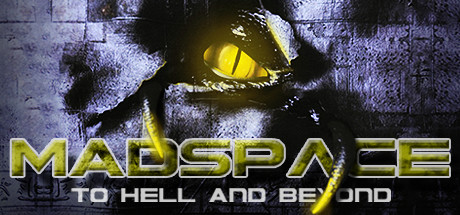
MadSpace: To Hell and Beyond, developed by Maddox Games and revived by Nightdive Studios, is a fascinating relic from the late 1990s that captures both the ambition and the eccentricity of its era. Originally released in 1997 for DOS, it was an attempt to push the boundaries of first-person shooters by fusing traditional gunplay with experimental mechanics such as dual-wielded weapons, rocketpack traversal, and even an early voice command system. The modern re-release preserves this strange but compelling mix of ideas, presenting the game as both a nostalgic time capsule and an example of creative risk-taking that defined an era when developers were unafraid to experiment. Though dated in many ways, it remains an intriguing piece of shooter history that offers a window into a transitional period for the genre.
The story of MadSpace is pure pulpy science fiction, fitting perfectly into the aesthetics of its time. The game places players in the role of a cybernetic super-soldier known as a Proteus—an enhanced human mind trapped in a mechanical body. The setting is grim and claustrophobic: humanity is locked in an interstellar war against an alien race called the Krakin, and the protagonist’s mission is to infiltrate one of their massive warships, destroy its core, and end the conflict from within. The plot is delivered through sparse cutscenes and text briefings rather than elaborate storytelling, which suits its minimalist tone. This design choice reflects the era’s focus on atmosphere and player-driven immersion rather than narrative depth. The lack of dialogue or companions adds to the isolation, making the game’s environments feel oppressive and otherworldly, a lonely battlefield of steel corridors, glowing chambers, and impossible geometry.
What makes MadSpace stand out is its ambitious approach to level design and mechanics. The environments are not simple corridors or arenas but labyrinthine, interwoven spaces that challenge players’ perception. The developers toyed with non-Euclidean architecture—rooms that seem to defy spatial logic, corridors that loop back in unexpected ways, and portals that transport players into reconfigured versions of familiar areas. This approach gives each level a surreal, dreamlike quality, but it also introduces disorientation and confusion. Navigation becomes as much a puzzle as combat itself. The rocketpack mechanic further complicates traversal by adding verticality, allowing players to soar through open shafts or access hidden pathways. Combined with the dual-wield system—where players can equip different weapons in each hand—the game offers a surprising degree of freedom for its time, encouraging experimentation and improvisation in combat.
Combat in MadSpace is fast, chaotic, and occasionally clunky, yet deeply satisfying when mastered. Weapons range from standard ballistic tools to exotic energy guns and experimental alien armaments, each with distinct firing patterns and ammo limitations. Dual-wielding allows for creative combinations, such as pairing a high-damage cannon with a faster sidearm, though managing resources becomes critical as energy and ammunition are consumed quickly. Enemies are varied but brutal, with many capable of dealing significant damage if players hesitate. The AI may seem primitive by modern standards, but it contributes to the game’s sense of tension—foes move erratically, ambush players from corners, and force split-second decision-making. Despite the roughness of the mechanics, the combat system has a raw intensity that harkens back to the earliest days of FPS design, when quick reflexes and spatial awareness were key to survival.
Graphically, MadSpace has not aged gracefully, yet its visual direction remains striking in a nostalgic sense. The environments are constructed from sharp-edged polygons, filled with metallic surfaces, neon lights, and flickering displays that create a distinctly industrial science fiction feel. The color palette leans heavily on greens, reds, and grays, evoking a sense of mechanical decay and alien hostility. Although textures are basic and models blocky, the lighting effects and atmospheric soundscape help preserve immersion. The audio design is simple but effective—weapon blasts echo through corridors, engines hum in the background, and alarms pulse during combat. The original version even included CD-quality music, though this feature is inconsistently supported in the re-release. Despite its technical limitations, the game’s audiovisual style reinforces its claustrophobic tone, making the player feel like a lone intruder lost in a hostile starship.
However, the game’s age also brings with it a number of frustrations. The controls are cumbersome by modern standards, with awkward sensitivity and sometimes unreliable input responses. Navigating the intricate maps can be confusing, especially when switches and doors are poorly labeled or feedback is unclear. It’s not uncommon to wander for minutes trying to locate the next objective, only to realize that a crucial door had been unlocked without indication. These design quirks can make the pacing uneven, alternating between bursts of thrilling combat and stretches of disorientation. The difficulty curve is steep, and the game’s punishing checkpoints add to the challenge, as death often means restarting from earlier points with fewer resources. While these aspects might frustrate players accustomed to modern conveniences, they also underscore the uncompromising design philosophy of classic shooters—demanding, relentless, and unapologetically old-school.
Nightdive Studios’ re-release faithfully preserves this experience with minimal alteration, running the game through DOSBox to maintain authenticity. This preservationist approach ensures that MadSpace feels exactly as it did in 1997, for better and worse. On modern systems, the game performs well, though occasional emulation quirks and sound inconsistencies can occur. There are no major enhancements or remastering efforts; the focus is purely on accessibility. This decision will please purists who want to experience the original version, but it may also limit its appeal to newer audiences looking for smoother, updated gameplay.
MadSpace: To Hell and Beyond is ultimately a time capsule—a strange, ambitious experiment from a period when the boundaries of the first-person shooter genre were still being defined. It is rough, uneven, and often confusing, but it is also full of bold ideas that demonstrate the creative risks smaller developers were willing to take. Its mix of non-linear exploration, dual-wielded combat, and unconventional level architecture give it a unique personality that stands apart from its contemporaries. For players with a taste for retro games or those curious about the evolution of early FPS design, it offers an experience that is both challenging and rewarding in its eccentricity. While modern audiences may find its archaic design and dated visuals off-putting, those who approach it with patience will discover a forgotten gem that embodies the fearless experimentation of 1990s PC gaming.
Rating: 8/10