Mad Games Tycoon 2 doesn’t reinvent the wheel, but it absolutely refines it. While the core gameplay remains faithful to the original (starting in a garage, building custom engines, hiring staff, creating games, and gradually expanding your company into a global powerhouse) the sequel introduces a wide array of new mechanics and layers of depth that make the original feel more like a proof of concept than a fully realized vision.
Players coming from the first game will feel right at home. The familiar loop of researching tech, tweaking development sliders, combining genres and topics, and releasing games to climb the charts is still the foundation. You’ll still move from modest office spaces to full-fledged headquarters, hire developers and artists, build marketing and QA departments, and even create your own consoles. The visual style retains its colorful, cartoon-like isometric aesthetic, though now polished by a more modern engine.
But while the basics remain, almost everything surrounding them has been either expanded or reworked to offer a far more engaging experience. One of the most immediate and impactful additions is the inclusion of online multiplayer, something completely absent from the first game. You can now compete (or collaborate) with other human-run studios in the same game world, fighting over awards, staff, contracts, and market dominance. It’s entirely optional, of course, but it adds a new dimension of replayability and competitiveness that elevates the experience.
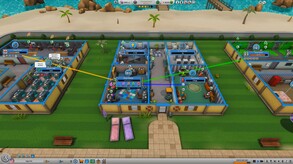
The physical layout of your studio also changes significantly. While the first game forced you to move between fixed building sizes, MGT2 allows you to expand freely within massive, campus-style maps. You can buy plots, construct adjacent buildings, and plan your layout with far more flexibility. It’s still limited to one floor per structure, but the available space is leagues ahead of what the first game offered.
Personnel management also receives a substantial overhaul. Employees now have individual traits (both positive and negative) that influence productivity, and morale is now a meaningful factor. Overworked, underpaid, or neglected staff will eventually quit, forcing you to consider working conditions, break rooms, and HR policies in ways the original never asked you to. In MGT1, your staff were simply numbers on a spreadsheet; in MGT2, they feel more like people.
Another major innovation is the IP system. In the original, sequels existed, but franchises were little more than a naming convention. Now, each game contributes to a franchise’s IP value, which influences future sales, boosts merchandise revenue, and gives real weight to building long-term sagas. There’s even a leaderboard that tracks the top 100 franchises across all studios, adding a strategic layer to how and when you release sequels or spin-offs.
And the types of products you can create have exploded in variety. While the first game stuck mostly to full games and basic sequels, MGT2 lets you develop MMOs, expansion packs, F2P titles, remasters, GOTY editions, ports, mobile versions, bundles, and even arcade machines. You can manufacture physical editions, manage stock, set up your own production lines, and become a publisher for other studios. This significantly expands your role from game developer to full-fledged entertainment corporation.
Platform development is also much more sophisticated. Every console now has a complexity rating and technology level that directly impact your development pipeline. Advanced engines might be too much for older systems, while cutting-edge consoles demand longer dev cycles and higher budgets. These considerations were nonexistent in the original, where platform selection was primarily about market share.
The market itself has also evolved. Fans are no longer a generic number; instead, they are segmented by genre. If your studio repeatedly produces successful RPGs, you'll gain a loyal RPG fanbase, but releasing a racing game might disappoint them. Market trends now fluctuate, and you can conduct research to identify emerging platforms or genre popularity, allowing you to plan ahead strategically. This makes each decision more meaningful, and each release carries real consequences for your reputation.
The simulation of the gaming world is also more dynamic. Historical and random events can now affect the market in unexpected ways: economic crashes, sudden booms in casual games, or shifts in platform popularity... which weren’t present in the original. Yearly awards still exist, but are now more detailed, and every annual winner is recorded in a persistent timeline for long-term comparison.
MMOs and online games, previously limited and somewhat abstract, are now fully supported through server management. If you launch a live-service title, you’ll need to allocate server capacity, manage subscriptions, release patches, and handle customer support tickets to maintain user engagement. Ignoring this aspect leads to player loss and damaged reputation, reinforcing the reality of maintaining games post-launch, a layer that was completely missing in MGT1.
Artificial intelligence also sees a major upgrade. In MGT1, rival companies existed but felt largely passive. In MGT2, they are aggressive, competitive, and play by the same rules as you do. They develop franchises, release consoles, and may even keep exclusive games to boost their platforms. On higher difficulties, they’ll actively challenge you for market dominance and Game of the Year awards. Planned features like acquiring other companies (turning them into subsidiaries) further reinforce the idea that you’re part of a living, breathing industry.
Other features (such as multiple difficulty levels, adjustable game speed, automation of production and development pipelines, a more responsive UI, and basic modding support) round out the improvements. These quality-of-life enhancements don’t change the core mechanics, but they greatly streamline long sessions and improve usability, particularly in the late game where MGT1 sometimes became unwieldy.
In really-short: Mad Games Tycoon 2 is Mad Games Tycoon 1, but massively expanded, deepened, and matured. It retains what made the original compelling, but introduces enough strategic systems, management depth, and simulation realism to make the first game feel comparatively barebones. It’s not a complete overhaul, but it doesn’t need to be: it builds upward and outward, making each part of the simulation more robust and interconnected.
For returning players, this is the definitive version of the experience. For new players, this is the one to start with. The first game is still respectable in its own right, but MGT2 renders it largely obsolete through sheer scope and polish.
Score: 8/10 – While it doesn’t change the formula, it improves almost every part of it, delivering the most complete and polished game dev simulator currently available.