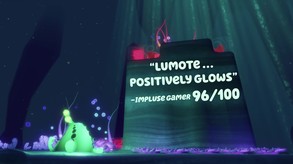
Meet Lumote, the squishiest bioluminescent creature, in this beautiful 3D puzzle platformer. Take control of the world’s inhabitants on a quest into the Great Depths to seize control from the Mastermote.
Modeled estimate, not a reported figure. How we estimate →
Media

About
Genres
Stats
All-time low is the lowest price we've recorded for this game since we started tracking it.
Engagement
Hours played at review time, across 40 reviews with recorded playtime.
Reviews
Themes across 40 recent reviews and how positive each mention is. A keyword signal, not full sentiment analysis.
positive critical· bar length = how often the theme comes up
Reviews
I honestly have some mixed feelings about this game. First of all the good stuff: A lot of the game's design is really good. From the colorful visuals to the sound design, everything about this game looks, sounds, and feels really good. The problem I have with this game is with the puzzles, themselves. About halfway through, I felt like they started to get much less intuitive and required a lot of moving parts to get from start to finish. Many puzzles need you to move one object to one spot so you can pick up another object to move to another spot, then go back and get the first object to move to a third spot, and continuously move things around again and again to the point where it feels exhausting. After a while, I realized that I just wasn't having any fun and started looking up solutions without feeling bad about it. Overall, this could have been a pretty good game, but the puzzle design was too frustrating for me.
This game is absolutely gorgeous & atmospheric. The puzzle design is neat, featuring tons of puzzles based on simple elements which obey clear rules and interact in interesting ways. While I liked the game, I did have a bunch of criticisms: 1) It's laughably easy to die, or get squished, or fall down while trying to obtain a collectable... and then you have to replay the current puzzle level due to the checkpointing system. Wow. This got particularly annoying in world 2; I died soooo often in W2-T4-2. 2) On the technical side, to my surprise I often reached max FPS despite my outdated GPU. However, at the mid-point "level of detail" setting, which presumably refers to draw distance, there was a high degree of pop-in. And I experienced one outright game crash, in world 2. 3) There are annoying laser misalignment issues, where a diverter (laser redirecter) seems to snap in place, and is then still off by a few pixels. As a result, I had a few situations where the Guards then didn't follow the correct path. 4) The game features optional artifacts to collect. But the game design is *lousy* for completionists: There are two achievements for completing the game without dying (the game is *not* designed not to die); an achievement for collecting all hidden artifacts (but you can't return to previous levels for some reason, and must instead replay the entire world), and a speedrun achievement to finish the whole game in <83.5 min.
Unfortunately I can't recommend this game. Level and sound design are very good, but at a certain point the puzzle mechanics start to be less and less intuitive. Additionally, the game isn't rewarding at all: after completing a puzzle, there's simply another one. Some puzzles also seemed to be rather tedious than challenging. I did not have fun anymore after some levels and forced myself to keep going for some more and then stopped playing.
I've played this game for literally 38 minutes and love it completely. 100% would recommend for ANYONE who loves cute puzzlers. Platforming, problem-solving, color-puzzles? Yes, please! <3<3<3 Take my money!!! Make a sequel!!!
Quite a disappointing game. There may be spoilers. The story is about two parasites who fight over a bubble and one is banished and tries to take over the other's territory. The puzzles quickly become boring and as a chors there is almost nothing to explore and discover except . The things to search for are like this, one for each level with a puzzle and they are taken only once in total for all saves, and when you take one, it is saved immediately, but. If you go through the flower checkpoint, there is no going back. You have to start a new game to find the missing ones. Which also makes the game even more limited and the feeling that you are taking territory is just lighting. Some of the puzzles even have nonsensical things. And the way to pass the puzzles is to do it yourself, but the problem is that you rarely do some of the things and it's hard to understand what you can do. And also some puzzles require too much perfect accuracy. The first world is big and the second looks like a demo only 1/4 puzzles and nothing hidden and half the things are repeated. Passing the first world starts the second, passing it starts the first and so on ad infinitum unless you start a new game and choose the parasite and the level. There are also bugs disappearing lasers confusing the puzzle and others. Also, they did not put much thought into the achievements. There is nothing relaxing about the game and it quickly becomes irritating and boring. So long waiting for nothing. Perhaps with a very big discount, it does not offer much.
[Fully played on steamdeck LCD] You will play both parasites: one that turn red things to blue, the other that turn blue things to red. The first world (as the achievement says) is easy, the overall puzzles will be like this thingy, nothing complex. And the second world starts with precise jumping maps so I was like "Oh, the 2nd world is filled with this precise jump control puzzles, sick." But nope, just same puzzles that can be bypassed with that precise jump control. (3rd world is just same 1st world. No need to play 3rd one.) I don't know. It's not a bad game, but also doesn't have a thing to like. Well, at least they did the puzzle right. So, why not? By the way, don't pause the game when you are on the jellyfish. The wacky physics will launch you out of the map.
Very cute little puzzle platformer. Runs perfectly fine on the SteamDeck.
I honestly feel bad for not liking Lumote, but it just wasn’t that good. The strongest part of the game was definitely the art style. The colors and environments are really pretty and visually interesting, which is what kept me playing as long as I did. Unfortunately, the puzzles felt confusing more than rewarding, and I never really felt compelled to keep going. Overall it just ended up feeling boring and hard to stay invested in. Pretty colors aside, I definitely don’t think it’s worth $20.
Lumote: The Mastermote Chronicles unfolds like a serene descent through an otherworldly ocean of light, presenting a puzzle-platformer that prioritizes atmosphere, rhythm, and spatial logic over narrative exposition or mechanical complexity. Playing as Lumote — a soft, bioluminescent creature made of gentle pulses and curious chirps — you are dropped into the Great Depths, a massive living structure overtaken by red corruption. The world itself becomes your guide as you move deeper, lighting towers one by one, turning crimson regions back to cool blues, and gradually drawing closer to the enigmatic Mastermote who presides at the bottom. The game avoids conventional storytelling, leaning instead on visuals, color shifts, and the progression of puzzles to convey its journey from imbalance to renewal. The gameplay is built around elegant minimalism. Lumote’s abilities consist of moving, jumping, double-jumping, and — most importantly — possessing other creatures known as Motes. These Motes act as organic switches, tools, or carriers of energy that activate platforms, rotate structures, or open gates. Each puzzle space is a kind of organic circuitry board, its glowing pathways revealing where energy flows and what must be manipulated to restore order. Early tasks are straightforward introductions, but as the world expands and grows more intricate, the puzzles require careful observation of how color, motion, and flow interact. The gratifying part of Lumote’s design lies not in flashy mechanics but in how it teaches you to read the environment’s logic without words. Mastery emerges from paying attention to subtle shifts in the world’s glowing patterns and understanding how each Mote’s behavior forms part of a larger system. Visually, the game thrives on a neon-biological aesthetic that feels at once alien and calming. Everything is built from soft luminescence — towers curve like coral, platforms thrum gently, and the air seems filled with living particles that respond to your presence. The contrast between the poisoned red regions and the revitalized blue ones makes each victory feel tangible, as if the world were breathing again. That sense of visual purity extends to the camera, which often zooms out to reveal impressive panoramas of the interconnected towers, giving the impression of traveling through a vast underwater cathedral. The soundtrack and ambient soundscapes reinforce the meditative quality of the world, offering a quiet backdrop rather than demanding your attention. Combined, these elements give Lumote a rare identity: it’s meant to soothe while it challenges. While the simplicity of its mechanics contributes to its clarity, it also defines the game’s limitations. The platforming remains gentle throughout, rarely pushing beyond basic movement skills, which means the sense of physical progression is less exciting than in more kinetic platformers. The puzzles, though clever, sometimes lean heavily on repetition: rotating platforms, rerouting energy, and repositioning Motes recur frequently across the Great Depths. As the game becomes more complex, the visual uniformity of its neon structures occasionally makes it difficult to track puzzle components or gain spatial orientation, especially during multi-step sequences. These frustrations are generally mild but may accumulate for players who prefer bolder mechanical variety or clearer pacing. The absence of a traditional narrative may also feel like a missed opportunity for those who look for emotional stakes or character arcs. Lumote itself is charming in its mannerisms, but the world communicates through symbols and tone rather than dialogue, leaving players to project meaning onto what they see. For some, this creates a refreshing sense of open-ended interpretation; for others, it may feel like a lack of narrative payoff. The game’s final stages, which introduce subtle shifts in perspective and design, hint at broader themes — creation, hierarchy, balance — but they remain more poetic than explicit. Even with these caveats, Lumote: The Mastermote Chronicles succeeds beautifully within its chosen space. It offers a calming but intellectually engaging journey, rewarding patience and quiet focus. Its puzzles rarely rely on cheap tricks; instead, they ask you to internalize the world’s rules and trust your understanding of its rhythms. Every tower conquered and every field of light restored feels meaningful because the world reacts so intimately to your actions. For players who appreciate atmospheric puzzle-games, who enjoy immersion through mood and spatial reasoning rather than story or speed, Lumote is memorable and distinct. It may be modest in scope and occasionally repetitive, but it delivers an experience that lingers — a luminous descent into a world that gradually reveals itself through light, motion, and quiet discovery. Rating: 8/10
Wholesome. Creative. Pretty.
Related
Related
Trends
Modeled estimate over time, reconstructed from Steam's monthly review histogram.
Momentum
Pace estimated from the game's recent review growth (our daily snapshots) at its own sales-per-review ratio — a momentum signal, not booked sales.
Audience
Languages: English, Italian, French, German, Spanish - Spain, Czech, Japanese, Korean, Polish, Portuguese - Portugal, Portuguese - Brazil, Russian +5 more
Estimated from the language of this game's reviews — a proxy for where players are, not official Steam demographics.
Related
| Lucky's Tale | $29.2K | 78 | 90% | $19.99 |
| Desktop Tourney World | $29.2K | 150 | 68% | $5.99 |
| Star Traders: 4X Empires | $29.2K | 82 | 63% | $9.99 |
| Outbreak | $29.2K | 130 | 61% | $9.99 |
| One Last Clip | $29.2K | 171 | 87% | $4.99 |
| Santa Rockstar | $29.2K | 343 | 83% | $4.99 |