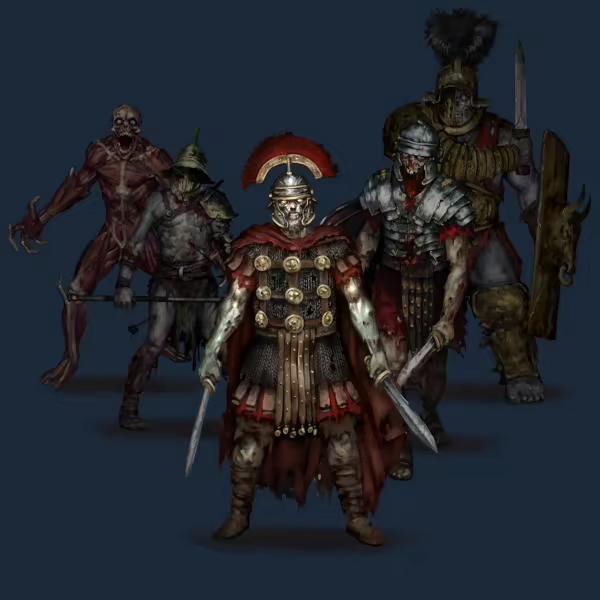
Grid-Based First Person Dungeon Crawler set in a Dark Fantasy version of the Imperial Rome. Create and develop your party, explore catacombs, manage your Gladiatorial School and fight demons and undead to free Rome. Inspired by old-school cRPG from the 80s and 90s.
Modeled estimate, not a reported figure. How we estimate →
About


Stats
All-time low is the lowest price we've recorded for this game since we started tracking it.
Languages: English, Italian, French
Engagement
Hours played at review time, across 40 reviews with recorded playtime.
Reviews
Themes across 40 recent reviews and how positive each mention is. A keyword signal, not full sentiment analysis.
positive critical· bar length = how often the theme comes up
Reviews
英語分からなくても結構なんとかなりますが、 レベルが上がるとダンジョン入るのにHSコストがかかるようになって 無駄遣いしていると詰みます。
It took me 70 hours to fully get through it. I was pretty slow and didnt max everyone out. I only had a core group of 4 and didnt branch out into different classes. I really enjoyed this game, the systems and UI made sense. It will be interesting to try different classes. I like the undead Roman setting, I prefer dark fantasy settings. Even though there are a ton of classes, it is always good to have more. I always spend a lot of time looking at the class options which is a lot of fun. Thanks for making the game, an A+ effort, and dont forget for next game keep dark fantasy setting, more classes and generally just more (well it was a good length but just want more of it ;))
Very fun dungeon crawler set in an "ancient Rome" setting, which is refreshing! The EXP you earn can only be used after completing a dungeon successfully, either on active skills/spells, passive abilities, abilities and to actually level up. This makes it interesting on how to develop your character. Loads of classes to choose from too. My only gripe is that it requires some grinding although one way to mitigate redoing the same dungeon multiple times is to crank up the enemy encounter level when you're nearing the end of the level. Overall, definitely recommended.
Best game in that style i've played so far. Quite challenging, interesting mechanics and amazing design, love that ancient Rome style
呪われた古代ローマが舞台のダンジョンクロウル。 敵キャラや装備品がローマ風。英語とラテン語が表示されるので面食らうが、そんなに難しいものは無い。ヘルプ画面のバフ/デバフの説明が読めれば問題なくプレイ可能。前作「Inferno」は延々デーモン軍団とのタイマンバトルだったが、今作は敵最大3体とのパーティバトルになり、戦術面でも攻略面でも段違いに面白くなった。 一番最初の剣闘士作成画面ではサイコロ振り振りステータス決めとなっており(ここが一番楽しかったりする)、正に「くんれんし”ょう」のごとく楽しめる。高い値がでるまでサイコロを振りまくろう。14のクラスがあるが、途中で転職とかマルチクラスにするとかはできない。どれも結構個性が際立っていて、早熟型/晩成型/専門型/万能型があり、いろいろなキャラを作成してパーティ編成しながら最適解を探すようなプレイとなる。 最終的には晩成/専門のクラスが最強と思われるが、ゲームクリアには最大レベルにする必要はなかったので万能クラスのパーティ編成でも大丈夫だった。早熟なクラスではゲーム中盤でスキルレベルが最大となってしまい、高位魔法が使えなかったりするが、INTやWIZ等の能力値は伸ばし続けることができるので低位魔法でも攻略に十分な火力は出せるバランスとなっている。そのへんのキャラクター育成のシステムバランスが絶妙で、このゲームの最大の魅力となっている。 その反面、キャラ育成がダンジョン探索より重視されているからか、どうしてもレベル上げ作業が必要な局面が多くなり、好みが分かれそうなところ。中盤くらいからレベル上げ専用のダンジョン(自動生成ダンジョン)が登場するので、攻略済のダンジョンに何度も潜るより作業効率化できるが、楽しいかは微妙。 また、登場武器やアイテムの種類も少なく(レアリティはそれぞれの装備アイテムにある)、各ダンジョンも1フロアしかないシンプル構成なので、ダンジョンの奥深くに危険を犯してレアアイテムを探しに行くようなスリルと興奮のようなものもなく、ただひたすら敵と戦ってパーティを育てていくだけのゲームとも言える。(さすがに初めて潜るダンジョンを一歩一歩探索するのは十分楽しいのですが) 自キャラを育てて強くしたり、最強のパーティや戦術を編み出すのが好きな人には非常におすすめ。レベル上げとか今時ねぇ・・・という人にはちょっと不向きなゲームです。
J'ai eu un peu de mal à comprendre comment aborder ce Ludus Mortis. Ceux qui ont joués à 7th Circles et sa suite (Beyond 7th Circles) , Ludis Mortis n'est absolument pas une suite aux 2 jeux précédemment cités. Il s'agit toujours d'un dungeon crawler , mais nettement plus tourné vers le die&retry . Ici on a une équipe de 4 persos . Pour gagner de l'xp , soit il faut finir le niveau (battre le boss) de fin ou (en fait dès le 1er on a pas le choix) aller jusqu'au boss de fin et sortir du donjon pour gagner 25% de l'xp et de l'or seulement car si vous vous faites tuer par le boss , vous aurez 0xp. Du coup , pas le choix , il faut refaire le donjon pour regagner de l'xp et ressortir et refaire le donjon ect...jusqu'à réessayer de battre le boss de fin de niveau pour passer à la suite. Même si en entrant de nouveau dans le donjon on conserve la carte et les loots précédents (lockpick ect) , je trouve ça quand même dommage d'avoir opté pour ce système car à aucun moment on nous dit qu'il serait peut être mieux de sortir que d'affronté le boss (ce que je me suis obstiné à faire 3 ou 4 fois...). Mais une fois passé cette frustration , le jeu devient vraiment plaisant. Il y a de bonnes mécaniques et se veut une sorte d'hommage aux anciens dungeons crawlers comme Eye of the Beholder , Dungeon Master , la série des Might&Magic , Wizardry ect... Chose sympa : les mobs gagnent des compétences par rapport au lvl précédent. Un même mob projettera de l'acide quand il meurt , du coup , si au niveau précédent vous le tuiez en 1er , ici il faudra le tuer en dernier pour ne pas qu'il vous asperge d'acide. Le développement des persos demandera beaucoup d'xp et les choix à faire seront cornéliens (à moins de refaire de très nombreuses fois les niveaux , mais au bout d'un moment , on ne gagne plus la même xp donc il faudra passer au niveau suivant). Un point négatif cependant est sur la traduction de l'équipement. Il est à moitié en fr et moitié latin (ou romain) , ce qui peut poser quelques soucis de compréhension....
It's pretty good. Not well balanced at all, most classes are pretty bad compared to the few that are extremely good It's the main flaw of the game, but it does stop being a flaw once you figure out the best party composition Levels are pretty repetitive, caves and catacombs aren't exactly super fun locations, especially when you can only see about a square and a half in front of you with a torch out Grinding is a must, pressing "U" a bunch to trigger encounters is the secret forbidden technique to succeeding at this game. The post-game "trials" were OK, they should have been set prior to the final level, but that's just me All in all though, if you like DRPGs and you want to have a comfortable time, get it.
Excellent blobber all around.
Ludus Mortis, developed and published by 68k Studios, is a dungeon crawler that deliberately looks backward rather than forward, drawing heavily from the traditions of classic grid-based RPGs while framing its experience within a dark reimagining of ancient Rome. It doesn’t attempt to streamline or modernize its core ideas for mass appeal; instead, it commits to a slower, more methodical style of play that emphasizes planning, resource management, and tactical decision-making. This approach immediately sets expectations: this is a game built for players who enjoy systems-driven progression and are willing to engage with mechanics that demand patience and attention. The setting is one of the game’s more distinctive qualities. Instead of the usual medieval fantasy backdrop, Ludus Mortis takes place in a decaying Roman world overtaken by necromancy and supernatural forces. The Senate’s desperate attempt to cling to power through forbidden means has unleashed horrors that now infest the city’s underground, creating a grim, oppressive atmosphere that permeates every dungeon. You are not cast as a singular chosen hero, but rather as the manager of a gladiatorial school, training and deploying fighters into these dangerous depths. This framing adds a layer of detachment that feels appropriate for the setting, reinforcing the idea that survival is uncertain and individuals are expendable in the face of a larger struggle. Gameplay revolves around first-person, grid-based exploration combined with turn-based combat, a structure that will feel immediately familiar to fans of classic “blobber” RPGs. Movement is deliberate, with each step requiring consideration, especially in tight corridors where positioning can dictate the outcome of an encounter. Combat itself leans heavily on preparation and party composition. With a wide selection of classes available, each bringing different strengths and tactical roles, success often hinges on building a balanced team and understanding how their abilities interact. There is little room for improvisation once a fight begins, making the choices made before entering a dungeon just as important as those made within it. Beyond the dungeon itself, the management of your ludus plays a central role in progression. Resources gathered during expeditions are used to recruit new gladiators, craft equipment, and upgrade facilities, creating a loop that ties together preparation and execution. This system adds a sense of continuity and purpose, as each successful run contributes to strengthening your overall operation. It also introduces an element of long-term strategy, encouraging players to think not just about surviving the next encounter, but about building a sustainable roster capable of handling increasingly dangerous threats. The game’s depth is both a strength and a potential obstacle. It offers a wide range of interconnected systems—equipment management, stamina considerations, class synergies, and exploration risks—that create a rich tactical experience. However, it provides little in the way of guidance, expecting players to learn through experimentation and, at times, failure. Mistakes can be costly, and progress may require revisiting earlier areas to gather resources or improve your party. This design philosophy aligns closely with its old-school influences, but it can feel unforgiving for those accustomed to more forgiving modern RPGs. Replayability is supported by randomized loot and dungeon variability, ensuring that each expedition carries a degree of unpredictability. Finding new gear and optimizing your party composition becomes a central motivator, though the repetition inherent in this loop may not appeal to everyone. The game’s pacing is intentionally slow, and while this can enhance immersion and tension, it may also test the patience of players looking for a more dynamic or story-driven experience. Visually, Ludus Mortis opts for a stylized presentation that emphasizes atmosphere over technical complexity. The environments are dark and foreboding, filled with shadowy corridors and unsettling enemy designs that reinforce the tone of a world in decline. While the graphics are not particularly advanced, they serve their purpose well, maintaining clarity during exploration and combat. The interface, however, reflects its retro inspirations, which can make navigation and management feel somewhat cumbersome until you become familiar with its layout. In the end, Ludus Mortis is a focused and uncompromising take on the dungeon crawler genre. It delivers a deep, strategic experience that rewards careful planning and persistence, wrapped in a setting that offers a refreshing departure from typical fantasy tropes. Its refusal to cater to modern sensibilities may limit its appeal, but for players who appreciate the deliberate pace and complexity of classic RPG design, it provides a satisfying and immersive challenge that stays true to its roots. Rating: 8/10
★★✰✰✰
Related
Related
Trends
Concurrent players on Steam, sampled daily since tracking started.
Audience
Estimated from the language of this game's reviews — a proxy for where players are, not official Steam demographics.
Related
| 7 Days to Die | $425.3M | 403.5K | 87% | $44.99 |
| Mount & Blade II: Bannerlord | $309.8M | 293.9K | 88% | $49.99 |
| Palworld | $279.6M | 445.8K | 94% | $20.99 |
| Clair Obscur: Expedition 33 | $263.7M | 178K | 95% | $47.99 |
| Stardew Valley | $243.2M | 1M | 98% | $14.99 |
| Project Zomboid | $239.1M | 460.8K | 94% | $19.99 |
Related
| Tea For God | $39K | 94 | 95% | $19.99 |
| Polismos | $39K | 60 | 75% | $19.99 |
| ChainStaff | $39K | 95 | 94% | $14.99 |
| Interregnum: False Prophet | $39K | 58 | 59% | $24.99 |
| 1bitHeart | $39K | 915 | 91% | $2.99 |
| Foreign Legion: Multi Massacre | $39K | 309 | 61% | $4.99 |