A fully voiced branching narrative RPG of the Roman arena with a unique engraving and VO for every choice and outcome. Four origins, over 1,800 choices, and 19 endings. You will bleed on the sand. The only question is whether you bleed for them, or for yourself. Every choice leaves a scar.
Modeled estimate, not a reported figure. How we estimate →
About
A fully branching narrative Roman Gladiator RPG across 12 chapters.
"You will bleed on the sand. The only question is whether you bleed for them, or for yourself."

A fully branching narrative RPG set in the blood and politics of the Roman arena. You arrive at the ludus with nothing but your origin and your will. What you become is written one choice at a time, and the story remembers every one of them. This is not a game about winning fights. It is a game about what the fighting costs you, and who is left standing when the crowd finally stops chanting your name.

The Slave. Born in chains. The arena is just another cage.
The Conquered. A warrior brought low by Roman iron.
The Debtor. Sold by the courts. Survival is a transaction.
The Volunteer. You chose this. The crowd will remember.

Ludus tracks who you are, not just what you can do. Your character grows across three kinds of stat:. Body and mind: Body, Nerve, Discipline, Cunning, Mind, Perception.
. Your standing in Rome: Fame, Crowd Favor, Roman Approval, Solidarity.
. Your soul: Defiance, Mercy, Rage, Humanity, Faith, Spirit, Cruelty, Despair, Obedience, Pride.
You earn these through choices, never through grinding. The soul stats are the hardest to master and the ones that matter most, because they decide which paths open to you and which quietly close. Two players can walk the same chapter and never see the same story.
577 historically grounded events. Over 1,800 choices. One arc that runs from your first morning in the training yard to the final question of what remains when the games are over.

Triumph, tragedy, exile, martyrdom, escape, rebellion, political compromise, or quiet freedom. The Champion. The Martyr. The Rebel King. The Honored Exile. The Freedman. The Escaped. The Senator's Hand. The Survivor. No two playthroughs close the same way, and every ending is a consequence you can trace back to the sand.
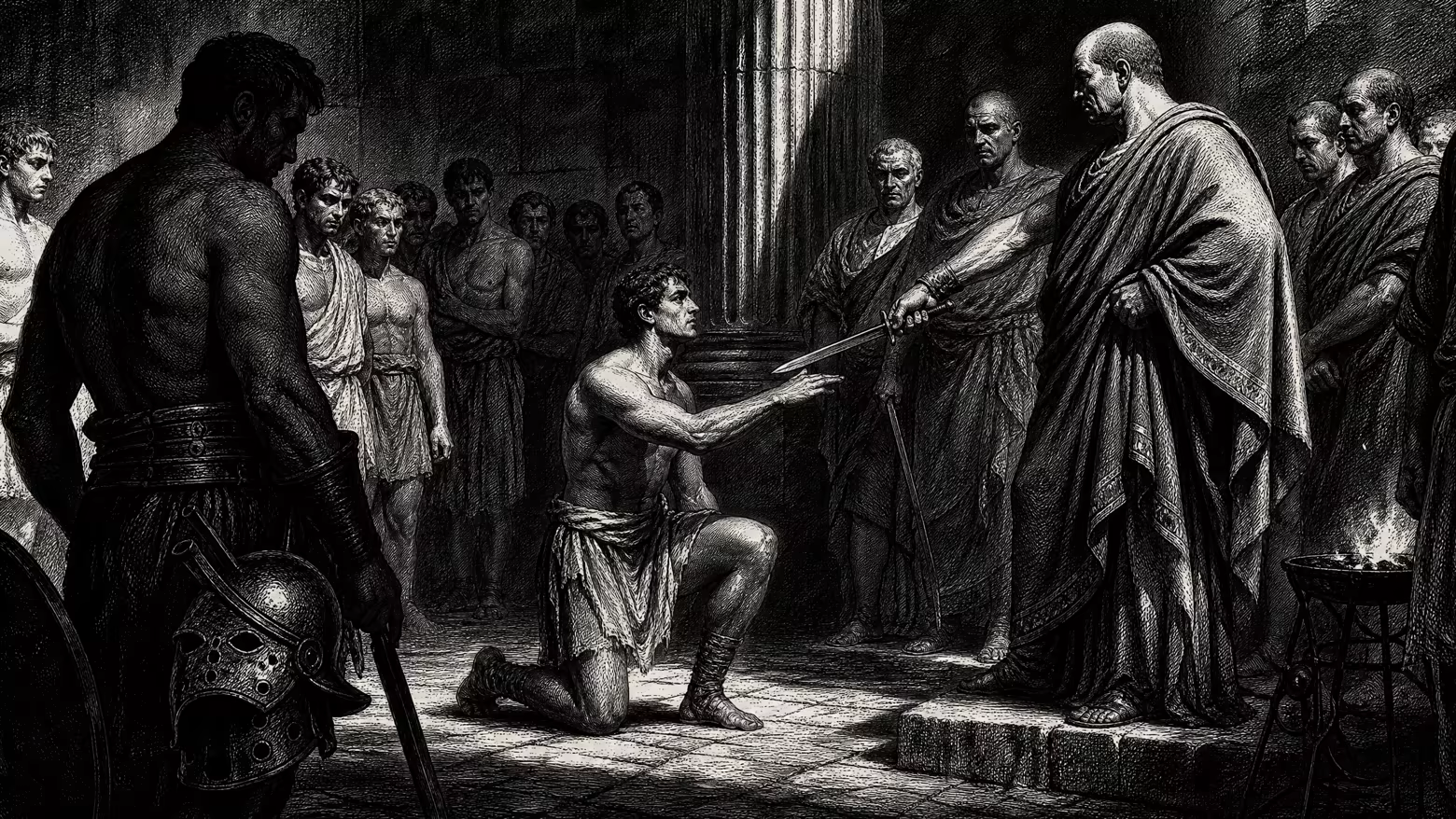
Over 2,500 bespoke pen-and-ink illustrations, engraved in the style of Roman antiquity, carry every event and every choice.

An original score and ambient soundscape. Each chapter has its own musical composition and environmental audio, shifting from the dusty heat of the training ground to the roar of fifty thousand Romans to the quiet of a cell the night before everything changes.
Three manual save slots plus autosave. Explore different origins and paths without losing your progress. The chapter select lets you return to any chapter you have already completed.


Genres
Stats
All-time low is the lowest price we've recorded for this game since we started tracking it.
Add-ons
Each DLC is estimated with the same model as a game, then summed — a modeled figure, not reported DLC sales.
Reviews
Sadly its AI garbage. First couple chapters at least playable and demo gived me good first impression but its super bad later on. Choices not matter, different naration voices even robotic ones. Game is in super bad shape cos its AI coded and its just mess. Do not buy it. Nothing can fix it. Не покупайте игру ребят, просто мусор.
[h1][b]Not Recommended[/b][/h1] Truth be told, this game has the foundation for an enjoyable interactive RPG, but its current execution leaves a lot to be desired. While the clean presentation and historical aesthetic initially drew me in, the AI slop was a huge red flag for me. But ignoring that for now, by the end of my playthrough, I was left feeling that the game's systems needed far more refinement before they could support the experience it aims to deliver. [b]Choices & Progression[/b] The core appeal of a choice driven RPG is that your decisions matter. Unfortunately, Ludus rarely delivers on that promise. Many dialogue options that should logically produce vastly different outcomes often reward the same, or even greater, trait bonuses regardless of the decision made. This makes the progression system easy to exploit, removing any incentive to carefully consider your choices. Rather than shaping your own gladiator, it often feels like you're simply selecting whichever option grants the best statistics. The game would benefit greatly from a complete rebalance of its choice system, with stronger long-term consequences and meaningful butterfly effects that encourage replayability. [b]Writing[/b] There is clearly ambition behind the narrative, but the presentation makes it difficult to stay invested. Large blocks of text are frequently interrupted by punctuation and grammatical inconsistencies, and important names, events, and locations often become lost within lengthy passages. Highlighting key information or improving text formatting would go a long way towards making the story easier to follow. [b]Visuals[/b] Visually, the user interface is one of the game's strongest qualities. The menus are clean, easy to navigate, and evoke the feeling of classic CRPGs such as Baldur's Gate. Unfortunately, the interface itself isn't always as polished as it looks. Rapidly progressing through dialogue can cause page transitions to stutter or even return to previously viewed pages, making reading feel clunky rather than seamless. The game also relies heavily on AI-generated artwork and voice acting. While this may not bother every player, the visuals are often inconsistent, and the voices lack the emotion and natural delivery needed for dramatic scenes. As a result, the presentation struggles to maintain immersion. [b]Optimization & Content[/b] One aspect I found particularly difficult to overlook was the install size. Despite occupying roughly 29 GB of storage, I completed the game in under an hour. For a predominantly text-driven RPG, the amount of content simply doesn't justify the storage requirements in its current state. Better optimization and compression would significantly improve the overall package. [b]Okay finally[/b] There is potential here. The historical setting is interesting, the UI is attractive, and the concept itself has promise. However, the gameplay systems currently undermine player choice, the writing requires further editing, the presentation feels inconsistent due to its AI-generated assets, and the optimization is surprisingly poor for the amount of content available. With substantial revisions to the choice system, meaningful story consequences, writing quality, optimization, and overall presentation, Ludus could become a much stronger experience. As it stands, however, I cannot recommend it. [h1][b]Note to developer[/b][/h1] [b]I cannot say this enough, AI slop games will never be as successful and or enjoyed to the same degree as human made games. Please choose to support actual artists to create a more lasting experience.[/b]
Media

Related
Related
Price dynamics, follower growth, revenue and sales trajectories with interactive tooltips
This and every other Pro feature is free until October 20, 2026. A free account is all it takes.
Languages: English*, Italian, German, Spanish - Spain, Portuguese - Brazil, Russian, Simplified Chinese, Japanese, Spanish - Latin America*languages with full audio support
The game is not really good. The storyline feels very inconsistent. Characters appear or disappaer seemingly randomly. The game´s illustrations seem rather random as well.
A truly pathetic effort. 99% of the stats never affect anything, the transitions are completely random, like, you're in the middle of some fight, but a moment later you're eating. Characters just come and go. The story is 100% AI-generated, did you even have the decency to read it through? Refunded.
The stories start playing in seemingly random orders with scenes like the night before the rebellion playing right before a fight with Verrix. Seems to fall apart noticeably in chapter 3, but you have clear references to origins you didn't play pop as early as the second chapter.
Refunded. So disappointed to find this was just AI created with no attention to detail as pages didnt match up with choices. Sad whats happening in the industry
Incoherent AI story.
Aparentemente apenas um amontoado de texto gerado por IA. A ideia é boa, mas não tem mecânicas próprias de um jogo e é muito inconsistente e confuso. Coisas se repetem, aparecem fora de ordem, esquece suas escolhas, ate a voz do narrador muda subitamente.
Game has potential but should have been flagged as Early Access. Some issues that need to be worked out before recommending to others: - Pages within chapters are often out of sequence, making the narrative inconsistent and confusing; - Event outcomes and tags not applying properly. For example, despite playing as an Honorable Debtor, many of the options that should have been unlocked for me remained locked. Likewise, options that should have been unlocked with certain in-game choices remained locked - Pacing of skill progression is all over the place. Some skills/attributes are easy to max in the early stages of the playthrough, while others are not - UI doesn't do a great job tracking inventory items or story unlocks, nor does it explain more obscure mechanics very well (i.e. there is a skill cap for attribute gains on certain chapters, after which all points go to Will. But neither the cap nor the transfer mechanic are well articulated)
Ludus: A Gladiator Story (First Impressions Review) After several hours with Ludus: A Gladiator Story, I can confidently say this is not the gladiator game I expected—it is something much more thoughtful. Rather than rushing you into the arena with swords and spectacle, the game begins by asking a much more interesting question: What does it mean to become a gladiator? The opening chapters aren't about fighting. They're about losing everything. You witness your village destroyed, are captured by Rome, marched across Italy in chains, sold in the slave markets, stripped of your identity, and slowly forced to confront what it means to survive without becoming the very thing your captors want you to be. That premise is executed remarkably well. Writing – 10/10 The writing is easily the game's greatest strength. The prose consistently feels mature and deliberate without becoming overly flowery. Every chapter contains lines that make you stop and think. Some of my favorite examples include: "You are looking at it as a map." That single sentence perfectly summarizes the transformation of the protagonist from warrior into strategist. Another excellent passage reads: "Adaptation is also surrender. And you can feel exactly where the one shades into the other." That's an incredibly nuanced observation about captivity. Even something as simple as learning Latin becomes a philosophical discussion about identity rather than just another skill tree. The game repeatedly asks difficult questions: Does surviving mean surrendering? Can you learn from your enemy without becoming them? How do you preserve your culture after losing your homeland? Is memory itself an act of resistance? Those themes elevate the experience far beyond a typical historical adventure. Choice Design – 9.5/10 Many games advertise meaningful choices but ultimately funnel players toward the same result. Here, the choices don't necessarily change where the story goes—but they genuinely shape who your protagonist becomes. Throughout the opening, I found myself choosing between: pride versus patience resistance versus adaptation memory versus survival emotion versus strategy None of the choices felt obviously "good" or "evil." Instead, they felt like genuine personality decisions. By the time we reached Rome, my character no longer felt like a generic barbarian. He had become someone with a consistent philosophy. That is excellent role-playing design. Historical Atmosphere – 9.5/10 As someone playing specifically to evaluate historical authenticity, I have been impressed. Nothing has felt like Hollywood Rome. Instead, Rome feels enormous, indifferent, organized, and frighteningly efficient. The descriptions of: slavery Roman bureaucracy auctions language infrastructure discipline all feel grounded. The game understands that Rome's greatest weapon wasn't simply its army. It was its systems. That comes through repeatedly. The Philosophy This surprised me the most. Instead of glorifying gladiators as unstoppable heroes, the game spends its opening examining slavery, identity, and survival. It constantly returns to questions like: What is freedom? What is dignity? What parts of yourself can never be conquered? That gives the narrative emotional weight. Minor Historical / Continuity Issue The only issue we've noticed so far is a small continuity problem involving the roads. At one point the narrative appears to identify the journey to Rome using the Via Appia, despite that road historically running from Rome toward Capua. It's likely just a wording or sequencing issue rather than a misunderstanding of Roman history, and it's an easy fix. Considering how historically grounded everything else has been, this is a very minor criticism. What We Haven't Seen Yet This review only covers the opening portion of the game. We still need to experience: gladiator training the ludus arena combat character progression relationships with fellow gladiators the larger story Those systems will determine whether the game maintains the quality established in its opening chapters. Final Thoughts (So Far) If the remainder of the game maintains this standard of writing, Ludus: A Gladiator Story has the potential to become one of the strongest historical narrative games about ancient Rome. Rather than presenting gladiators as action heroes, it presents them as human beings—people with memories, languages, cultures, and identities that Rome could chain but never fully erase. That perspective is refreshing, historically grounded, and emotionally engaging. Current Recommendation: Highly Recommended (based on the opening chapters) Current Score: 9.5/10 It's rare to find a game that treats history not just as a backdrop for action, but as the foundation for exploring what it means to lose everything—and still choose who you are.
Selling now
See how fast this game is selling right now — estimated copies and revenue per day from recent review growth.
Related
| Game | Estimated lifetime revenue | Reviews | Review score | Price |
|---|---|---|---|---|
| $0 | 1.1K | 87% | Free | |
| — | 0 | — | — | |
| $698K | 2.7K | 74% | $7.99 | |
| $30.6K | 1.1K | 94% | $1.19 | |
| $9.6K | 33 | 88% | $8.99 | |
| $8.5K | 36 | 92% | $17.99 |
Related
| Game | Estimated lifetime revenue | Reviews | Review score | Price |
|---|---|---|---|---|
| $4.5K | 142 | 77% | $0.99 | |
| $4.5K | 213 | 49% | $0.99 | |
| $4.5K | 53 | 79% | $4.99 | |
| $4.5K | 112 | 76% | $1.99 | |
| $4.5K | 256 | 62% | $0.99 | |
| $4.5K | 146 | 81% | $2.99 |