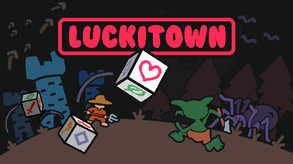
Luckitown is a turn-based tower defense where you roll dice to build new structures and cast spells to defend your town.
Modeled estimate, not a reported figure. How we estimate →
Media

About
Genres
Stats
All-time low is the lowest price we've recorded for this game since we started tracking it.
Languages: English
Engagement
Reviews
Themes across 40 recent reviews and how positive each mention is. A keyword signal, not full sentiment analysis.
Reviews
SOCKpop 게임 다 해보는거 같네요. 다 재밌어.. 플탐 짧지만 제법 난이도 있고 난이도 있어도 하다보면 어케든 깨게되고 일단 재밌음.. 이것도 재밌었어요 ㄳㄳ
very fun play game good very game fun play good fun play very game good fun You can go for different playstyles, different econ and different defensive strategies. Has just enough challenge where the win is never free. Thenk you
worse than flash games
Related
Related
Trends
Modeled estimate over time, reconstructed from Steam's monthly review histogram.
Hours played at review time, across 40 reviews with recorded playtime.
positive critical· bar length = how often the theme comes up
Roll (and re-roll) dice to generate resources. Spend resources to make buildings. Buildings will auto-attack incoming enemies and generate new dice. It's slick, addictive, turn-based yahtzee tower defense. The game probably takes 40 minutes to "finish", but it's hard enough that I have easily logged 6+ hours on the itch version trying and failing to survive all four seasons and defeat the final boss. Total banger.
a fun short game with pretty graphics. often flustrating and unbalanced, but overall I enjoyed it. took about 4 attemps to win. - bomb tower blows up half of your defences. - some towers do not re-aim when an enemy dies and shoot into the ground - arrow towers are basically uselles after 10 turns - friendly units will sometimes spawn in enclosed spaces + cheap game + wide variety of buildings to place -> diffrent strategies + unique dice (workshop, menhir, farm) + just the right difficulty and lenght + simple but beautiful artstyle
Good tower game. Getting all the achievements is proving to be hard.
Yep.
Luckitown, developed and published by Sokpop Collective, is a cleverly designed hybrid strategy game that merges dice-based randomness with town building and tower defense mechanics. At first glance, its colorful, minimalist presentation suggests a lighthearted casual experience, but beneath that accessible surface lies a surprisingly intricate system built around probability management, spatial planning, and long-term survival. The core concept is simple yet distinctive: every turn revolves around rolling dice, and those dice dictate what you can build, upgrade, or cast as you attempt to defend your growing settlement from relentless enemy waves. The entire game unfolds as a single extended survival session. Rather than dividing gameplay into short missions or discrete levels, Luckitown challenges players to endure as long as possible against steadily escalating threats. At the start of each turn, you roll a set of dice that display various resource symbols. These symbols represent materials used to construct buildings, reinforce defenses, and activate spells. You can choose which dice to use immediately and which to hold for future turns, introducing a compelling tension between short-term survival and long-term strategy. The decision to spend a roll now or preserve it for a critical future action becomes one of the game’s central dilemmas. Town expansion is driven by careful placement and synergy between structures. Basic buildings generate additional dice or provide passive bonuses, while defensive towers attack incoming enemies. Farms, workshops, magical structures, and support buildings all contribute to a growing web of interactions that gradually transforms your humble settlement into a fortified stronghold. Placement matters significantly, as certain structures benefit from proximity to others. Defensive buildings must be positioned strategically to intercept waves efficiently, while economic structures need protection to sustain long-term growth. The interplay between expansion and defense keeps the player constantly recalibrating priorities. What makes Luckitown particularly engaging is how it integrates randomness without surrendering control entirely to chance. Although dice rolls introduce unpredictability, the game provides enough agency through dice retention, resource management, and building combinations to reward thoughtful planning. Success depends on adapting to the roll rather than rigidly pursuing a single strategy. Over time, players learn to anticipate probabilities and construct flexible town layouts that can withstand fluctuations in resource availability. The system captures the thrill of chance while ensuring that strong decision-making remains the dominant factor in survival. Enemy waves intensify steadily, introducing greater pressure as the settlement grows. Early threats are manageable with minimal infrastructure, but later assaults demand carefully layered defenses and efficient resource allocation. The pacing ensures that complacency is punished. Even a well-built town can falter if dice rolls are mismanaged or if defenses are poorly positioned. This creates a satisfying arc where each successful wave feels earned through deliberate preparation rather than mere luck. Visually, Luckitown embraces a clean and readable 2D art style characteristic of Sokpop’s design philosophy. Buildings and units are rendered with simple shapes and vibrant colors, ensuring clarity even as the town becomes densely packed with structures. The minimalism enhances functionality, allowing players to quickly interpret the board state during critical moments. The soundtrack is understated and unobtrusive, providing a calm backdrop that contrasts with the rising tension of advancing enemy hordes. Despite its depth, Luckitown remains approachable. The rules are easy to grasp, and early turns introduce mechanics gradually. However, the game reveals surprising strategic nuance over extended sessions. The variety of available buildings and resource combinations encourages experimentation across multiple runs. While the core loop remains consistent, different dice outcomes and strategic choices can lead to diverse town layouts and defensive approaches. Some players may eventually recognize recurring patterns in enemy waves, but the inherent unpredictability of dice keeps each playthrough dynamic. Ultimately, Luckitown stands out as one of Sokpop Collective’s more mechanically layered projects. It successfully fuses city-building logic, tower defense tension, and dice-driven probability management into a cohesive and addictive experience. Its balance between randomness and strategy ensures that every run tells a slightly different story of risk, adaptation, and survival. For players who enjoy thoughtful planning wrapped in a compact and visually charming package, Luckitown offers a uniquely satisfying blend of luck and logic that continues to engage long after the first roll of the dice. Rating: 7/10
I requested a refund. I think there's a problem with this "genre" of roguelite games where it's wholly rng. There's no way or time to focus on strategy or learning the mechanics, because you're entirely at the whims of the dice. If you could weight the dice in one favor or another that would balance it out and give players a fair chance, but I really think this kind of game just needs to stop being made. Dice Legacy has the same issue.
这是我小时候拥有电脑时购买的第一款游戏,记得当时拿笔记本电脑游玩还买到了盗版哈哈哈
Momentum
Pace estimated from the game's recent review growth (our daily snapshots) at its own sales-per-review ratio — a momentum signal, not booked sales.
Audience
Estimated from the language of this game's reviews — a proxy for where players are, not official Steam demographics.
Related
| Desktop Kitten Girl | $39.2K | 276 | 87% | $3.99 |
| The Moon Hell | $39.2K | 172 | 77% | $8.24 |
| The Music Machine | $39.2K | 490 | 88% | $4.99 |
| Cyber Crush 2069 | $39.2K | 779 | 74% | $1.99 |
| Club Life | $39.2K | 138 | 81% | $7.49 |
| Goblin Buster: Incremental Tower Defense | $39.2K | 157 | 77% | $6.99 |