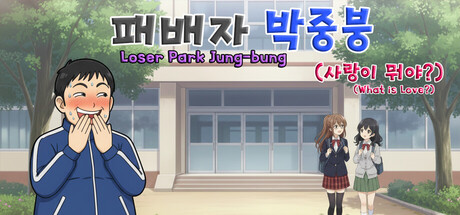
Loser Park Jung-bung: (What is Love?) is a JRPG-style Visual Novel with Dating Simulation elements. Start your romance by striking up a conversation with women you meet by chance! Experience a variety of episodes, begin dating, and complete your own definition of love!
Modeled estimate, not a reported figure. How we estimate →
Media

About
Loser Park Jung-bung: (What is Love?) is a JRPG-style Visual Novel with Dating Simulation elements.
Meet Park Jung-bung, an utterly ordinary man born without any special abilities. He’s a struggling, unpopular game streamer who is practically unemployed. Despite his seemingly hopeless situation, an opportunity for romance suddenly arrives!
In this game, you will craft your own love story by helping female characters and going on dates with them in various locations.
Your choices in the game are crucial. Making the wrong decision can lead to an immediate Game Over, while the right choices will deepen your relationship with the female characters and open doors for exciting developments.
Engage in conversations with NPCs throughout the town to gather various pieces of information, and use them to complete your heartwarming romance!
🕹️ Simple Controls and Battle System: Enjoy easy-to-learn turn-based combat that even beginners can pick up quickly.
🌿 Simple and Compact Map: Explore a small, straightforward map packed with diverse episodes and story events.
🎭 Charming Characters: Date and interact with cute and captivating characters.
🧍♀️ High-Quality Graphics: Experience dramatically improved graphics and stunning visuals compared to the previous title.
Movement: Arrow Keys (Up, Down, Left, Right)
Interaction: Spacebar
Running: Left Shift Key
Stats
All-time low is the lowest price we've recorded for this game since we started tracking it.
Languages: Korean**languages with full audio support
Reviews
Moin, Ich habe seit langer zeit kein geileres spiel als das gespielt und muss sagen dass es einfach geil aber auch traurig zugleich ist. Ich habe 30 Shiba Inus getötet nur um aus der Privat Insolvenz raus zu kommen und danach mit der Dame, Eis essen zu gehen oder auf ein käffchen zu gehen. Ich wurde 2 mal gebaitet von diesen Träumen und wir hatten ein sehr geiles Happy Ending gehabt aber ich hätte mir besser vorgestellt, dass die Träume in wirklichkeit ingame passiert hätten weil sonst ist das game nur purer Bait. Und du hast die selben UI copy pasted von anderen spielen die du schon veröffentlicht hast. Dann noch eine Sache wo ich mich beschwere ist die NPC die nur rumlaufen und im weg stehen also ich bitte euch. Dann was soll das ganze ♥♥♥♥ mit den Waffen und Magie wenn ich eh ein übergewichtiger mann bin der die ganze zeit die selbe Adidas Temu Sportanzug trage und er 5-mal in denen durchschwitz als wäre er ein Wasserfall. Dann habe ich 10 min gebraucht nur um in der Story weiter zu kommen und in der Hoffnung Yuna zu smashen. Ansonsten war es ein schönes spiel und würde es keinem empfehlen außer euer leben ist genau so scheiße wie von Loser Park Jung-bung (wortwörtlich loser). P.S.: Bitte mach ein game rein wo man wirklich nicht gebaitet wird und mal etwas aktion sieht und nicht das DJ Kahled wegläuft und ins wasser spring weil sonst die chili con Carne aus seinem Ass rauskommt Lg Verfauke Westi, Toothpaste
패배자 박중붕(사랑이 뭐야?) Loser Park Jung-bung (What is Love?) by SEO SOFT is a quietly unconventional narrative experience that leans more into introspection than spectacle, presenting a story centered on an unremarkable protagonist trying to navigate both life and relationships. Instead of offering an escapist fantasy filled with heroic achievements or dramatic stakes, the game deliberately grounds itself in the mundane struggles of everyday existence. Park Jung-bung is not designed to impress; he is awkward, uncertain, and often stuck in cycles of self-doubt, which gives the entire experience a tone that feels more personal and occasionally uncomfortable in its honesty. The game unfolds primarily through dialogue and decision-making, with a structure that resembles a visual novel but incorporates light exploration and gameplay elements to add variety. Conversations are the backbone of the experience, and the choices you make shape how relationships evolve and how the story progresses. These decisions are not always straightforward, often reflecting the ambiguity and unpredictability of real social interactions. A single misstep can lead to awkward outcomes or even early endings, which reinforces the idea that the game is less about winning and more about understanding consequences. This branching structure encourages multiple playthroughs, as different approaches can reveal new sides of both the protagonist and the supporting cast. While the narrative is the clear focus, the game does attempt to break up its pacing with simple RPG-style mechanics. Exploration segments allow players to move through a compact world, interacting with characters and triggering events, while occasional turn-based encounters add a layer of gameplay beyond dialogue. These systems are easy to grasp and serve their purpose in giving the player something to do between story beats, but they remain relatively shallow throughout. They never evolve into anything particularly complex, which means they function more as support for the narrative rather than as compelling mechanics in their own right. One of the game’s most notable strengths lies in its characterization. Park Jung-bung’s flaws are front and center, and the game does not shy away from portraying him in an unflattering light at times. This makes his interactions feel more grounded, as he struggles with insecurities and awkward social situations that many players may find relatable. The supporting characters add variety to the experience, each bringing their own personalities and dynamics into the story. Some interactions lean toward comedic awkwardness, while others carry a more sincere emotional weight, creating a balance that keeps the narrative from feeling one-dimensional. Visually, the game follows a familiar 2D style commonly associated with smaller-scale RPG and visual novel projects. Character portraits and illustrated scenes do most of the heavy lifting in terms of presentation, conveying emotion and tone effectively even if the overall aesthetic remains simple. There is a noticeable mix of art styles in certain parts, which can feel slightly inconsistent, but it does not detract significantly from the experience. The focus remains firmly on the writing and character interactions rather than visual spectacle. The tone is an interesting blend of humor and introspection. On the surface, there are moments of lightheartedness and even absurdity, particularly in how the protagonist reacts to situations. Beneath that, however, is a more reflective exploration of loneliness, self-worth, and the often confusing nature of relationships. The game poses its central question, what is love, not as something to be definitively answered, but as something to be experienced through trial, error, and personal growth. This gives the narrative a sense of sincerity that stands out, even when the execution is uneven. That said, the game’s limitations become more apparent over time. The scope is relatively small, and while multiple endings add replay value, the core experience does not change drastically between playthroughs. Some parts of the writing can feel inconsistent, with certain scenes resonating more strongly than others. The gameplay elements, while appreciated, do not add much depth, and players looking for a more mechanically engaging experience may find themselves underwhelmed. It is very much a story-first game, and its success depends heavily on how much the player connects with its themes and characters. In the end, Loser Park Jung-bung (What is Love?) is a modest but thoughtful project that prioritizes character and emotional nuance over complexity. It offers a different kind of experience, one that focuses on small, relatable struggles rather than grand narratives. While it may not appeal to everyone, particularly those seeking deeper gameplay systems or a more polished presentation, it leaves an impression through its honesty and its willingness to explore imperfect characters. It is a game that invites reflection as much as it provides entertainment, and that alone gives it a unique place among similar titles. Rating: 7/10
[b]사랑[/b]을 깨닫게 해주는 게임 [b]인생[/b]이 담긴 철학적인 게임 그저 [b]GOAT[/b]
중하하하
Related
Related
Trends
Modeled estimate over time, reconstructed from Steam's monthly review histogram.
Related
| Food and Girls | $315.6 | 51 | 86% | $0.99 |
| Glasses and Girls | $315.6 | 51 | 82% | $0.99 |
| Dances and Girls | $322 | 52 | 83% | $0.99 |
| Anime Sunset Ride | $334.4 | 54 | 67% | $0.49 |
| Carnival and Girls | $334.4 | 53 | 85% | $0.99 |
| Cosmic Journey PC Live Wallpaper | $336.3 | 52 | 71% | $0.49 |