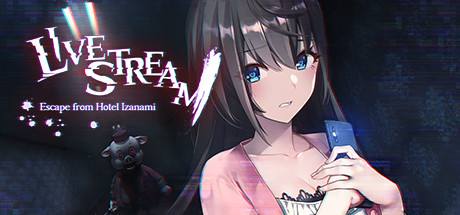
Livestream: Escape from Hotel Izanami, developed by qureate and Orgesta Inc. and published by qureate, is a side-scrolling horror adventure that combines visual novel storytelling, exploration, and survival elements into an eerie and unsettling experience. The premise is modern yet steeped in traditional Japanese horror: three young streamers—Mio, Nana, and Azusa—enter the long-abandoned Hotel Izanami to film a livestream exploring its supposed hauntings. What begins as a gimmick for social media clout turns into a nightmare when they discover that something malicious is alive within the hotel’s decaying walls. The result is a chilling game that balances tension and vulnerability, using the aesthetics of digital age voyeurism to explore both the thrill and terror of broadcasting fear for an audience.
Visually, the game immediately sets itself apart from other low-budget indie horror titles through its effective use of 2D environments, layered lighting, and expressive character animations. The hotel’s corridors are steeped in darkness, punctuated only by the dim glow of your flashlight and the flicker of old lights struggling to stay alive. The textures are gritty and realistic enough to immerse you, while the anime-styled characters, animated via Live2D, contrast sharply against the grimy backdrop—an intentional dissonance that amplifies unease. The sound design completes the effect: creaking floorboards, faint whispers, and the distant echo of footsteps echo through the halls, ensuring that silence is never comforting. The Japanese voice acting adds emotional weight to the narrative, especially in moments of panic or exhaustion. While much of the game is presented from a 2D side perspective, it never feels flat; every space feels like a tangible, haunted environment that breathes its own sinister life.
The core gameplay alternates between exploration, puzzle-solving, and high-stress chase sequences. As you navigate the hotel, you must search for items, examine clues, and uncover keys or codes that open new areas. These puzzles are rarely complex but require careful observation and a willingness to explore every nook and cranny. The game’s signature threat, a grotesque mascot character dressed in a pig costume, serves as the central source of terror. Its slow, relentless pursuit of the protagonists creates an atmosphere of constant dread. The first time it appears, it seems almost comical, but as the game progresses, its unpredictability and brutality make it truly terrifying. When the mascot arrives, the tone shifts abruptly from quiet investigation to frantic survival, forcing you to hide, run, or risk instant death. These encounters can feel unfair at times, especially since the creature can spawn suddenly with little warning, but the randomness also keeps players on edge, preventing complacency.
One of the most distinctive qualities of Livestream: Escape from Hotel Izanami is how it weaves its horror around modern digital culture. The protagonists’ profession as streamers adds a meta-commentary on performance and voyeurism—the very act of documenting fear becomes a source of danger. There’s an underlying sense that the horror isn’t just supernatural but also social, reflecting the exploitative nature of chasing views and attention at any cost. This concept gives the story an intriguing foundation, though the execution sometimes leans too heavily on surface-level scares and fanservice rather than fully exploring its thematic potential. The narrative unfolds through a combination of in-game events and visual novel-style dialogue sequences, giving insight into each character’s personality. While some scenes effectively build tension and empathy, others linger too long on dialogue or shift tone abruptly, diluting the pacing of the horror. Despite this inconsistency, the characters are likeable enough to make you care about their fate, particularly Mio, whose determination to protect her friends grounds the story emotionally.
There are moments where the game’s tone wavers between horror and sensuality, a hallmark of qureate’s catalog. Some sequences introduce lightly erotic elements—such as the option to touch or interact with the characters in suggestive ways—that feel jarring in the middle of otherwise tense situations. For some players, this mixture of fanservice and fear will feel out of place, breaking immersion; for others, it’s simply part of the studio’s established identity. Thankfully, these moments are not pervasive enough to dominate the experience, and they remain mostly optional. The underlying horror remains effective, particularly when the game emphasizes vulnerability and isolation over shock or titillation. The multiple endings, each shaped by your choices and level of exploration, add a layer of replayability. Completing the story once leaves enough unresolved mysteries to tempt players into revisiting the hotel in search of alternative outcomes and hidden lore.
The game’s greatest strength lies in its atmosphere. Everything—from the claustrophobic corridors to the sound of distant mechanical hums—conspires to create a sense of unease that never fully dissipates. The limited save points, available only at specific terminals, enhance this tension, forcing players to weigh risk and reward before pressing deeper into danger. The flashlight mechanic, too, contributes to the constant anxiety of limited visibility and the fear of what might lurk just outside your beam of light. When the pacing is right, the experience feels genuinely nerve-wracking, with perfectly timed scares and a creeping dread that stays under your skin. However, when the pacing falters—due to repetitive backtracking, abrupt deaths, or uneven checkpoint placement—it can lead to frustration rather than fear. The balance between tension and fairness isn’t always consistent, but the overall design ensures that players remain alert and cautious throughout.
Livestream: Escape from Hotel Izanami is ultimately a unique entry in the anime horror genre—a fusion of classic survival mechanics, narrative experimentation, and digital-age anxiety. It doesn’t reach the narrative sophistication of psychological horror masterpieces, nor does it deliver the smooth pacing of larger survival titles, but it compensates with atmosphere, presentation, and an earnest commitment to its unsettling premise. Its flaws, from sudden deaths to uneven tone, are noticeable but not fatal to the experience. What lingers after the credits roll is not frustration but the image of flickering screens, empty hallways, and the echo of voices that were never meant to be heard. For players who appreciate Japanese horror with a modern twist—one that flirts with the absurd but remains genuinely tense—this game offers a haunting and memorable journey through the ruins of vanity, fear, and survival.
Rating: 7/10