Little Rooms by CCS is a relaxed hidden object experience that focuses on atmosphere, observation, and quiet satisfaction rather than difficulty or complexity. It presents a series of small, carefully arranged spaces where the player’s role is simply to look closely, take their time, and gradually uncover objects hidden within each environment. The game immediately establishes a calm tone, encouraging a slow and deliberate pace that feels more like exploring a cozy space than solving a traditional puzzle.
The main gameplay loop revolves around searching for items placed throughout various rooms, each acting as its own contained scene. At first, the objective is straightforward, locate a set of objects from a list. However, the challenge comes from how these items are integrated into the environment. Objects are often placed in ways that blend naturally with their surroundings, requiring players to pay attention to small details and think about how shapes and colors might disguise them. This creates a satisfying process of discovery, where each find feels earned through observation rather than trial and error.
To keep the experience from becoming too repetitive, the game introduces several variations on this core idea. Some modes ask players to locate the same type of item multiple times, while others rely on riddles or clues instead of direct lists. There are also moments where players must search for more abstract targets, such as hidden figures that require careful scanning of the environment. These variations do not fundamentally change the gameplay, but they shift the focus enough to keep each room feeling slightly different from the last.
The environments themselves are one of the strongest aspects of the game. Each room is designed with a sense of personality, filled with objects that make the spaces feel lived-in and believable. Whether it is a cluttered bedroom, a quiet study, or a small garden, each setting has its own character while maintaining a consistent visual style. The attention to detail in these spaces enhances the experience, as it makes exploration enjoyable even when you are not actively searching for specific items.
Visually, the game adopts a simple but appealing style that prioritizes clarity. Objects are distinct enough to be recognizable once spotted, but not so obvious that they stand out immediately. The color palette and lighting contribute to the overall sense of comfort, reinforcing the relaxed tone. Sound design complements this approach with soft background music and subtle ambient effects that help create a peaceful atmosphere. The inclusion of small customization options, such as adjusting environmental elements or music, adds to the feeling of a personalized, low-pressure experience.
One of the most notable features of Little Rooms is its pacing. There are no strict time limits or penalties for taking too long, allowing players to engage with the game at their own speed. This makes it particularly accessible, as it removes the stress often associated with puzzle games. It is easy to play in short sessions, but it can also be enjoyed for longer periods without feeling overwhelming. The lack of urgency encourages a more mindful approach, where the act of searching becomes the main source of enjoyment.
At the same time, the simplicity of the design can become a limitation. While the different modes add some variety, the overall structure remains consistent throughout. There is little in the way of progression beyond unlocking new rooms, and the game does not introduce significantly new mechanics as it goes on. For players who enjoy the core activity, this consistency can be comforting, but for others it may lead to a sense of repetition over time.
Another aspect to consider is the relatively narrow scope of the experience. The game does not attempt to expand beyond its hidden object foundation, and there is no overarching narrative or deeper system to maintain long-term engagement. Once players have explored most of the available rooms, the motivation to continue may depend entirely on personal enjoyment of the gameplay rather than a sense of progression or discovery.
Despite these limitations, Little Rooms succeeds in what it sets out to do. It offers a calm and visually pleasing experience that emphasizes relaxation and observation. The combination of detailed environments, gentle pacing, and simple mechanics creates a cohesive experience that is easy to return to when looking for something low-pressure.
In the end, Little Rooms is best suited for players who appreciate quiet, methodical gameplay and are looking for a break from more demanding or fast-paced titles. It does not aim to challenge in a traditional sense, but instead provides a space where players can slow down and enjoy the process of discovery. While it may lack depth and variety in the long term, it delivers a satisfying and consistent experience within its niche.
Rating: 7/10

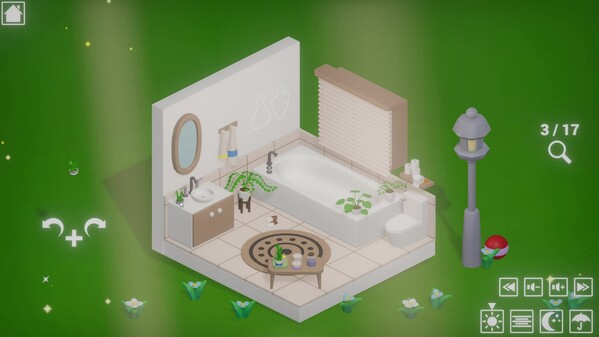
 Enter a house, pick a room and search the requested objects!