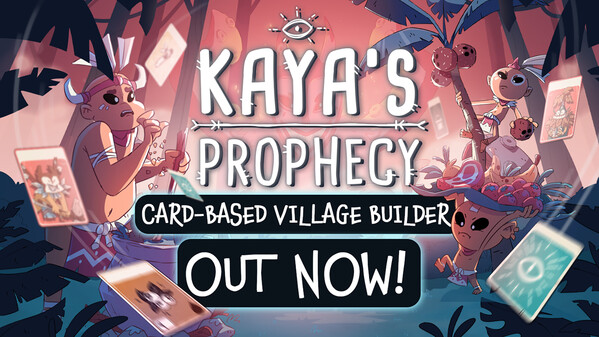
Kaya’s Prophecy is a unique card based village builder! establish your village, gather resources, and craft tools and buildings in a vibrant world. Explore and combat various challenges and other groups in this colourful, deck-builder while appeasing your god to earn his favour.
Modeled estimate, not a reported figure. How we estimate →
Media
About

Kaya's Prophecy is a card-based village builder that challenges your strategic skills and resource management. As the leader of your village, you'll build a thriving community while navigating the whims of your god. Manage your resources wisely, collect cards that synergize to build the perfect deck, forge your village’s destiny, and above all – keep your god happy, you don’t want to be on his bad side!
Open booster packs to acquire a variety of resources and gathering cards. These will form the foundation of your village's growth and success. Strategically use your cards to maximize resource collection and efficiency.
Gain your god’s favour to access new technologies and make breakthrough discoveries. Combine your hard-earned resources to craft new materials, tools and structures. Watch your village evolve as you unlock new possibilities!
Always make sure your god has enough food offerings! He might be a bit greedy. Prepare your offerings to earn valuable boons and bonuses for your village. Beware – appease your god or face his wrath. He can unleash devastating consequences upon your village, from lightning strikes and tornadoes to harming your loyal followers.
Head out on expeditions to discover new resources and expand your options. But tread carefully – the wilderness is bustling with dangerous wildlife. Use your deck-building skills to create the perfect strategy against your opponents in combat to overcome these threats and return victorious.
You'll need to constantly adapt your strategies, overcome unexpected challenges, and make tough decisions to ensure your village's survival. Only the most resourceful leaders will see their villages succeed in this perilous world.
Will you rise to the challenge and fulfil Kaya's Prophecy?
Genres
Stats
All-time low is the lowest price we've recorded for this game since we started tracking it.
Languages: English, French, Japanese, Korean, Simplified Chinese, Traditional Chinese, German, Spanish - Spain, Polish, Portuguese - Brazil, Russian
Engagement
Hours played at review time, across 40 reviews with recorded playtime.
Reviews
Themes across 40 recent reviews and how positive each mention is. A keyword signal, not full sentiment analysis.
positive critical· bar length = how often the theme comes up
Reviews
So far, the game is a waiting simulator. I don't really understand the point of these mechanics. "You must have xxx by the end of the day or face the consequences" but then are offered no ability to actually get those items, so you just wait through the game day with 0 interactions so you can face the consequences at the end. Why isn't there an ability to explore, at least once a day, on your down time? I'll give it another 30 minutes or so -- maybe there's just something hidden in an unintuitive UI? But if I'm just stuck waiting day after day to lose because I didn't get the exact right combination of cards from the start, definitely submitting a refund request.
The updates made to the gamer are a huge improvement. Combat feels challenging but fair, the village building seems to be less punishing which means I have a bit more freedom to choose what I build. I'm kinda addicted right now
The game is both too short and too long. The first 3 stages are really fast and the in-between exploration phases are pretty quick. The last stage however is much too long, requiring you to essentially do what you've already done 9 separate times already but slightly longer and slightly harder each time. Would still recommend the game but be aware the game is only 2/3rds of the way done by the time you get to the end.
Needs lots of work, the intro into game is ass
Kaya’s Prophecy is a thoughtful and ambitious hybrid strategy game developed by Jérémie & Thibaut and published by Yogscast Games, and it immediately distinguishes itself by weaving together village management, card-based systems, and thematic tension into a single, cohesive experience. At a glance, its vibrant tribal-inspired art style and colorful presentation suggest something light and welcoming, but beneath that surface lies a game that consistently asks the player to plan carefully, balance competing priorities, and live with the consequences of imperfect decisions. It is a title that thrives on momentum and foresight, encouraging a slow, deliberate approach rather than impulsive play. At the center of the experience is the act of building and sustaining a village through card-driven interactions. Resources, villagers, tools, and structures are all represented as cards, and progress comes from stacking, combining, and sequencing them efficiently. This system creates a tactile, almost puzzle-like rhythm to village management, where every card placement matters and wasted actions can snowball into larger problems later. Gathering food, producing materials, and expanding your settlement feels satisfying because each step forward is earned through deliberate planning rather than passive accumulation. The limited space and card availability ensure that you are constantly making trade-offs, deciding whether to focus on short-term survival or long-term growth. Running parallel to this builder-focused loop is the game’s deck-building combat system, which comes into play when you send villagers beyond the safety of your settlement. Combat encounters shift the tone into a more traditional turn-based card battle structure, requiring you to build and refine a deck capable of handling escalating threats. While combat is not overwhelmingly complex, it demands thoughtful deck composition and an understanding of synergies between cards. Victories feel meaningful because they feed directly back into village progression, rewarding you with resources, upgrades, and opportunities that strengthen your settlement. This interplay between combat and construction creates a satisfying feedback loop, where success in one area fuels advancement in the other. One of the most defining aspects of Kaya’s Prophecy is the ever-present influence of the god your people worship. Divine demands loom over nearly every decision, forcing you to regularly offer tributes to avoid catastrophic punishment. This mechanic introduces a constant undercurrent of tension, as failing to meet expectations can result in devastating setbacks such as disasters or direct damage to your village. Unlike many management games where failure comes gradually, Kaya’s Prophecy is willing to be harsh and sudden, reinforcing the idea that survival depends on preparation and respect for forces beyond your control. This system adds thematic weight to the experience, but it can also be unforgiving, especially in the early hours when resources are scarce and priorities are unclear. Pacing plays a crucial role in shaping the overall experience. Early on, the game can feel overwhelming as multiple systems are introduced in quick succession, and experimentation often comes at a high cost. Learning through failure is very much part of the design philosophy, and players are expected to adapt, restart, and refine their strategies over time. Once the mechanics click, however, the flow becomes deeply engaging. You begin to recognize efficient card combinations, plan tributes well in advance, and approach combat encounters with clearer intent. This gradual mastery is one of the game’s strongest elements, giving a genuine sense of growth not just to the village, but to the player’s understanding of the systems. Visually and aurally, Kaya’s Prophecy supports its mechanics with a cohesive and charming presentation. The art style is bright and expressive, with clear iconography that helps keep complex systems readable despite the dense interactions on screen. Animations are simple but effective, reinforcing actions without slowing down play. The soundtrack and ambient sound design maintain a steady, atmospheric tone that complements both the calm of village management and the tension of looming divine judgment. While the audiovisual elements are not flashy, they are purposeful, contributing to immersion without distracting from strategic decision-making. That said, the game’s hybrid nature may not appeal equally to everyone. Players deeply experienced in deck-builders may find the combat relatively straightforward, while those drawn primarily to city or village builders might find the card-based abstraction limiting. The balance between its systems can occasionally feel uneven, and some runs may end abruptly due to a single miscalculation, which can be frustrating depending on one’s tolerance for harsh setbacks. However, these rough edges are closely tied to the game’s identity, emphasizing consequence and adaptability over comfort. Ultimately, Kaya’s Prophecy succeeds by committing fully to its hybrid design and thematic vision. It is a game about stewardship under pressure, about growth shaped by scarcity, and about navigating systems that are only partially within your control. While it may not radically redefine its genres, it blends them into an experience that feels cohesive, challenging, and rewarding for players willing to engage with its demands. For fans of strategic planning, card-driven mechanics, and management games that embrace tension rather than safety, Kaya’s Prophecy offers a distinctive and memorable journey that rewards patience, foresight, and adaptability. Rating: 7/10
its just such a slog to play. I tried to power through and get it over with but everything just feels like they take 50% longer than they should. the next fest demo had some slog but its so much worse here just play stacklands or cult sim.
I replayed Stacklands too many times and really just wanted SL2, but this scratches the itch. Kaya combines the card-merger & deck builder genres for an overall experience that is greater than the sum of its parts. The card-merger portion is where you spend most of your time and is decent, maybe 6/10 if SL is a 10. The deck builder portion (similar to Slay the Spire) is much weaker when compared to a stand-alone game, like a 3/10 with very limited deck customization. Still, when combined, the loop between the 2 genres fit perfectly and the overall experience was quite fun for me, helped by beautiful sound and art.
Игра багнулась на последнем боссе, после перезапуска пропали все боевые артефакты. Я потратила кучу времени чтобы собрать новые, вышла из игры, а когда зашла снова, то артефакты опять исчезли. Да и в целом игра средненькая, но со скидкой 90, как я и брала, можно и поиграть. Разработчикам +реп, баг исправили, только поэтому оставляю положительный отзыв.
this is one of those "i really wish there was a mixed option". in the aftermath of CotL many games have explored the concept of combing game genres. this game is going for slay the spire meets stacklands but fails to excell in either direction. the card combat is incredbly basic and deck building is nearly non-existant, which is a must have for any card combat game. expeditions are incredibly repetitive and not very difficult. meanwhile the colony management loop is far less "colony management" and more "RNG based progression". unlike in stacklands, where there is many different directions to build the back of your economy, this game feels more progession gated. where the goal is always more food, with new buildings just being ways to make the repetitive expeditions faster or new ways to generate food. this game does have incredible presentation and clearly has a lot of work put into it, however without further support i see this game joining the many others in the "fun for a few hours and then forever forgotten" pile.
Positive review with the caveat that this game is best for children. This game is a bit STS and a bit Stacklands, but with a difficulty level, reading comprehension, and goal management tailored for young children. Anyone who has played a lot of STS is going to be able to autopilot the easy combat, and anyone familiar with city building is going to be able to autopilot the card stacking. This is not for those people. This is for kids, who will eventually graduate to STS and city builders. As an adult, I still had fun with this game, but I got it for a bargain price of $1. It was an interesting few hours.
Related
Related
Trends
Concurrent players on Steam, sampled daily since tracking started.
Momentum
Pace estimated from the game's recent review growth (our daily snapshots) at its own sales-per-review ratio — a momentum signal, not booked sales.
Audience
Estimated from the language of this game's reviews — a proxy for where players are, not official Steam demographics.
Related
| Dark Pals: The 1st Floor | $91.8K | 712 | 89% | $6.70 |
| Working Sakuya | $91.7K | 808 | 96% | $6.99 |
| Dangerous Waters | $91.8K | 398 | 78% | $7.49 |
| Knights of Braveland | $91.7K | 315 | 74% | $14.99 |
| Mage and Monsters II | $91.7K | 367 | 84% | $8.99 |
| Make Your Kingdom | $91.8K | 197 | 58% | $14.99 |