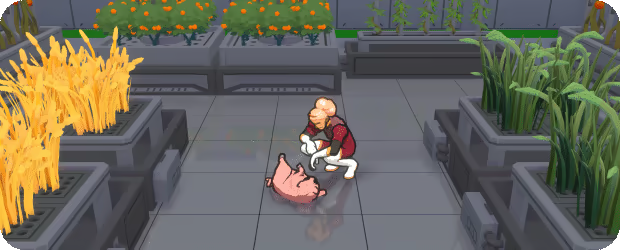
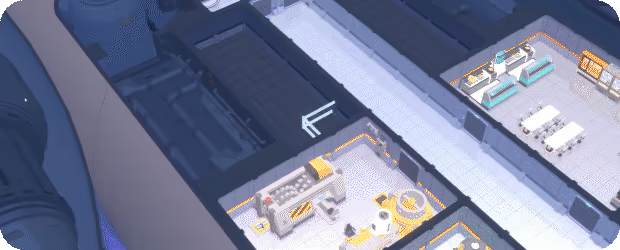
Keep hope alive on your adventure to the mythical Forever Star! Gather survivors, repair and build out your starship, brave black holes, and fend off attacks, all while managing the daily soap opera of your colorful crew.
Modeled estimate, not a reported figure. How we estimate →
Media

About


Genres
Stats
All-time low is the lowest price we've recorded for this game since we started tracking it.
Languages: English*, French, Italian, German, Spanish - Spain, Japanese, Korean, Polish, Portuguese - Brazil, Russian, Simplified Chinese, Traditional Chinese*languages with full audio support
Engagement
Hours played at review time, across 43 reviews with recorded playtime.
Reviews
Themes across 43 recent reviews and how positive each mention is. A keyword signal, not full sentiment analysis.
positive critical· bar length = how often the theme comes up
Reviews
abandonware so good i keep checking the job openings of the developer to see if they are hiring anyone to finish this one day
I don't know if the developers read the reviews.. I really want this game to be finished. There are a lot of things I like about it, from the visual style to the gameplay that combines a chase and a colony simulator. I didn't play very much, after some point the game starts to slow down a lot, strange errors occur, some are treated by restarting and some spoil the whole game, for example, missing food in the hands of a hungry character, which is why he can't satisfy his hunger, so he also wasted food. I mean, I want to see this game in my library, and I want to play it, but so far it's not working out. but.. I do not regret the purchase, and I hope someday the game will be brought to mind.
sad they never finished it
a beautiful dream that deserves so much more very playable in its current state, and hey, with support maybe they can get it going again <3
The bones of this game seem great but being stuck in an EA state with no sign of revival in development makes the price tag questionable especially when it is stated that the game is on hiatus. Had this title been sold for less in its current patch I probably would've kept it in hopes of the development resuming.
Questo è un gioco che raccomando vivamente, pur essendo in accesso anticipato è molto tranquillo e rilassante. Essendo in accesso anticipato co sono alcune meccaniche che andrebbero sistemate ma nel complesso e giocabile molto tranquillamente. Purtroppo il gioco è stato messo in pausa e da quel che ho capito anche l'azienda però spero vivamente che l'azienda riapra e completi il gioco. Questa recensione e anche una voce di speranza in modo che possa far capire che c'è ancora gente che spera per il meglio
Tolle Idee hat wirklich Spaß gemacht - schade das es nicht fertig gestellt wurde.
Jumplight Odyssey, developed and published by League of Geeks, is a roguelite colony management game that combines starship survival, crew simulation, and retro-inspired science-fiction adventure into an experience filled with charm, tension, and enormous ambition. Drawing heavy inspiration from classic anime space operas, the game places players in command of a massive fleeing starship carrying the last survivors of a devastated civilization. While its unfinished development leaves noticeable gaps in polish and content, the core experience still manages to stand out because of its striking atmosphere, memorable visual style, and emotionally engaging survival systems. The game begins after a catastrophic attack forces humanity’s remaining survivors to escape aboard the SDF Catalina while being relentlessly pursued by the hostile Zutopan Empire. Players are tasked with guiding the ship toward the legendary Forever Star, a distant sanctuary that may represent humanity’s final hope. This simple but effective setup gives the entire experience a strong sense of desperation and forward momentum. Every decision aboard the ship feels tied directly to survival, and the constant threat of pursuit creates pressure that drives the gameplay from beginning to end. One of Jumplight Odyssey’s strongest qualities is its visual identity. The game fully commits to a retro anime-inspired aesthetic reminiscent of classic science-fiction series from the late twentieth century. Brightly colored ship interiors, expressive character animations, and dramatic environmental designs give the game enormous personality. Even mundane management tasks feel visually engaging because the ship itself becomes a living environment filled with crew members rushing through hallways, repairing systems, cooking meals, or panicking during emergencies. The art direction constantly reinforces the fantasy of commanding a desperate but determined starship crew. The colony simulation mechanics form the core of the experience. Players must construct facilities, manage oxygen and fuel supplies, repair damaged systems, assign crew responsibilities, and maintain morale while traveling through dangerous regions of space. Crew members are not simply generic workers either. They possess individual personalities, emotional states, needs, and relationships that influence how effectively the ship functions. This social simulation aspect gives the gameplay much more emotional weight because the crew gradually begins to feel like a fragile community rather than a collection of statistics. Managing life aboard the Catalina becomes increasingly stressful as resources grow scarce and threats multiply. Fires break out unexpectedly, systems malfunction, food shortages create panic, and enemy attacks can destroy critical sections of the ship within moments. The game excels at creating cascading disasters where small mistakes can rapidly spiral into larger crises. This constant instability creates tension throughout nearly every stage of progression and makes successful recovery from emergencies feel genuinely rewarding. Exploration also adds important variety to the gameplay loop. As players travel through procedurally generated sectors, they encounter abandoned stations, black holes, dangerous anomalies, hostile fleets, and valuable resource opportunities. Deciding which risks are worth taking becomes a major part of survival. Some sectors offer desperately needed fuel or supplies, while others may leave the crew vulnerable to catastrophic damage. The roguelite structure helps keep journeys unpredictable and encourages players to adapt constantly rather than relying on one fixed strategy. Another major strength is the game’s atmosphere. Despite the colorful visual presentation, Jumplight Odyssey often feels emotionally exhausting in the best possible way. Supplies run low constantly, crew morale deteriorates under pressure, and the ship itself feels fragile despite its massive size. The game creates the sensation of trying to preserve hope during an unwinnable war, which gives even routine management tasks emotional significance. Watching exhausted crew members continue working to keep the ship alive becomes surprisingly compelling over time. The soundtrack and sound design contribute heavily to this atmosphere as well. Orchestral music and retro-inspired sci-fi themes help balance the sense of adventure and desperation throughout the journey. Alarms, machinery sounds, and ambient ship noises constantly reinforce the feeling of living aboard a functioning vessel under immense strain. During major emergencies or enemy attacks, the sound design becomes especially effective at amplifying chaos and tension. One particularly admirable aspect of Jumplight Odyssey is its ambition. Few management games attempt to merge colony simulation, emergent storytelling, roguelite exploration, and anime-inspired sci-fi presentation into one cohesive experience. The game constantly aims for large-scale emotional storytelling through systems-driven gameplay rather than scripted cinematic sequences, and many of its strongest moments emerge naturally from player decisions and crew interactions. However, the game’s unfinished state remains impossible to ignore. Development was paused indefinitely after financial difficulties affected the studio, leaving the project incomplete despite its enormous potential. As a result, certain mechanics feel underdeveloped, balancing issues remain unresolved, and some systems clearly lack the refinement originally intended. Players can still enjoy the existing content, but there is an unavoidable feeling that the game never fully reached its final vision. Technical roughness also affects the experience. Bugs, performance issues, and inconsistent AI behavior occasionally disrupt gameplay, particularly during larger emergencies where many systems operate simultaneously. Crew pathfinding can sometimes become unreliable, and certain interface elements feel less polished than they should for a management-heavy game. The learning curve may also overwhelm some players. Managing resources, morale, repairs, combat damage, exploration, and crew assignments simultaneously creates a significant amount of pressure, especially during later stages when multiple disasters occur at once. While this chaos supports the game’s desperate atmosphere, it can also become frustrating for players unfamiliar with colony management systems. Pacing issues occasionally emerge during longer runs as well. Certain progression systems become repetitive once players understand the core survival loop, and some late-game mechanics lack the depth needed to sustain long-term variety. The ambition of the project is clear, but so are the signs of systems that never received final refinement before development stopped. Despite these flaws, Jumplight Odyssey remains a fascinating and highly memorable experience because of its atmosphere, personality, and creativity. Even unfinished, it succeeds at creating emotionally engaging stories about survival, leadership, and maintaining hope while drifting through hostile space aboard a deteriorating starship. For fans of colony simulators, roguelite survival games, and retro science-fiction adventures, Jumplight Odyssey offers a unique and compelling journey filled with tension, charm, and emergent storytelling. Although its incomplete state prevents it from fully realizing its ambitious vision, the game still stands as one of the more imaginative and emotionally engaging indie management experiences in recent years. Rating: 7/10
hey, jeu très sympa. un peu court, un peu bugué, vraiment dommage qu'il ait été abandonné
Sadly this is the type of game i would like to inject millions in crownfounding. Deserved better... u'll remain a masterpiece.
Related
Related
Trends
Modeled estimate over time, reconstructed from Steam's monthly review histogram.
Momentum
Pace estimated from the game's recent review growth (our daily snapshots) at its own sales-per-review ratio — a momentum signal, not booked sales.
Audience
Estimated from the language of this game's reviews — a proxy for where players are, not official Steam demographics.
Related
| AFL 23 | $868.2K | 450 | 44% | $59.99 |
| RACE 07 | $867.4K | 2.7K | 86% | $7.99 |
| Stories Untold | $867.3K | 5.5K | 87% | $9.99 |
| Kona | $867.2K | 3.7K | 83% | $14.99 |
| Lumines Arise | $868.9K | 912 | 95% | $39.99 |
| Saleblazers | $868.9K | 2.2K | 80% | $29.99 |
Related
| Two Point Campus | $6.6M | 8.1K | 88% | $29.99 |
| Starmancer | $411.5K | 1K | 62% | $14.99 |
| Two Point Hospital | $28.8M | 34.8K | 92% | $29.99 |
| Two Point Museum | $12M | 12.9K | 95% | $29.99 |
| Space Haven | $5.5M | 11K | 86% | $14.99 |
| Planetbase | $2.6M | 10.4K | 80% | $14.99 |