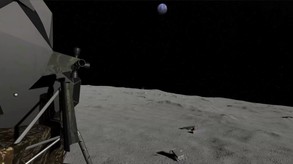
You can experience how it feels to stand on the surface of planets, satellites or comets, view the amazing scenery there, and get a better understanding of the differences between these heavenly bodies and the Earth.
Modeled estimate, not a reported figure. How we estimate →
Media

About
Genres
Stats
All-time low is the lowest price we've recorded for this game since we started tracking it.
Languages: English
Engagement
Hours played at review time, across 40 reviews with recorded playtime.
Reviews
Themes across 40 recent reviews and how positive each mention is. A keyword signal, not full sentiment analysis.
positive critical· bar length = how often the theme comes up
Reviews
Journey to Alien Worlds is a serene virtual reality exploration experience that prioritizes presence, scale, and scientific curiosity over traditional gameplay mechanics. Developed by Ideographer and published by Conglomerate 5, it positions itself closer to a digital planetarium and interactive museum than to a conventional game. From the outset, it sets expectations clearly: this is a slow, contemplative journey designed to let players stand on alien terrain, observe historic space missions up close, and appreciate the vastness of our solar system through immersive VR. The experience is structured around a curated tour of key celestial locations, each presented as a self-contained environment. Rather than racing players through objectives, the game encourages lingering—walking across surfaces, looking back at landers and rovers, and simply absorbing the atmosphere of each world. The absence of combat, puzzles, or failure states creates a calming rhythm that feels intentional, allowing the technology of VR to do most of the storytelling. Movement and interaction are deliberately minimal, keeping focus on scale, distance, and environmental detail rather than on systems or progression. What truly defines Journey to Alien Worlds is its use of real-world space exploration as its thematic backbone. Players can explore the Moon alongside iconic Apollo-era hardware, gaining a sense of how stark and exposed the lunar surface feels when experienced at human scale. Mars is represented through environments featuring famous rovers, offering a grounded look at humanity’s ongoing exploration of the Red Planet. Other locations, such as Venus, Titan, and even cometary bodies, expand the scope beyond what many space-themed experiences attempt, reinforcing the idea that this is a guided tour through decades of scientific ambition rather than a single fictional narrative. Visually, the game strikes a careful balance between realism and performance. Surfaces are detailed enough to feel convincing in VR, with distinct textures and lighting that differentiate each world, yet they avoid excessive complexity that could compromise comfort or clarity. The placement of probes, landers, and rovers acts as an effective sense-of-scale tool, constantly reminding players how small human technology appears against alien landscapes. In VR, this contrast can be striking, evoking a sense of awe that flat-screen presentations struggle to replicate. Sound design and presentation support the experience subtly. Audio cues are restrained, often relying on ambient tones and minimal narration rather than dramatic music or constant commentary. This restraint reinforces the feeling of isolation and vastness, especially on barren worlds where silence becomes part of the atmosphere. When information is presented, it tends to be educational and contextual rather than intrusive, making the experience feel informative without turning it into a lecture. The pacing, however, is deliberately slow, and this can be divisive. Transitions between locations and guided moments are measured, sometimes lingering longer than players accustomed to interactive games might expect. For first-time visitors, this pacing enhances immersion and contemplation, but repeat visits can make the lack of skip options or faster traversal more noticeable. The experience does not significantly change on subsequent playthroughs, which means its long-term replay value depends largely on the player’s desire to revisit environments for relaxation or educational appreciation rather than discovery. Despite these limitations, Journey to Alien Worlds excels at what it sets out to do. It uses VR not as a novelty, but as a medium for presence—allowing players to stand where humans or machines have stood, and to look out across landscapes that are otherwise accessible only through images and imagination. It is particularly well suited for space enthusiasts, educators, and players seeking a tranquil VR experience that emphasizes wonder over stimulation. Taken as a whole, Journey to Alien Worlds is less about gameplay and more about perspective. It invites players to slow down, look outward, and reflect on humanity’s reach into the cosmos. While it may feel sparse to those seeking traditional interaction or challenge, it succeeds as a virtual voyage—one that transforms scientific milestones into personal moments of awe. For anyone interested in space exploration or in using VR as a window to places beyond Earth, it offers a thoughtful and quietly powerful experience that lingers long after the headset comes off. Rating: 7/10
hell yea
Pretty cool, you can see Mars, Venus, the Moon, Saturn and some other destinations in VR. I hope they keep working on it. Without a doubt it's worth the money!
I went to explore alien skies but came back with a space llama who insists on doing my taxes.
Что-то странное, что-то неземное , что-то без пива
Это спокойное и познавательное VR-путешествие по Солнечной системе, которое впечатляет своим масштабом и вниманием к деталям. Ты действительно чувствуешь себя космонавтом, который высаживается на поверхность Луны, Марса.
<3
very very good but very very short, I picked this up during VR Fest for £0.44 so no complaints, standing on venus, the moon etc was fantastic so I would recommend for any Space enthusiasts
dasdas
card
Related
Related
Trends
Modeled estimate over time, reconstructed from Steam's monthly review histogram.
Momentum
Pace estimated from the game's recent review growth (our daily snapshots) at its own sales-per-review ratio — a momentum signal, not booked sales.
Audience
Estimated from the language of this game's reviews — a proxy for where players are, not official Steam demographics.
Related
| Grow a Carrot | $1.4K | 94 | 70% | $0.99 |
| DogDogDog | $1.4K | 52 | 75% | $1.79 |
| looK INside - Chapter 2 | $1.5K | 106 | 71% | $1.04 |
| Apothecarium: The Renaissance of Evil - Premium Edition | $1.5K | 109 | 55% | $0.83 |
| Noosphere | $1.5K | 132 | 67% | $0.87 |
| King Of Water | $1.4K | 52 | 94% | $0.99 |