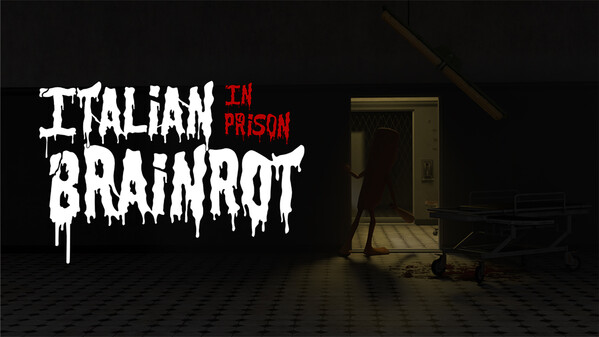
A horror survival game set in a prison corrupted by the madness of the Italian Brainrot movement. Watch the cameras, shut the doors, and save power to survive the monsters. Each night grows more terrifying and unpredictable.
Modeled estimate, not a reported figure. How we estimate →
Media

About
Italian Brainrot: In Prison is an atmospheric survival horror set within a terrifying prison consumed by absurd madness. You play as a night-shift guard, unaware that you've become the target of entities spawned by the enigmatic and disturbing phenomenon known as Italian Brainrot.
Creatures with bizarre yet sinister names—NOOO NIKOTINE, TUNG TUNG SAHUR, TRALALERO TRALALA, BRR BRR PATAPIM—have escaped their cells and are closing in. They're not just insane—they're part of something larger, defying logic. Your task is to survive five nights, using surveillance cameras, closing doors at the right moments, and conserving electricity until dawn.
⚙️ Features:
Genuine Tension: Monitor the monsters' movements through cameras, use a flashlight to check if they've left the door—but every action consumes energy, which must be conserved.
Limited Electricity—Your Main Threat: If it runs out, doors won't close. Cameras will shut down. Lights will vanish. And they are already close.
Five Nights of Fear: Each night becomes more challenging. Monsters move faster, rules change, and your composure starts to crack.
The Italian Brainrot Phenomenon: This isn't just a set of strange creatures—it's a viral, chaotic movement spawning monsters whose names sound like a mania distorting reality. This delirious nightmare seeps into the prison walls... and into your mind.
No Jump Scares for the Sake of It: Fear here is built on atmosphere, anticipation, and the constant feeling that you're the last sane person in a world gone mad.
Italian Brainrot: In Prison offers an absurd, tense, and strangely captivating experience that doesn't explain itself. Survival requires not only quick reactions but also the ability to maintain composure amidst escalating madness. Can you make it to 6 AM—or will you become part of the Brainrot?
Stats
All-time low is the lowest price we've recorded for this game since we started tracking it.
Languages: English, French, Italian, German, Arabic, Portuguese - Brazil, Vietnamese, Simplified Chinese, Korean, Polish, Russian, Turkish +1 more
Engagement
Hours played at review time, across 40 reviews with recorded playtime.
Reviews
Themes across 40 recent reviews and how positive each mention is. A keyword signal, not full sentiment analysis.
positive critical· bar length = how often the theme comes up
Reviews
If you're looking for a simple game in the spirit of Five Nights at Freddy’s but with a stranger twist, this game might catch your eye. The core gameplay will feel familiar: nightly survival, checking various cameras, and fending off oddball monsters. However, the atmosphere takes a much goofier direction with bizarre antagonists like a cackling, walking hotdog. Depending on your sense of humor, this can be endearing or baffling. The horror aspect is on the lighter side. There aren’t many genuine scares, so if you’re in the market for tense, nerve-wracking moments, you might be left wanting. In fact, the comedic design of the monsters may take you out of the mood entirely rather than heighten any tension. Technical polish is an issue here. Several players reported save problems—if you expect to pick up from your last night, you might end up frustrated by being forced to restart from the beginning after relaunching the game. This can limit how far you want to progress in one sitting and feels like an oversight. Despite these flaws, a few players found some fun and even catharsis in the offbeat vibes. The low price point makes it a low-risk curiosity if you like strange indie titles or simply want to see what developers are doing with the FNaF template. Overall, this feels like a rushed experiment that could have used more time in the oven. Unless you have an affection for weird, meme-y horror games and don’t mind technical hiccups, it’s probably worth passing on. Those just looking for a budget laugh or want to see a hotdog monster chasing them might find something to like, but most fans of the genre will likely want a more polished and traditionally scary experience.
нестрашная пародия на фнаф на 5 минут) рублей за 15 пойдет
за 13 грын норм
Cool
Я создатель хайпа
um welten besser als landwirtschafts simulator 25 grüße an r. hübsch der mich auf dieses spiel gebracht hat
este juego cambio mi vida recomendadisimo compralo yaaaaaaaaaaaaaaaaaaaaaaaaaaaaaaaaaaaaaaaaaaaaaaaaaaaaaaaaaaaaaaaaaaaaaaaaaaaa
Ну норм
I refunded this game and didn';t get any money back
Italian Brainrot: In Prison, developed by ShLeks and Hero and published by Immortal Hero, is a compact survival horror experience that leans into a deliberately bizarre identity. It takes a familiar formula—managing surveillance systems while fending off threats in a confined space—and filters it through a surreal, meme-inspired aesthetic that constantly walks the line between tension and absurdity. The result is a game that feels both recognizable and strangely unpredictable, depending largely on how well the player connects with its tone. The core gameplay is built around monitoring security cameras, managing limited power, and reacting quickly to approaching threats. Players are stationed in a control room, where every action—checking feeds, activating lights, or sealing doors—consumes a finite energy supply. This creates a constant balancing act between awareness and conservation, forcing players to think carefully about every decision. The mechanics are straightforward and easy to learn, but they become increasingly demanding as the game progresses, especially when multiple dangers must be tracked at once. As the nights advance, the difficulty ramps up steadily. Enemies become faster, more aggressive, and less predictable, requiring sharper reflexes and better timing. The game introduces subtle variations in how threats behave, encouraging players to adapt rather than rely on a single strategy. This escalation helps maintain tension, turning what begins as a manageable routine into a more frantic and high-pressure experience. However, because the underlying mechanics remain the same, the challenge comes more from intensity than from meaningful mechanical evolution. What distinguishes the game most is its unusual thematic approach. Instead of traditional horror antagonists, players are confronted with exaggerated, meme-like figures that embody the chaotic “brainrot” concept. These characters are intentionally absurd, blending humor with unsettling design in a way that feels both disjointed and oddly effective. The contrast between the serious survival mechanics and the nonsensical presentation gives the game a unique identity, though it also makes the experience highly dependent on personal taste. Atmosphere plays a key role in sustaining engagement. The game relies heavily on anticipation, using sound cues, limited visibility, and the constant threat of incoming danger to build tension. The confined prison setting enhances this feeling, creating a sense of isolation and vulnerability. Even during quieter moments, there is an underlying pressure that keeps players alert, as the possibility of sudden danger is never far away. Visually, the game adopts a simple and functional style that prioritizes clarity. The environments are minimal, but they effectively support the gameplay by ensuring that important elements are easy to identify. The contrast between the grounded setting and the exaggerated enemy designs reinforces the game’s surreal tone. Audio design complements this with ambient sounds and cues that signal approaching threats, helping to guide the player’s reactions without overwhelming the experience. Despite its strengths, the game’s limited scope becomes evident over time. The core loop does not change significantly, and while the increasing difficulty adds intensity, it does not introduce new systems or mechanics to expand the experience. This can lead to repetition, particularly for players who engage with the game for extended periods. The relatively short length also limits replayability, as there are few additional layers to explore once the main challenge has been completed. Another factor that shapes the experience is its niche appeal. The blend of horror and absurd humor is a defining feature, but it may not resonate with everyone. For some players, the unconventional tone adds charm and originality, while for others, it may detract from the tension that the game is trying to build. Ultimately, Italian Brainrot: In Prison is a focused and distinctive take on survival horror that succeeds in creating a memorable, if unconventional, experience. Its simple mechanics, escalating difficulty, and unique presentation make it engaging in short bursts, even if it lacks the depth and variety needed for long-term play. It stands out through its willingness to embrace absurdity, offering a blend of tension and humor that is rarely seen in the genre. Rating: 7/10
Related
Related
Trends
Concurrent players on Steam, sampled daily since tracking started.
Audience
Estimated from the language of this game's reviews — a proxy for where players are, not official Steam demographics.
Related
| Ookibloks | $1.3K | 73 | 90% | $1.99 |
| Lover's Trophy | $1.3K | 50 | 94% | $1.99 |
| Neko Puzzle | $1.3K | 105 | 78% | $0.99 |
| TABLE GAME END | $1.3K | 64 | 92% | $0.66 |
| 卖萌恶霸喵霸霸 Cute Bully Nyanbaba | $1.3K | 203 | 98% | $0.49 |
| Luster | $1.3K | 52 | 54% | $1.99 |