
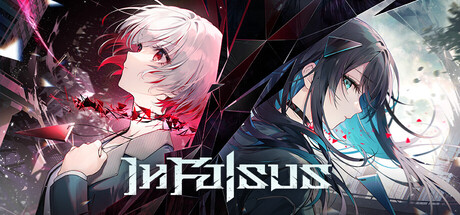
In a world bound by truths: connect. In Falsus is a mesmerizing rhythm game tied to an intricate card system brought together through a layered narrative. Taking place in a near-future world, traverse an atmospheric soundscape through the eyes of 5 interconnected protagonists.
Modeled estimate, not a reported figure. How we estimate →
Charts
Each storefront's own chart, in its own country — the closest public signal to sales where none is published. A country missing from a list is one we don't collect there, not one where the game doesn't chart.
Latest in each market: best MX #30, worst PL #89 · 11 markets collected
About

Tying music gameplay to a tale of lies and truth, 'In Falsus' guides players through seamless progression from flow to mastery, welcoming those new and experienced to surmount challenges and rise higher with each and every encounter.
Follow the separate perspectives of 5 girls making their way through high school in a near-future world, whose lives take a sharp turn one day as they are bid to join a strange government program, and soon are forced to face an undiscovered side of their reality.

Progression: With a signature control system of mouse and keyboard, In Falsus brings challenges across 4 difficulties, rising in intensity of incoming notes and a sweeping aerial Field.
Encounters: Every step forward brings a greater trial. Throughout their ordeals, the protagonists encounter characters who they must contend with or assist, with these key moments each tied to unique songs.
Songs: Produced by composers at the forefront of Japan's independent music scene as well as international artists, In Falsus features over 70 songs, over 40 of which are original, represented across a multitude of genres and styles.

Crafting: Overcome challenges to collect materials, craft unique Cards, and gain new advantages and approaches during song gameplay.
Blueprints: Integrate Cards by slotting earned materials into Blueprints, grids with a wide variety of choices in stat boosts and bonuses. Every Card crafted is different, and every Blueprint is a puzzle. How you choose to arrange materials within Blueprints shapes unique possibilities in solutions and effects.
Cards: Featuring artwork of characters met and unfolding narrative moments witnessed, illustrated by a range of skilled and renowned artists, equip up to 5 Cards to vary your approach when challenging the songs you come across.

Narrative: Through visual novel-styled narrative design, switch between the individual perspectives of 5 protagonists—all of whom are interconnected.
Immersion: Become drawn into a new world through expressive characters, captivating environments, and full Japanese voice acting.
Experience: Narrative is at the heart of In Falsus, with music gameplay, sound design, and themes reflecting and directly linked to the events of the game.
Engagement
Reviews
Themes across 405 recent reviews and how positive each mention is. A keyword signal, not full sentiment analysis.
Reviews
this game makes me gnaw on my hand
this game is clearly intended to be multifaceted and long, i'm not yet done with the game but i've progressed to arc 3 so i think i can write this now i have time and i will take my sweet time for this game, whether it be practicing gameplay, reading the story, or studying the crafting mechanics, and it has been worthwhile so far. if i want lots of content and adrenaline i can just hop on osu. i'm here not for that, and in falsus has provided something beyond instant gratification for me
Media

Related
Related
Price dynamics, follower growth, revenue and sales trajectories with interactive tooltips
This and every other Pro feature is free until October 20, 2026. A free account is all it takes.
Genres
Stats
All-time low is the lowest price we've recorded for this game since we started tracking it.
Languages: English, Japanese*, Simplified Chinese, Traditional Chinese*languages with full audio support
Hours played at review time, across 406 reviews with recorded playtime.
positive critical· bar length = how often the theme comes up
In Falsus is a visual novel / rhythm / puzzle game. No part of the game feels particularly undercooked and all is fun. I thoroughly enjoyed my time with it and even took the extra time to get all of the achievements. I'm not great at the rhythm game but still had a lot of fun. I'm also not too good at puzzles, but aside from asking friends for help with one card I managed to get all of the challenges done by myself. The difficulty is there if you want it, but if you want to play the game casually and enjoy all aspects it's all there and the experience isn't diminished for it. The art is good, the story is good, the music is good... It's well worth the price tag. It's a good piece of art and I would highly recommend supporting the developers. The story also took me out back and shot me repeatedly. I love all the main characters. I love Mei and Story and Iris especially. Reading about a character who shares my name though is really weird.
The crafting/mastery/discovery puzzles were surprisingly fun, the rhythm game itself is very good, I liked the songs. I just wish some of the "fights" or whatever they are were harder, I just matched colors and picked big numbers for most of the game, and I didn't have to use any traits until the final fight.
Good Good GOOD GOOD GOOD
MIXED REVIEW, sadly Steam removed these. There are so many issues with the core game that I can't not see, as lowiro would say. Story's great, characters are interesting enough you want to learn more about them, but the pacing is horrendous for the first few hours. I'm all for world building and character development. However, these first two hours are just way, way too slow. Having to go back on every single character's point of view about the SAME situation, one by one, four to five times just to get one single piece of information on their background is overkill. There are ways to make this much more digest, and the game's intro chapter doesn't live up to my expectations of a story-focused game. Please note, I'm talking about chapter 1 here. Pacing does significantly improve down the line, but gosh that isn't newcomer-friendly. Now, for the rhythm game... Love the weird 6k with one hand take. Honestly, really fun once you get the hang of it, well executed all the way through, from charts to song/artists selection. Now, where's the calibration tool? An absolute must in every rhythm game, because everyone's setup is different? I still haven't figured out mine, and it's utterly frustrating. Come on, Arcaea has a simple beat count tool, you know how to make these, that's all we were asking for here as well. Same thing for a visual offset, where the option just doesn't exist altogether. And worst of them all, no visibility options. I absolutely hate how invisible these red notes are on the far right, timing judgement is either way too high or way too low, on top of being way too small anyway. I just ended up not caring about timings anymore... in a rhythm game. Finally, to add insult to the injury, highest difficulties are locked through scoring a few songs from the previous tier. Great, one might say! You can learn the game with these lower difficulties, then go up one... Oh. There aren't enough "free" (= not gatekept behind story progression) songs to unlock these? Why? I was cruising through FBD 10s, had to wait for AGES to get a third one for the game to allow me to try my luck on FBD 11? And the same thing happens for FBD 12???? Why? Let us play the way we want, playing through Normal and Hard was already more than enough. I was really, REALLY tempted to leave this as a negative review when seeing such glaring issues that could be fixed with a little more effort, but I don't want it to be detrimental to the game's reach. For once, we have innovative rhythm games coming to PC, and that's great! But please, for the love of everything that has six fingers on each hand like me, get some QoL improvements here and there; that alone will make the whole experience much more enjoyable. Story's a done deal, let's just hope new players will push through the utterly slow paced intro. Rhythm game-wise however, you have so much experience already, I can't possibly understand your choices there.
不如pigurous
Hard as hell, but fun as hell. Wish we could properly skip the story though. I really don't care for it. Nor about the whole card system. I just wanna play the rhythm game.
it's peak
tl;dr Fantastic rhythm game with a heavy focus on its story with some puzzle elements (that apparently can be skipped if that's not your thing). The game's different genres don't quite mesh together imo but I still enjoyed navigating the different modes. A solid package overall even at base price. This is essentially [b]three genres in one[/b] (rhythm, puzzle, visual novel), so to fully enjoy what the game has to offer, you ideally want to go in with an open mind if you're not used to playing games of those genre. So to evaluate the game, I'll need to look at all three and see how they blend together. [h3]Rhythm part[/h3] Primarily a 6-key game, but all the keys are handled by the left hand, and the right hand uses the mouse to move an arrow left and right (similar to Ongeki if you know of that). Since all buttons are handled by one hand, that means that your enjoyment hinges upon whether you enjoy hitting complex patterns one-handed (potentially using your non-dominant hand which I imagine some people may not be comfortable with) Because the core 4 lanes have to compete with the side lanes, you're often forced to move around your middle 3 fingers to properly hit notes, making it very easy to lose track of where you're fingers are. Consequently, much of this game's difficulty comes from reading the chart and figuring out how to hit certain patterns properly. Overall, it's quite trickier than other games but pretty satisfying when you get a difficult pattern down. Definitely takes getting used to, [h3]Visual novel part[/h3] A long visual novel (roughly [b]30-40 hour range[/b] as of 1.0), this is arguably the biggest part of the game and the main reason people may consider playing. The story for the most part is very character centric, and personally I enjoyed how the group meshed together and seeing them grow throughout the story. One thing that I found interesting has to do with the Binds (the choker) that you can see on characters. Since you can literally see a character's emotions through them, it adds an extra bit of information beyond the text you see, so it often had me looking more into in what people said vs. how they felt. It's quite fun trying to figure out which colors correspond to which emotion, and how that ties into what they're saying (or not saying). Having additional elements like this generally doesn't happen in visual novels, so just on the visual novel aspect alone, it was a fun read all throughout and I look forward to what they have in store for the future. [h3]Puzzle part[/h3] A smaller part of the game is creating a set of cards that act as your "party" used to battle other characters. Somewhat overwhelming at first but ultimately boils down to each card being a literal puzzle where you have to figure out how to fit hexagonal puzzle pieces within a limited space. I'm not too proficient at puzzle games so can't speak much on this, but most if not all the cards can be figured out through simple trial and error and aren't too difficult. Additionally, how each puzzle is completed (like which piece you chose to use to reach a solution) plays into a card's stats, so there are often multiple ways of solving puzzles as you're expected to try different solutions to get different builds and configurations set up. For me, it ended up being an okay experience. Early on as I was learning, it was a bit fun but gradually grew more tedious as there was little variety and things felt samey across most cards (outside of that one card towards the end, that was cool and it's unfortunate they didn't experiment more with stuff like that). [h3]Everything together[/h3] In short, it felt like the three genres served as ways to help you take breaks if you were tired of one of them, rather than something that complements each other. Unfortunately, I think this is just a fundamental issue with trying to mesh genres of drastically different "vibes" together. To bring an example from other games, the Zelda series does this well with weaving puzzles into an adventure game, as both "adventure" and "puzzle" generally involve exploring around and some level of problem solving. Pragmata mixes "puzzle" into a third-person shooter by having second-long puzzles be at the core of combat and not in its own mode. However for this game, you have genres with conflicting gameplay styles. With rhythm games in general, especially with higher difficulty charts, you often need some amount of time to warm-up before you can get into progging the hard stuff. So if you've just finished a long section of reading or puzzling, it's likely you're not warmed up enough to handle a surprise boss song and will have to re-adjust to rhythm gaming again. Conversely, if you've just finished playing a bunch of songs, maybe you got your blood pumping and you're hitting PBs, so you might not be in the mood to read and just want to play. It's switching from high intensity action gameplay to low intensity reading and vice versa. This can work to the game's benefit though if you're the type to take breaks and constantly switch things up. If I'm crashing out playing a stupidly hard chart I should not be playing, I can just go vibe with the gang in story mode or do puzzles and relax, and reset my mental. If the story hits a major plot point and becomes overwhelming, I can go let off some steam by mashing buttons to the beat. I did this every so often, so it helped some of the time, though the genres got in the way of each other at other times. I can see the vision for what they wanted with the three genres, I just personally think there's a limit to how well it works. [h3]Overall[/h3] It's a solid package of different games and the quality is particularly high across the board. While I might have mixed feelings about how the rhythm, visual novel and puzzle aspects work together, this is still one of my favorite rhythm games this year and oddly enough also one of my favorite visual novels this year too. I look forward to seeing more of the game going forward. More importantly, as a die-hard Feryquitous fan I'm super satisfied with all the in-game music and I hope lowiro continues to bother them to make more stuff, the world needs more Fery music.
Selling now
See how fast this game is selling right now — estimated copies and revenue per day from recent review growth.
Active players
Estimated daily and monthly active players (DAU/MAU) modeled from peak concurrency.
Players by region
Where this game's players are, estimated from review languages.
Players also reviewed
The games this title's players most often review too — audience affinity.
Related
| Game | Estimated lifetime revenue | Reviews | Review score | Price |
|---|---|---|---|---|
| $1.1M | 1.7K | 91% | $24.99 | |
| $1.1M | 3.6K | 93% | $12.99 | |
| $1.1M | 1.9K | 90% | $19.99 | |
| $1.1M | 2.2K | 89% | $12.99 | |
| $1.1M | 3.5K | 57% | $19.99 | |
| $1.1M | 2.1K | 93% | $17.99 |
Related
| Game | Estimated lifetime revenue | Reviews | Review score | Price |
|---|---|---|---|---|
| $1.4M | 5.5K | 92% | $11.99 | |
| $106.8K | 158 | 98% | $19.99 | |
| — |
| 0 |
| — |
| — |
| $7.3M | 18.5K | 92% | $19.99 |
| $2.4M | 4.3K | 91% | $16.99 |
| $247.7K | 494 | 90% | $14.99 |