Imperi is a strategy-focused kingdom management simulator developed and published by Nuts and Volts Electronics that emphasizes careful planning, political growth, and long-term survival over flashy visuals or cinematic storytelling. Built around a minimalist interface and text-heavy systems, the game places players in charge of a small frontier settlement within the Imperi empire and challenges them to transform it into a prosperous and respected province. Although its presentation is simple and old-fashioned, the game offers surprisingly deep management mechanics that reward patience, strategic thinking, and efficient resource control.
The adventure begins with very limited resources. Players are given a small population, a modest military force, basic food supplies, and a narrow area of land barely capable of supporting long-term growth. From these humble beginnings, the objective is to slowly expand the settlement through careful management and intelligent decision-making. Progress feels rewarding because every improvement must be earned through planning and balancing multiple interconnected systems. As the settlement grows stronger and more stable, players gradually rise through the ranks of the Imperi hierarchy, gaining greater influence and responsibility over larger territories.
What immediately makes Imperi stand out is its strong focus on realistic resource management. Every turn forces players to make difficult decisions involving food production, military upkeep, population growth, treasury management, and land expansion. Expanding too quickly can result in food shortages and economic instability, while neglecting defense may leave the settlement vulnerable. The game constantly pushes players to think several turns ahead, creating an experience where success depends more on careful preparation than aggressive expansion. Even small mistakes can eventually lead to famine, unrest, or financial collapse if left unchecked.
The seasonal turn-based structure adds another layer of depth to the gameplay. Each year is divided into seasonal cycles that directly influence food production, economic stability, and overall settlement survival. Environmental conditions and random events create ongoing uncertainty, preventing players from relying on predictable routines. Harvests may fluctuate unexpectedly, resources can become strained, and unexpected crises may force players to quickly adapt their strategies. This dynamic structure helps the management systems feel more alive and prevents the gameplay from becoming entirely mechanical.
One of the game’s strongest features is how naturally tension emerges from its simulation systems. There is always a sense that the settlement exists on the edge of disaster, especially during the early stages where resources remain scarce and growth feels fragile. Watching population numbers rise while trying to maintain enough food and military strength creates a constant balancing act that keeps every decision meaningful. The pressure intensifies as the settlement expands because larger populations demand greater resource production and more careful planning.
Despite its simplicity, the game includes several systems designed to make the simulation feel more dynamic and fair. Certain mechanics help mitigate complete collapse during severe shortages, giving players opportunities to recover from mistakes rather than immediately ending the game after one poor decision. This balance between difficulty and forgiveness helps the experience remain challenging without becoming excessively punishing. Success still requires intelligent management, but the game avoids feeling unfairly restrictive.
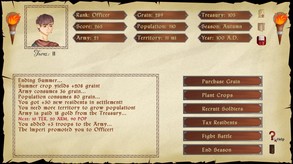
The interface is intentionally minimalistic, relying heavily on menus, statistics, and text descriptions instead of detailed maps or visual effects. While this presentation may initially appear outdated, it serves the gameplay surprisingly well by keeping the focus entirely on strategic decision-making. Information is presented clearly, allowing players to quickly analyze resource levels and make adjustments between turns. Fans of older management simulators and classic strategy games will likely appreciate the straightforward structure because it emphasizes planning and imagination over graphical immersion.
Visually, Imperi remains extremely basic compared to modern strategy titles. There are no large cinematic battles, detailed character models, or visually elaborate cities. The game instead embraces an old-school style where mechanics and numbers carry the experience. This minimalist design may discourage players expecting modern presentation standards, but for those willing to engage with its systems, the simplicity becomes part of its charm. The game feels reminiscent of classic text-based management simulations where the challenge came entirely from understanding interconnected systems and making intelligent long-term decisions.
The pacing is also deliberately slow and methodical. Unlike fast-paced real-time strategy games, Imperi rewards patience and careful observation. Much of the satisfaction comes from gradually watching a struggling settlement evolve into a powerful province through steady improvement and efficient planning. This slower progression may not appeal to players looking for constant action or immediate rewards, but it works extremely well for those who enjoy thoughtful strategy experiences where long-term decisions matter.
However, the game’s minimalist structure also creates some limitations. Players who prefer visually rich strategy games or heavily narrative-driven experiences may struggle to remain engaged due to the lack of story content and graphical variety. The gameplay loop can also become repetitive once players fully understand the core systems and discover efficient strategies for expansion. Since the experience relies almost entirely on resource management mechanics, enjoyment depends heavily on personal interest in detailed simulation gameplay.
Despite these shortcomings, Imperi succeeds remarkably well within its niche. It offers a challenging and rewarding management experience that prioritizes intelligent decision-making over spectacle. The interconnected systems, seasonal resource balancing, and constant pressure to maintain stability create a satisfying strategic loop that rewards careful planning and adaptability.
For players who enjoy text-heavy simulations, old-school management games, and strategy experiences built around long-term planning, Imperi provides a surprisingly deep and engaging challenge. Its minimalist presentation hides a thoughtful resource management system where every decision carries meaningful consequences. While it may lack the visual polish and accessibility of larger modern strategy titles, it succeeds as a focused and immersive simulation that captures the tension and satisfaction of building a thriving province from almost nothing.
Rating: 6/10