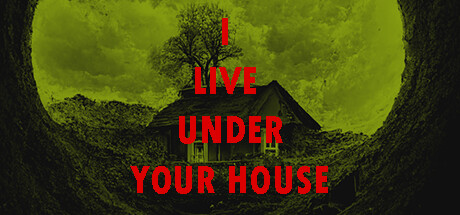
I Live Under Your House, developed and published by SpoocleMacBoogle, is an unsettling yet strangely introspective indie horror experience that inverts the traditional structure of monster stories. Rather than playing as a victim fleeing from a creature, you inhabit the role of the creature itself—a lonely, grotesque being that dwells beneath the home of an unsuspecting human. The result is a narrative-driven exploration of isolation, obsession, and identity, rendered in a lo-fi, surreal art style that perfectly matches the game’s uncomfortable tone. Released in late 2022, it quickly attracted attention within the indie horror community for its originality and its unflinching portrayal of what it means to be both predator and outsider.
From the first moments, the game establishes an atmosphere of claustrophobia and unease. You awaken in a crude subterranean burrow, surrounded by dirt walls and the muffled sounds of the world above. The interface alternates between point-and-click adventure elements and limited first-person exploration, immersing you in the damp, confining environment. As the creature, you navigate through a series of vignettes that slowly unveil your nature and your connection to the house above. Early on, you hunt small animals to survive, but your instincts soon draw you toward the human presence overhead. The narrative unfolds in fragments, balancing grotesque imagery with moments of unexpected tenderness, and gradually builds toward a confrontation between the monstrous and the mundane. It’s a story told through implication rather than exposition, leaving much of its meaning to player interpretation.
The visual presentation is deliberately crude, using low-polygon models and distorted textures reminiscent of early PlayStation horror games. The color palette is muted and sickly, dominated by greens, browns, and greys that give the world an oppressive, subterranean atmosphere. This retro aesthetic enhances the game’s sense of otherworldliness—familiar enough to evoke nostalgia, yet corrupted just enough to be deeply unsettling. The human home above you, glimpsed in brief segments, contrasts sharply with your dark, organic world, creating a striking visual metaphor for alienation. The minimalist design choices—low draw distance, flickering shadows, and blurred filters—heighten the feeling of unease without relying on conventional horror tricks. Instead of jump scares or loud noises, the game disturbs through its textures, pacing, and the uncomfortable intimacy of its premise.
Sound design is one of the game’s strongest assets, reinforcing the tension between the creature’s isolation and the liveliness of the human world above. Ambient noises—dripping water, the scrape of claws, distant footsteps—create a layered soundscape that evokes both fear and loneliness. The soundtrack, sparse and ambient, often gives way to silence, allowing the player to focus on the muffled sounds of breathing or movement. This restraint in audio design makes the world feel suffocatingly real and adds to the psychological tension. When the creature finally ventures above ground, the contrast in sound is jarring—the sudden hum of electricity, the creak of floorboards, and the faint sound of human life emphasize how foreign this world feels to the player. It’s an example of subtle horror design, where sound becomes as powerful a storytelling tool as imagery.
Narratively, I Live Under Your House thrives on moral ambiguity. It refuses to frame the protagonist as either hero or villain, instead positioning you as a being defined by instinct, curiosity, and loneliness. The internal monologue, written in fragmented and often childlike sentences, conveys a disturbing sense of innocence. The creature kills, consumes, and watches, but its actions are motivated less by malice than by a confused desire to connect. When the story reaches its turning point—when you begin to interact more directly with the human inhabitants—it forces the player to confront uncomfortable questions about empathy and monstrosity. Are you a victim of circumstance, a natural predator, or something else entirely? This thematic complexity elevates the game beyond simple horror, transforming it into a meditation on identity and alienation.
In terms of gameplay, the experience is minimalist but effective. The puzzles are simple and often symbolic—small acts of exploration or interaction that move the narrative forward. There are moments of stealth when navigating the house above, but these are more about building tension than testing reflexes. The focus remains on atmosphere and introspection rather than challenge. Some players may find the gameplay too sparse, as it occasionally leans toward passive observation rather than active engagement. The short length, typically one to two hours, reinforces this impression. However, the brevity also gives the experience a focused intensity, allowing it to explore its themes without overstaying its welcome. Multiple endings add slight replay value, though the emotional weight of the first playthrough is where the game leaves its strongest mark.
Despite its simplicity, I Live Under Your House achieves a level of psychological depth rarely found in indie horror. It blurs the line between empathy and disgust, forcing the player to inhabit a perspective that is both alien and tragically human. Its lo-fi visuals, haunting sound design, and minimalist storytelling come together to create an experience that is more emotionally disturbing than conventionally frightening. Rather than relying on cheap scares or gore, it draws its horror from intimacy—the horror of understanding something monstrous too well. It’s a game that lingers in the imagination long after it’s over, not because of what it shows, but because of what it makes you feel.
Ultimately, SpoocleMacBoogle’s creation stands as a testament to how small-scale, concept-driven games can achieve profound emotional resonance through restraint and perspective. I Live Under Your House is not a game for everyone—it’s brief, slow, and deliberately uncomfortable—but for those who appreciate narrative experimentation and psychological depth, it offers a rare, thought-provoking experience. It turns the act of hiding in the dark into something existential, transforming the monster under the floorboards into a mirror for the player’s own sense of loneliness and need for connection. In a genre often dominated by spectacle, this quiet, unsettling descent into empathy and isolation stands out as one of the most hauntingly original indie horror experiences of recent years.
Rating: 8/10