Gravity Cat, developed and published by Quiet River, is a minimalist puzzle-platformer that takes a simple concept and turns it into an intricate exercise in timing, coordination, and spatial awareness. The game revolves around a cat that can manipulate gravity, flipping the world upside down to traverse obstacles and reach its destination. It is a deceptively straightforward idea, one that has appeared in various forms across indie games, yet Gravity Cat manages to give it its own sense of identity through the sharpness of its level design and the clarity of its mechanical focus. What begins as a casual, almost relaxing experience quickly transforms into a challenging series of puzzles that demand precision, patience, and an intuitive understanding of how gravity interacts with movement and momentum. It’s a game that thrives on the elegance of its own limitations—every level asks the player to master a very small set of tools and apply them in increasingly complex ways.
At its core, Gravity Cat is built around two distinct gameplay modes. In the first, the player can only switch gravity when the cat is in contact with a surface, adding a layer of strategic timing to every move. The second mode, more forgiving, allows gravity to be changed at any point, offering greater freedom but less structure. This duality effectively tailors the experience for different kinds of players: those who crave tight, rule-based challenges can test themselves under strict conditions, while those who prefer freer experimentation can explore the levels more organically. Across both modes, the mechanics remain intuitive—press a button to flip the cat, and the entire world shifts accordingly. What makes this so effective is how the developers use this single mechanic to create more than seventy unique levels that each explore a different aspect of the concept. From simple introductory puzzles that teach you the basics of movement to later ones filled with lasers, traps, and narrow corridors, the game continually finds ways to surprise you without introducing unnecessary gimmicks.
The progression through Gravity Cat’s stages is designed to be gradual but firm. Early levels ease the player into the gravity-flipping mechanic, allowing time to adjust to the rhythm and inertia of the cat’s movements. There’s a certain flow to how the game teaches its rules—each new obstacle subtly builds upon the previous one, forcing you to think a step ahead. By the midgame, the levels begin to intertwine puzzle-solving with platforming reflexes, requiring players to flip gravity multiple times mid-jump or navigate labyrinths where one wrong move sends you hurtling into spikes or voids. The challenge can be intense, but it’s rarely unfair; the controls are responsive, and restarts are instantaneous, encouraging experimentation. Each death feels like a moment of learning rather than failure, reinforcing the loop of trial and error that defines many of the best minimalist platformers. That said, the simplicity of its design means the margin for error can sometimes feel narrow—precision is everything, and even a slight misstep can mean restarting from the beginning.
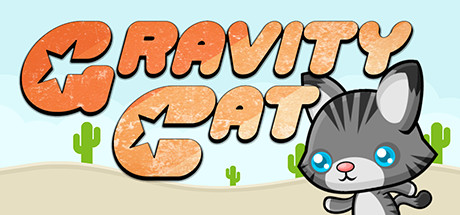
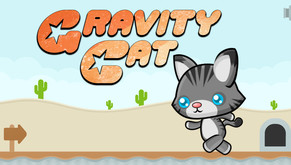
Visually, Gravity Cat adopts a clean, functional aesthetic that complements its gameplay philosophy. The environments are stark and geometric, defined by sharp edges and muted colors that highlight the paths, traps, and surfaces you must navigate. The lack of visual clutter makes every hazard clear, every movement deliberate, and every flip of gravity feel crisp. The cat itself, small and animated with a subtle charm, stands out just enough to make tracking your position easy even when the screen turns upside down. The minimalist art direction reinforces the game’s focus on clarity and precision, ensuring that the player’s attention remains fixed on the challenge at hand. Sound design follows a similar philosophy—simple, ambient, and rhythmic enough to support the gameplay without overwhelming it. The background music provides a sense of momentum, quietly propelling the player through each level without intruding on the meditative concentration that the puzzles demand.
As the difficulty ramps up, the game begins to test not only the player’s reflexes but also their understanding of physics and timing. The later levels incorporate moving hazards, switches, and sections that require chaining multiple gravity flips in rapid succession. In these moments, Gravity Cat can feel almost like a rhythm game, demanding perfect coordination between movement and timing. What elevates these challenges is how naturally they emerge from the game’s core concept—nothing ever feels arbitrary. Each level is designed with a logical structure that rewards methodical thinking as much as quick reflexes. The inclusion of instant restarts helps maintain flow, ensuring that repeated failures never feel punishing. When you finally succeed, the sense of accomplishment is genuine, earned through skill and understanding rather than luck.
Despite its strengths, Gravity Cat isn’t without its limitations. The simplicity of its premise, while elegant, can lead to a sense of repetition over long play sessions. The visual and mechanical minimalism that defines its charm also restricts its variety; after a few dozen levels, the novelty of flipping gravity may begin to wear off, especially for players looking for a more dynamic or narrative-driven experience. Some levels also demand pixel-perfect execution, where the smallest error in timing or positioning can lead to instant failure. For certain players, this will be part of the appeal, but for others, it may feel overly punishing, especially when precision rather than problem-solving becomes the main challenge. Still, these moments of frustration are offset by the game’s forgiving checkpoint system and fast restarts, which encourage persistence rather than discouragement.
Quiet River’s minimalist design sensibilities ensure that Gravity Cat remains accessible and technically smooth throughout. The game runs effortlessly on even low-end systems, with fast loading times and stable performance. The tight controls, instant feedback, and crisp visual feedback make the experience feel polished despite its simplicity. There are no unnecessary distractions—no elaborate menus or lengthy tutorials—just a direct line between player and game. This design clarity allows the experience to remain immersive in its own quiet way. Like many of Quiet River’s other small-scale puzzle projects, Gravity Cat demonstrates a love for mechanical purity and focus, where every element exists in service of the central idea.
Ultimately, Gravity Cat is a concise but thoughtfully constructed puzzle-platformer that captures the beauty of simplicity. It doesn’t rely on spectacle or story; instead, it builds a compelling rhythm out of precision, repetition, and problem-solving. The gravity-flipping mechanic, though straightforward, offers enough creative depth to sustain its brief but satisfying campaign. Its challenges are fair, its presentation is clean, and its pacing strikes a balance between calm contemplation and white-knuckle precision. For fans of minimalist design or gravity-based puzzle games like VVVVVV or And Yet It Moves, this is a worthy addition to the genre—one that rewards patience, persistence, and the quiet satisfaction of mastering a single, elegant idea. It may be modest in scope, but its execution reflects a confident understanding of what makes a puzzle-platformer engaging: clarity, control, and the simple joy of overcoming gravity one flip at a time.
Rating: 7/10