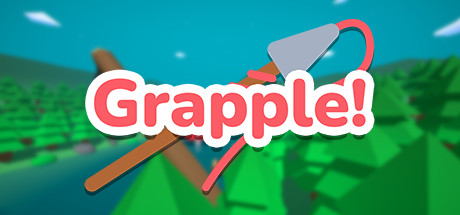
Grapple is a first-person movement platformer that focuses entirely on speed, momentum, and player mastery. Rather than building its experience around combat, story progression, or exploration, the game strips everything down to one central idea: moving through environments as quickly and efficiently as possible using a grappling hook and glider system. The result is a fast-paced and highly skill-driven experience that feels closer to a speedrunning challenge than a traditional platformer. What makes the game so compelling is how satisfying movement becomes once players learn to control the physics and momentum properly.
The core gameplay revolves around using a grappling hook to swing through obstacle-filled environments while maintaining speed and precision. Players can latch onto surfaces, launch themselves through the air, and combine momentum with gliding mechanics to travel across levels at incredible speed. At first, the controls may feel chaotic and difficult to manage because movement relies heavily on physics rather than fixed platforming systems. Overshooting jumps, slamming into walls, and losing momentum are common during the opening stages. However, once the mechanics begin to click, traversal becomes extremely rewarding and surprisingly addictive.
One of the game’s greatest strengths is how much satisfaction comes from pure mechanical improvement. There are no major progression systems, skill trees, or unlockable abilities carrying the player forward. Advancement comes entirely through learning how to move more efficiently and understanding how momentum behaves. Every successful grapple chain and perfectly timed glide feels earned because success depends completely on player skill. The game constantly rewards practice and experimentation, creating a strong sense of mastery over time.
The level design supports this movement-focused structure remarkably well. Stages are built around speedrunning principles, encouraging players to search for faster routes, cleaner movement patterns, and advanced shortcuts. The objective is always straightforward — reach the finish line — but the way players accomplish that task can vary dramatically depending on skill level and creativity. Some players may move carefully through levels while learning mechanics, while experienced players can launch themselves through entire sections with incredible speed and precision.
Replayability becomes one of the most addictive parts of the experience. Completing a stage once rarely feels like the true end goal. Instead, players are constantly encouraged to replay levels in pursuit of better times and more efficient movement. The game creates the same kind of appeal found in dedicated speedrunning titles where shaving a few seconds off a completion time becomes incredibly satisfying. As movement skills improve, previously difficult levels begin to feel smooth and fluid in ways that make replaying them genuinely enjoyable.
The pacing also works extremely well because levels are designed around short, repeatable attempts. Failure rarely feels overly punishing since restarting is quick and immediate. This rapid retry system encourages experimentation rather than frustration. Players can fail repeatedly while refining routes and movement techniques without losing significant progress or momentum. The game understands that repetition is central to mastery and structures its levels around that philosophy effectively.
Visually, Grapple adopts a minimalist presentation that prioritizes readability over realism or environmental storytelling. Levels are built using clean geometric structures and brightly colored surfaces that make traversal paths easy to identify even during high-speed movement. The environments themselves are not especially detailed or visually diverse, but the simplicity helps players focus entirely on movement and precision. The uncluttered presentation becomes especially important during advanced runs where reaction speed and spatial awareness matter constantly.
The sound design complements the gameplay effectively without drawing attention away from movement. Grappling sounds, impacts, and gliding effects provide useful feedback that helps reinforce momentum and timing during traversal. The soundtrack maintains an energetic atmosphere that supports the speed-focused gameplay loop while remaining subtle enough to avoid becoming distracting during difficult sections.
Another admirable quality of Grapple is how accessible it is despite its high skill ceiling. The game allows players to approach challenges at their own pace, whether they simply want to experiment with movement or aggressively optimize runs for speed. Since the game is free-to-play, it also becomes an easy recommendation for players curious about physics-based platformers or movement-focused games without requiring financial commitment.
However, the steep learning curve will likely frustrate some players. Momentum-based traversal naturally creates moments where movement feels unpredictable or difficult to control, especially early on. Players accustomed to more traditional platformers may initially struggle with the loose and physics-driven mechanics. The game expects patience and practice, and not everyone will enjoy the process of repeatedly failing while learning advanced movement control.
The overall gameplay structure can also become repetitive over time for players who are not interested in speedrunning or self-improvement. Since the game revolves almost entirely around replaying levels for faster times and cleaner movement, those looking for story content, combat systems, or constantly evolving mechanics may eventually lose interest. The minimalist design works well mechanically, but it also limits variety outside of traversal itself.
The presentation, while functional, may also feel visually plain compared to larger modern movement games. Environments prioritize gameplay clarity over atmosphere or worldbuilding, which can make the game feel somewhat emotionally detached despite how mechanically satisfying it becomes.
Despite these limitations, Grapple succeeds remarkably well at delivering a focused and highly rewarding movement experience. The combination of grappling, gliding, momentum control, and speed-focused level design creates traversal that feels genuinely exhilarating once mastered. Few indie games manage to make movement itself this consistently entertaining and skill-driven.
For players who enjoy speedrunning games, parkour platformers, and experiences built around mechanical mastery, Grapple offers an addictive and deeply satisfying challenge centered entirely on momentum and precision. While its minimalist structure and demanding controls may not appeal to everyone, the thrill of mastering its movement systems makes it a standout experience for fans of skill-based traversal games.
Rating: 6/10