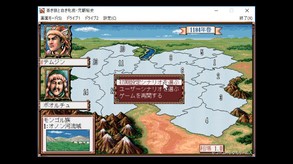
Genghis Khan II: Clan of the Gray Wolf, developed and published by KOEI TECMO GAMES CO., LTD., is a deeply layered grand strategy title that reflects an era when complexity and long-term planning defined the genre. Set against the backdrop of the 12th and 13th centuries, it places players in control of a rising power within a vast geopolitical landscape, with the option to step into the role of Temujin himself or take command of rival factions spread across Asia, the Middle East, and parts of Europe. Rather than offering a guided or cinematic experience, the game presents a systemic simulation of conquest and governance, where success is determined by how well you manage both external expansion and internal stability.
The structure revolves around turn-based decision-making, with each turn governed by a limited pool of actions that forces players to prioritize carefully. You are constantly weighing competing needs—developing agriculture to sustain your population, managing taxation to maintain economic growth, recruiting and training armies, and navigating diplomacy with neighboring factions. Progress is rarely immediate, and the game expects patience, rewarding those who think several steps ahead rather than reacting impulsively. This deliberate pacing gives the experience a strong sense of realism, as building an empire becomes a gradual process shaped by consistent, calculated decisions rather than rapid conquest.
What sets the game apart from many other strategy titles is its dual-layered design. On one level, you are managing the macro aspects of your empire—overseeing provinces, allocating resources, and making political decisions that influence long-term growth. On another, you can engage directly in tactical battles, where conflicts are resolved on grid-based maps that emphasize positioning and unit management. These encounters are not overly complex, but they provide a tangible connection to the outcomes of your strategic planning. Alternatively, you can delegate combat to your generals, reinforcing the idea that leadership is as much about trust and organization as it is about direct control.
A particularly distinctive feature is the emphasis on internal relationships and succession. Leadership is not treated as a static role; instead, the game incorporates family dynamics, inheritance, and loyalty into its core systems. Marriages can be used to strengthen alliances, heirs must be prepared to take over, and governors need to be managed carefully to prevent unrest. This adds a layer of political depth that goes beyond simple expansion, as maintaining cohesion within your empire becomes just as important as conquering new territory. Poor management of these elements can lead to instability or even collapse, making internal governance a constant concern.
The game’s scope is further expanded through multiple scenarios, each offering different starting conditions and challenges. Whether focusing on the early unification of Mongolian tribes or attempting broader domination across continents, each campaign presents a unique strategic puzzle. The variety of playable factions ensures that no two playthroughs feel identical, as each leader comes with different advantages and limitations. This replayability is one of the game’s strongest qualities, encouraging experimentation and long-term engagement.
Visually, Genghis Khan II is firmly rooted in its original era, with simple 2D maps and a menu-driven interface that prioritizes function over presentation. While this may appear dated, it serves the gameplay by keeping information clear and accessible once the player becomes familiar with its structure. However, the interface can be intimidating at first, especially for those accustomed to modern design standards. The lack of comprehensive tutorials means that much of the learning process comes through trial and error, which can be a barrier for newcomers.
The game’s age is most apparent in its pacing and accessibility. Early stages can feel slow, with progress coming in small increments, and the number of systems to manage can be overwhelming without prior experience in similar titles. Additionally, the absence of modern conveniences—such as streamlined controls or detailed feedback systems—can make certain aspects feel cumbersome. Despite this, the depth of its mechanics remains impressive, offering a level of strategic complexity that still holds up for players willing to invest the time to understand it.
Ultimately, Genghis Khan II: Clan of the Gray Wolf is a demanding but rewarding experience that captures the intricacies of empire-building in a way that few games of its time could achieve. It is not designed for quick sessions or casual play; instead, it rewards patience, foresight, and careful planning. For those who appreciate deep, methodical strategy and historical simulation, it offers a rich and engaging experience that continues to stand out despite its age. For others, its slower pace and dated interface may prove challenging, but even then, its ambition and depth are difficult to overlook.
Rating: 6/10