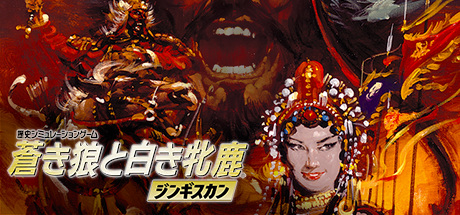
"Aoki Okami to Shiroki Mejika: Genghis Khan" was released in 1987, the second in the series. This was also the first title in the series to be released outside of Japan under the title "Genghis Khan." The game includes 2 scenarios.
Modeled estimate, not a reported figure. How we estimate →
Media
About
Genres
Stats
All-time low is the lowest price we've recorded for this game since we started tracking it.
Languages: Japanese
Reviews
When it says this game does not support English, it means it. All writing within the game is in Japanese. It is a shame as I did enjoy playing this a long time ago and wanted to play again. If you cannot read Japanese, I would not suggest buying this game
什么是情怀?这就是情怀,就是再隔夜的冷饭老子照样吃得香喷喷,这就是情怀!
昔88版でやった時は、内政をちゃんとやらなきゃとか思ってなかなか進めなかった。 朝鮮を併合して、満州を開拓し、福建省に影響を広め、なんて70年前の史実通りにコマを進めて悦に入っていた。 でもそれって、ジンギスカンじゃないよね。 っで、30年後の今、再チャレンジ。 ディスクアクセスがないから進行が早くストレスフリー。 文字も綺麗だし、グラフィックは昔のままで味がある。 まぁ88MAだったから、サウンドボード2が付いてたんで、昔やった時は声が出てたんだけど、これにはついてない。 あの声もかなり味があって良かったんだよ。サンプリング音源だったかな。 当時は画期的で近未来。 そこは残念かな。 で、かつて全く攻略できなかったが、30年後にしてエンディングを拝見した。 おー。素晴らしい。 感動。 次は提督の決断をお願いします。
This game used to be good when it was in ENGLISH, however this game doesn't even launch to play. It just goes through the paces of launching it just doesn't get to play. You have to watch what you buy on STEAM, you might get ripped off.
Genghis Khan is one of those classic Koei strategy games that feels simultaneously outdated and remarkably ambitious. Released during the late 1980s and later preserved through Koei Tecmo’s retro archive collection on Steam, the game serves as both a historical strategy simulation and an important piece of gaming history. While modern players may initially struggle with its archaic presentation and slow pacing, the deeper systems reveal a surprisingly sophisticated empire-building experience centered around politics, warfare, economics, and dynastic leadership during the rise of the Mongol Empire. The game places players in command of major rulers during a period of global instability, with the most iconic campaign following Temujin before his transformation into the legendary Genghis Khan. What begins as a regional struggle for survival gradually expands into a massive conquest campaign covering huge portions of Eurasia. One of the game’s most impressive qualities is how naturally this escalation unfolds. Early stages revolve around tribal alliances, food production, and securing enough military strength to survive neighboring rivals, while later sections evolve into managing enormous territories and balancing large-scale warfare with internal stability. Unlike many strategy games that focus almost entirely on battlefield victories, Genghis Khan places equal importance on administration and leadership. Players must constantly monitor agriculture, taxation, military recruitment, diplomacy, and public loyalty while preparing for future conflicts. Every decision affects the stability of the empire. Raising taxes too aggressively may increase short-term income but weaken population loyalty, while reckless military expansion can leave territories economically vulnerable. This constant balancing act gives the game a satisfying sense of tension because success requires much more than simply building larger armies. One of the most interesting systems is the emphasis on family and succession. The game includes marriage arrangements, heirs, and dynastic management that directly influence long-term stability and political relationships. These mechanics add a personal layer to leadership that many early strategy games completely ignored. Maintaining a successful empire depends not only on military conquest but also on ensuring that leadership remains stable across generations. This focus on dynasty management helps the experience feel larger and more immersive than many other strategy titles from the same era. The strategic gameplay remains surprisingly rewarding despite the game’s age. Campaigns unfold slowly, but every successful expansion feels meaningful because it is earned through careful planning and long-term preparation. Resources are limited, rival powers constantly shift alliances, and maintaining control over growing territories becomes increasingly difficult as the empire expands. The game creates a strong sense of responsibility because poor management decisions can destabilize an entire campaign even without enemy invasions. Combat itself is relatively simple compared to modern tactical strategy games, but it still serves the overall experience effectively. Battles focus more on preparation, troop strength, and positioning than detailed battlefield mechanics. While visually primitive, victories still feel satisfying because they usually result from smart management and logistical planning rather than flashy combat systems. The game constantly reinforces the idea that conquest begins with organization and leadership long before armies meet in battle. Historically, the atmosphere remains one of the game’s greatest strengths. Few strategy games from its era attempted to portray the rise of Genghis Khan with this level of scale and political complexity. The campaign successfully captures the transformation from tribal leadership to world conquest, and fans of historical simulations will likely appreciate how much attention is given to governance, diplomacy, and territorial management rather than nonstop warfare. Even without cinematic storytelling, the strategic systems themselves help create immersion by forcing players to think like rulers attempting to maintain order across rapidly expanding empires. At the same time, the game undeniably shows its age in many areas. The visuals are extremely primitive, relying heavily on static menus, simple maps, and minimal animation. The Steam version preserves the original structure with very few modern improvements, which is valuable from a preservation standpoint but also creates a steep barrier for newcomers. Players unfamiliar with retro PC strategy games may find the interface difficult to navigate and the pacing unusually slow. Accessibility is probably the game’s biggest weakness. Tutorials are minimal, menus can feel clumsy, and many systems require experimentation before they fully make sense. Modern strategy games often guide players through mechanics gradually, but Genghis Khan expects patience and a willingness to learn through failure. Campaigns progress slowly, and players looking for instant action or heavily streamlined systems may struggle to adapt to the deliberate structure. Despite these flaws, there is still something genuinely impressive about how much complexity the game manages to deliver. Considering the era in which it was created, the scale of the simulation remains remarkable. The blend of economics, politics, military conquest, family management, and diplomacy laid important groundwork for future grand strategy games. Many mechanics now considered standard in historical simulations were already present here in surprisingly advanced form. Replay value also remains strong because different rulers, scenarios, and strategic approaches can dramatically change how campaigns unfold. Some players may focus heavily on diplomacy and stability before expanding outward, while others pursue aggressive conquest from the beginning. Rival behavior and political shifts help prevent campaigns from feeling completely predictable, adding longevity despite the game’s retro structure. Genghis Khan is not a strategy game designed for modern convenience or fast-paced gameplay. It is slow, methodical, and demanding, requiring patience and genuine interest in historical simulation design. However, for players willing to embrace its old-school structure, the game still offers a rewarding and surprisingly deep empire-building experience filled with political tension and long-term strategic planning. Even decades after its original release, Genghis Khan remains an important example of Koei’s early ambition as a strategy developer. While later games would refine and modernize many of its ideas, the core systems here still demonstrate impressive depth and historical focus. For retro strategy enthusiasts and fans of large-scale historical simulations, it remains a fascinating and worthwhile experience. Rating: 6/10
攻略サイトのブログを、書いています。 「Steam ゲーム Blog」 (ky2021oct) https://plaza.rakuten.co.jp/ky2021/diary/202110270000/
當年是玩日文版,上了Steam之後一直在關注,看到有優惠馬上買了,沒想到現在的電腦還能玩,感動。
can't save games
Related
Related
Trends
Concurrent players on Steam, sampled daily since tracking started.
Momentum
Pace estimated from the game's recent review growth (our daily snapshots) at its own sales-per-review ratio — a momentum signal, not booked sales.
Related
| _dive | $2.6K | 85 | 66% | $1.99 |
| Stickit | $2.6K | 51 | 92% | $2.99 |
| The Insider – interactive movie | $2.6K | 51 | 41% | $3.99 |
| Escape This | $2.6K | 140 | 59% | $0.69 |
| Magdalena | $2.6K | 225 | 40% | $0.67 |
| XDeskClock | $2.6K | 59 | 61% | $2.99 |