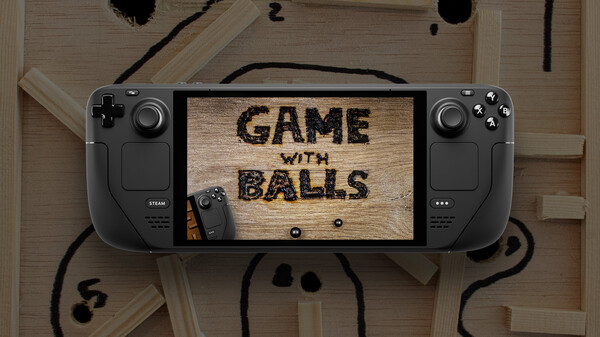
Game With Balls! Move the Steam Deck to navigate through handcrafted mazes. -- Game With Balls can only be played on a Steam Deck or with a controller that supports gyro.
Modeled estimate, not a reported figure. How we estimate →
Media

About
Game With Balls! A little collection of handcrafted mazes for the Steam Deck, where you use gyro movement to navigate one of the balls through them. Are you the one with the best time among your friends... Or even in the world?!
Handcrafted in the real world using real wood, drawings, and other materials, then converted for your digital pleasure.
Challenges that not only test you on the time it takes to complete each level but also on other objectives.
Keeps track of your fastest times using Steam Leaderboards, so you can see if you’re the quickest among your friends or the fastest in the world!
Collect all secrets in every level to not only be the fastest but also the ultimate completist.
Original soundtrack to relax to (or maybe not when you’re trying to beat your friends’ times).
Stats
All-time low is the lowest price we've recorded for this game since we started tracking it.
Languages: English*, Dutch, Swedish, German, Simplified Chinese, French, Spanish - Spain, Japanese, Portuguese - Portugal*languages with full audio support
Engagement
Hours played at review time, across 40 reviews with recorded playtime.
Reviews
Themes across 40 recent reviews and how positive each mention is. A keyword signal, not full sentiment analysis.
positive critical· bar length = how often the theme comes up
Reviews
Title doesn't lie The game does contain a lot of balls, and holes too
Must-have Steam deck game! I really love the level design how different every level is. I remember playing Labyrinth board game as a child and loved it so much. Finally you can get a marble labyrinth as a digital media and surprisingly Game with Balls feels like a real deal! As fun as the physical board game and I get exact same vibes out of digital version too!
The first game I have seen seemingly designed for the Steamdeck. Although I didn't play it with a Steamdeck, it does work with a PS5 controller. The gyro control was great and accomplished the same feeling of the classic ball in hole games of old. My only real complaint is that the music was a bit jank in that it was not consistent. I think this game would benefit from a constant soundtrack and not a level based soundtrack, hopefully that makes sense. Other than that if you like to put balls in holes you'll love this. I recommend this if you like balls.
Прощай невры но стилистика приятная👍
My one complaint is I have to manually recalibrate my gyro to get an angle I want. The standard "20-30 degree?" angle is good if you're resting the deck on a desk/table. if you're reclining you have to recalibrate, and guesstimate the gyro difference. There should be an in game calibration to recalibrate gyro z offset. Once you get the gyro dialed in it's an addictive marble maze game. I'd definitely recommend at least checking the demo
Fun for a very short while but ultimately the gyro in the Steam Deck is not sensitive enough for this kind of game. I also feel that the graphics look rushed with boring level-designs and basically unfinished woodwork. The developer said they will improve on those parts however. So yes, recommended since I love underdog games like these with novel and fresh takes on an older genre.
Feels almost nostalgic and reminds me of the old mobile/phone games that don't get made anymore
This is the very first game with balls I've ever played. 8/10
If you have a steam deck, GRAB THIS!
Game With Balls, developed by Geert Verhoeff and published by Sumatras Studios, is a deliberately minimalistic physics-based puzzle experience that builds its entire identity around one core sensation: control through motion. It takes a concept that most players instantly recognize—guiding a rolling ball through a maze—and distills it into a focused, almost meditative challenge where precision matters more than speed and consistency matters more than experimentation. Rather than layering mechanics or introducing complexity, the game chooses to deepen a single idea until it becomes both its greatest strength and its primary limitation. The gameplay is straightforward in principle. Players tilt their device or controller to influence the movement of a ball, navigating it through obstacle-filled courses while avoiding pitfalls and maintaining balance. There are no enemies, no narrative distractions, and no secondary systems competing for attention. Everything revolves around how well you can manage the physics of movement. Early stages are forgiving, allowing players to become familiar with the responsiveness of the controls and the way momentum behaves. However, as the game progresses, the demands increase significantly, turning simple navigation into a test of patience and fine motor control. What makes the experience compelling is how the difficulty evolves without changing the underlying mechanics. Instead of introducing new gameplay systems, the game challenges players by refining the same interaction—tightening pathways, adding moving elements, and occasionally requiring control over multiple balls at once. These additions push the player to think ahead, anticipate movement, and maintain composure under pressure. Success often feels earned through careful adjustment rather than quick reflexes, creating a different kind of satisfaction compared to more action-oriented puzzle games. A key aspect of the game is its reliance on motion input, which gives it a strong sense of physicality. When the controls feel responsive, there is an almost tactile connection between player and game, as if you are manipulating a real object rather than interacting with a digital simulation. This immersion is one of the game’s most appealing qualities. At the same time, it introduces a level of unpredictability. Small inconsistencies in input or sensitivity can lead to unexpected outcomes, and while this is partly intentional, it can occasionally blur the line between challenge and frustration. The level design reinforces the game’s grounded approach. Each stage feels like a carefully constructed physical puzzle, often resembling something that could exist outside the screen. The layouts are clean and purposeful, emphasizing clarity over visual complexity. As the game progresses, the environments become more intricate, but they never lose that sense of tangibility. This design philosophy extends to the overall presentation, which remains understated and functional, allowing players to focus entirely on the act of control. Visually, the game adopts a clean and restrained style that complements its mechanics. There is little in the way of visual excess, and this simplicity works in its favor by ensuring that players can easily read the environment. The audio design follows a similar approach, providing subtle feedback without overwhelming the experience. Together, these elements create a cohesive atmosphere that supports concentration and reinforces the game’s calm, methodical tone. Replayability comes primarily from the pursuit of mastery. The inclusion of time-based challenges, collectibles, and performance goals encourages players to revisit levels and refine their approach. There is a quiet satisfaction in improving a run, shaving off seconds, or completing a stage with greater precision. However, beyond this, the game offers limited variation. Once the mechanics are fully understood and the levels completed, there are few new elements to discover. This highlights the game’s central trade-off. Its commitment to a single mechanic results in a focused and polished experience, but it also limits the scope of what it can offer. Players who enjoy honing a specific skill and engaging with a tightly designed system will likely find it rewarding. Those who prefer variety, evolving gameplay, or narrative context may find it too narrow in focus. In the end, Game With Balls succeeds by embracing its simplicity and executing it with care. It captures the essence of a physical puzzle and translates it into a digital format with a strong sense of immersion and challenge. While it may not appeal to everyone, it offers a satisfying experience for players who appreciate precision-based gameplay and the gradual mastery of a single, well-defined mechanic. Rating: 8/10
Related
Related
Trends
Concurrent players on Steam, sampled daily since tracking started.
Audience
Estimated from the language of this game's reviews — a proxy for where players are, not official Steam demographics.
Related
| Log.in | $11.3K | 93 | 75% | $5.99 |
| Brume | $11.3K | 163 | 82% | $4.99 |
| Sunset Routes | $11.3K | 558 | 96% | $0.99 |
| Jumps | $11.3K | 342 | 93% | $1.74 |
| Rainy Butcher | $11.3K | 92 | 72% | $5.99 |
| SANRI | $11.3K | 52 | 58% | $6.99 |
Related
| Garry's Mod | $228.7M | 1.3M | 97% | $9.99 |
| Human Fall Flat | $109.3M | 225.6K | 95% | $19.99 |
| DAVE THE DIVER | $90.8M | 139.6K | 97% | $19.99 |
| Slime Rancher | $73.8M | 155.4K | 98% | $19.99 |
| House Flipper | $65.8M | 110.8K | 94% | $24.99 |
| People Playground | $62.2M | 315.3K | 98% | $9.99 |