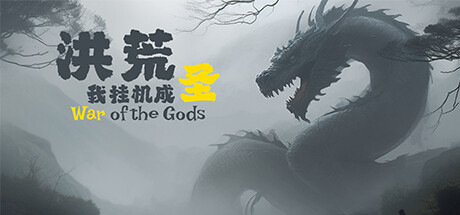
洪荒:我挂机成圣, developed and published by 老乌贼工作室, is a cultivation-themed idle RPG that leans fully into the timeless fantasy of rising from insignificance to immortality through patience, discipline, and cosmic transformation. Rather than presenting players with fast-paced combat or immediate narrative payoff, it embraces the slow-burn philosophy of xianxia literature—where centuries may pass in meditation, breakthroughs arrive only after countless failures, and ascension is as much spiritual as it is physical. The premise is simple but compelling: in the vast primordial Honghuang era, filled with chaotic energies, ancient deities, and boundless uncertainty, the player begins as a powerless mortal and gradually cultivates toward sainthood. The game’s confidence in this fantasy, and its refusal to rush the journey, is what makes it resonate.
The core progression loop revolves around automated cultivation, resource accumulation, and layered advancement systems that slowly unfold as players grow stronger. Early on, the focus is on gathering basic spiritual energy, refining meridians, and acquiring modest techniques, but soon new mechanics emerge—alchemy, artifact forging, scripture comprehension, divine insight, territory development, and eventually full cosmic dominion. Each layer feels like a natural extension of the cultivation journey rather than a random gameplay addition. The idle mechanics allow players to progress continuously, even while offline, capturing the feeling of retreating into secluded mountains to cultivate for decades. Instead of requiring active grinding, the game rewards strategic decision-making—choosing the right manuals, focusing on particular elemental paths, balancing internal and external cultivation, and timing breakthroughs to maximize power gains.
What makes the game particularly engaging is how every system reinforces the larger thematic arc of transcending mortality. Treasure hunting isn’t just loot collection—it represents destiny’s favor. Pills and elixirs are not consumable buffs but symbolic embodiments of refined spiritual essence. Even statistical increases feel meaningful because they represent internal transformation rather than arbitrary numbers. As cultivation realms increase—from mortal to foundation establishment, nascent soul, emperor, and beyond—the world subtly opens, introducing new cosmic laws, greater threats, and philosophical reflections on existence. The pacing allows players to savor each milestone, building anticipation for the next evolution rather than rushing through content.
Aesthetically, the game reflects deep respect for traditional Chinese artistic and literary influences. The visual style adopts a mixture of ink-wash motifs, elegant UI ornamentation, mythic landscapes, and spiritual symbolism, creating a meditative atmosphere that complements the idle structure. Characters, items, and environmental elements feel rooted in folklore and Daoist cosmology without becoming visually overwhelming. The soundtrack reinforces this tone—soft guqin strings, flowing wind, distant temple bells, and understated ambient soundscapes create a sense of timeless serenity. It avoids sensory overload, instead inviting players into quiet contemplation, much like the fictional cultivators it portrays. The audio-visual direction makes extended progression feel peaceful rather than monotonous.
The strategic layer is subtle but rewarding. Players must continuously assess how to allocate cultivation resources, which skills to prioritize, whether to diversify or specialize, and when to risk attempting breakthroughs. Mismanagement can lead to stagnation, while well-planned synergies produce exponential growth. As systems deepen, optimization becomes increasingly satisfying—unlocking new abilities, forging powerful spiritual artifacts, or restructuring cultivation paths can dramatically reshape one’s progression speed. This gives the game longevity, not through artificial grind, but through evolving decision-making. For players who enjoy theorycrafting, it becomes a long-term playground of mathematical and philosophical tinkering.
Like most idle games, however, the experience may not appeal universally. Those craving narrative-driven storytelling, character interaction, or moment-to-moment interactivity may find the pace too slow or detached. While the cultivation systems are richly thematic, gameplay ultimately revolves around watching numbers rise, optimizing builds, and waiting for breakthroughs. Some late-game progression phases may feel repetitive or require long idle stretches, particularly if players fail to optimize early decisions. The narrative is suggestive rather than explicit, delivered through implied worldbuilding rather than dramatic plot developments. For players expecting cinematic storytelling or action-heavy gameplay, the meditative structure may feel sparse.
Yet these characteristics are also what give the game its identity. 洪荒:我挂机成圣 never tries to be something else—it knows exactly what fantasy it is serving. It understands the psychological satisfaction of returning after hours or days to find yourself dramatically stronger, the quiet joy of completing a breakthrough once thought impossible, and the pride of building a personal cultivation path rather than following a scripted narrative. It offers reflection, patience, and endless growth—values baked into the genre’s literary DNA.
For fans of xianxia fiction, idle RPGs, cultivation simulators, or mythologically inspired progression games, it provides an engrossing and atmospheric experience. It captures the essence of the Honghuang mythos not through battles or cinematic storytelling, but through the slow, deliberate, fulfilling ascent toward divinity. It is a game to revisit over weeks or months, not rush through in hours—an interactive meditation on ambition, perseverance, and transcendence. In a market full of high-intensity instant gratification, 洪荒:我挂机成圣 stands out by offering something refreshingly patient, spiritually resonant, and quietly powerful.
Rating: 5/10